
SocDist: Solving Swarm Problems Through the Power of Being "Asocial"
Social Distancing in Robot Swarms: Modulating Exploitation and Exploration Without Signal Exchange
The paper introduces SocDist (Social Distancing), a swarm robotic algorithm that achieves target aggregation and area coverage through "asocial" avoidance behavior. Tested on e-puck robots, SocDist matches the performance of the established BEECLUST algorithm while eliminating the need for robot-to-robot signal exchange or global positioning.
TL;DR
Researchers at the University of Graz have challenged the "bio-inspired" status quo of swarm robotics. Instead of mimicking social animals that cluster together, they developed SocDist (Social Distancing)—an algorithm where robots actively avoid each other. This counterintuitive approach allows a swarm to explore environments more efficiently, avoid being trapped by obstacles, and maintain high performance without needing a single byte of communication or GPS data.
Background Positioning: This work is a "paradigm shifter" in swarm intelligence. It moves away from the traditional focus on aggregation and cooperation toward a strategy of mutual exclusion to achieve collective goals, specifically targeting the limitations of the classic BEECLUST algorithm.
The Problem with Being Too Social
In the world of swarm robotics, "simple" is the gold standard. To keep costs low, we want robots that don't need expensive memory, 5G communication, or precise maps. The BEECLUST algorithm was a breakthrough because it allowed robots to aggregate at environmental optima (like a heat or light source) simply by waiting when they bumped into each other.
However, being "social" has major drawbacks:
- The Density Trap: If there are too many robots, they constantly bump into each other and stop, leading to massive gridlock.
- Local Optima: If a U-shaped wall exists, robots bump into each other "inside" the trap, creating a cluster in a bad location.
- Redundancy: Social robots tend to huddle together, leaving the rest of the target area unmonitored.
Methodology: The SocDist Logic
The SocDist algorithm flips the script. Instead of stopping when they meet another robot, SocDist robots stop spontaneously based on local environmental quality (like light intensity).
The "Asocial" Twist
The genius lies in the modulation:
- Stop Probability: If a robot is at a "good" spot, it has a high probability of stopping (Exploitation).
- Social Distancing: If the robot detects another robot nearby, it cuts its stopping probability in half.
This simple rule ensures that if a spot is already "occupied," the newcomer will likely keep moving. This creates a natural spatial distribution across the target zone rather than a crowded pile-up.
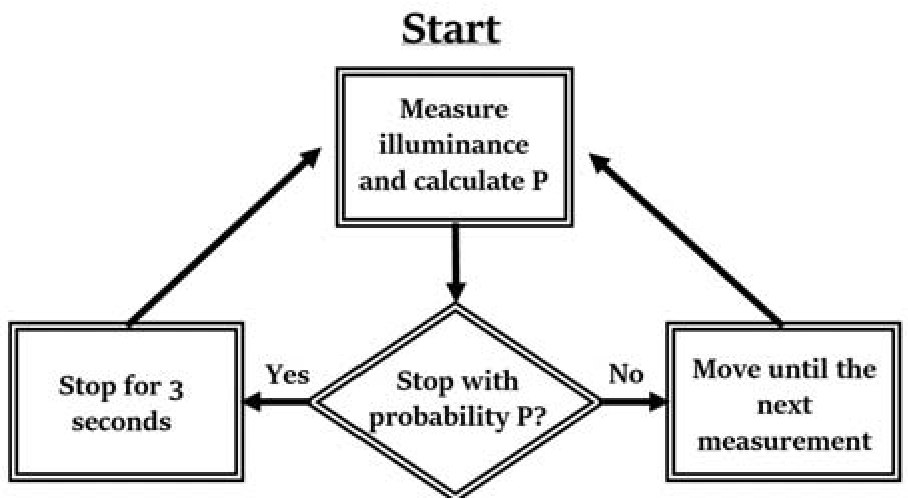 Fig 1: The Spont-Stop logic (left) vs. the SocDist logic (right). Note how SocDist integrates "asocial" inputs to adjust behavior.
Experiments: Breaking the Barrier
The researchers tested SocDist against BEECLUST in a "Nasty U-shaped Barrier" scenario. This setup was designed to trick greedy algorithms into getting stuck.
Key Findings:
- Scalability: As shown in the simulation results, BEECLUST's performance peaks and then drops sharply as the swarm grows. SocDist, however, remains remarkably stable across a wide range of swarm sizes.
- Obstacle Resilience: SocDist agents maintain a low and constant proportion of "trapped" individuals at the barrier, whereas social agents get increasingly stuck as density rises.
- Coverage: Robots using SocDist distribute themselves evenly across the target area, making it ideal for surveillance or environmental monitoring.
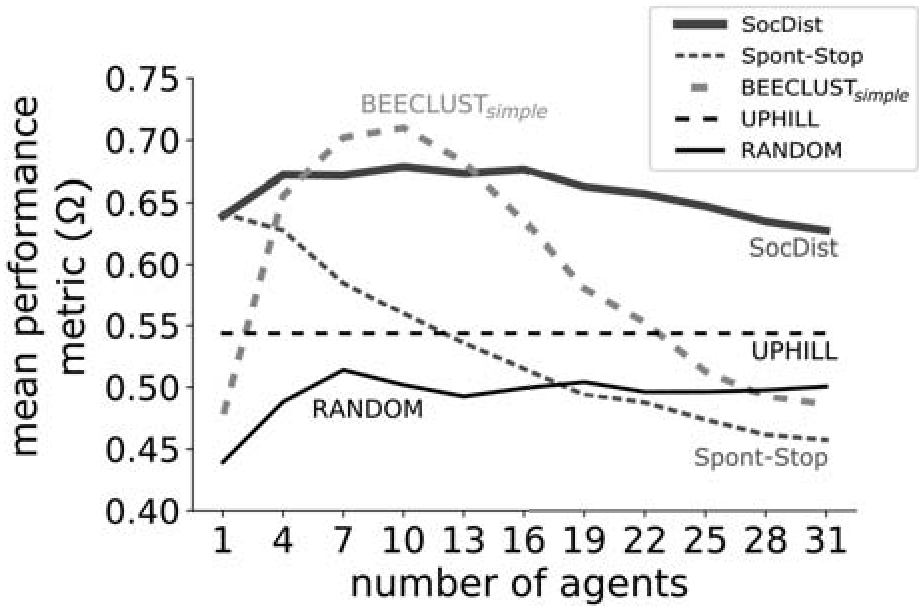 Fig 2: Mean proportion of agents at the barrier. Notice the thick line (SocDist) remains low and stable compared to the rising social algorithms.
Critical Analysis & Conclusion
Takeaway
SocDist proves that you don't need complex communication to solve complex spatial problems. By simply avoiding others, individual robots "push" the rest of the swarm toward unexplored or less crowded areas, leading to a more robust search.
Limitations
The study is currently focused on light gradients and simple barriers. While the "reality gap" between simulation and e-puck robots was addressed, the quantitative performance in 3D environments (like underwater or aerial swarms) remains to be tested.
Future Outlook
The authors suggest that SocDist is perfect for "sensitive" missions. Since there is no signal exchange, these robots can operate around animals that are sensitive to radio frequency or electromagnetic waves (the HIVEOPOLIS project). It turns out that in the world of robotics—just like in a pandemic—social distancing is a powerful tool for survival and efficiency.