
Decoding the Expert Mind: How Social Networks in FDA Panels Predict Technical Decisions
Analysis of Social Dynamics on FDA Panels Using Social Networks Extracted from Meeting Transcripts
This paper introduces a computational framework to analyze social dynamics in expert committees by extracting social networks from meeting transcripts using a modified Author-Topic (AT) model. Applied to FDA medical device advisory panels, the study demonstrates that linguistic alignment reflects shared medical backgrounds and predicts voting outcomes.
TL;DR
Researchers from MIT have developed a quantitative method to map the "social dynamics" of expert committees. By applying a Bayesian Author-Topic model to FDA transcript data, they discovered that an expert's medical specialty shapes their language, which in turn predicts their vote. In short: technical experts don't just see the data; they see the data through the lens of their professional training.
Background: The "Black Box" of Committee Decisions
How do experts from different fields reach a consensus on life-saving medical devices? While we like to imagine a perfectly objective evaluation of data, social science suggests that "where you stand depends on where you sit." However, capturing these subtle social-technical interactions in real-world settings has been notoriously difficult. This paper bridges that gap by treating meeting transcripts as traceable maps of information flow.
Methodology: From Words to Networks
The authors employ a modified version of the Author-Topic (AT) Model. In this framework:
- Authors (Speakers) are modeled as distributions over Topics.
- Topics are modeled as distributions over Words.
To isolate meaningful expert discourse, the study introduces a clever "Committee Filtering" technique. They created a "false author" named Committee to absorb common procedural language and domain-specific jargon used by everyone, allowing the model to highlight the unique linguistic signatures of individual experts.
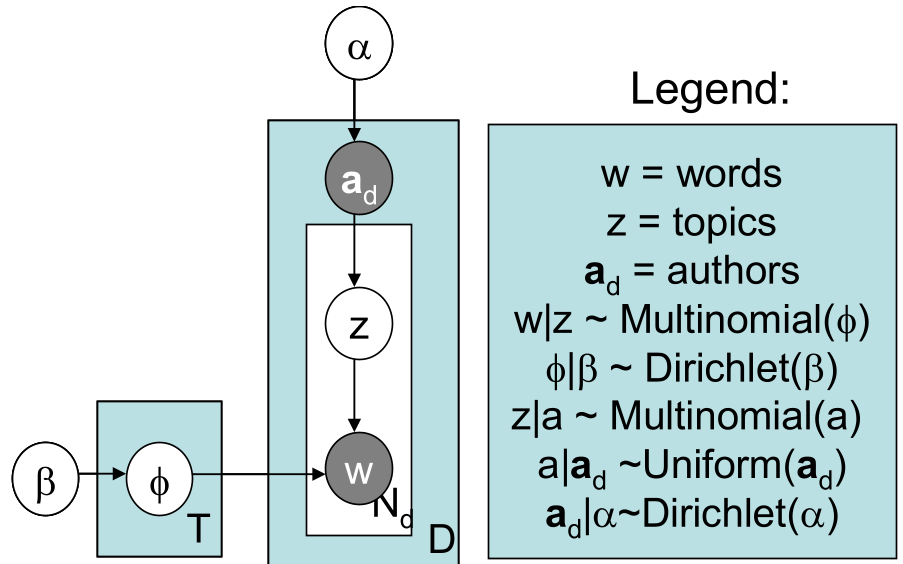
Once topics are assigned, the authors calculate the joint probability of two speakers discussing the same topic. If this probability exceeds a statistically rigorous threshold (using a Bonferroni-corrected binomial test), a "link" is established in a social network.
Key Insights: Specialty as a Cognitive Filter
The study analyzed 37 meetings of the FDA's Circulatory Systems Devices Panel. The results confirm two major hypotheses:
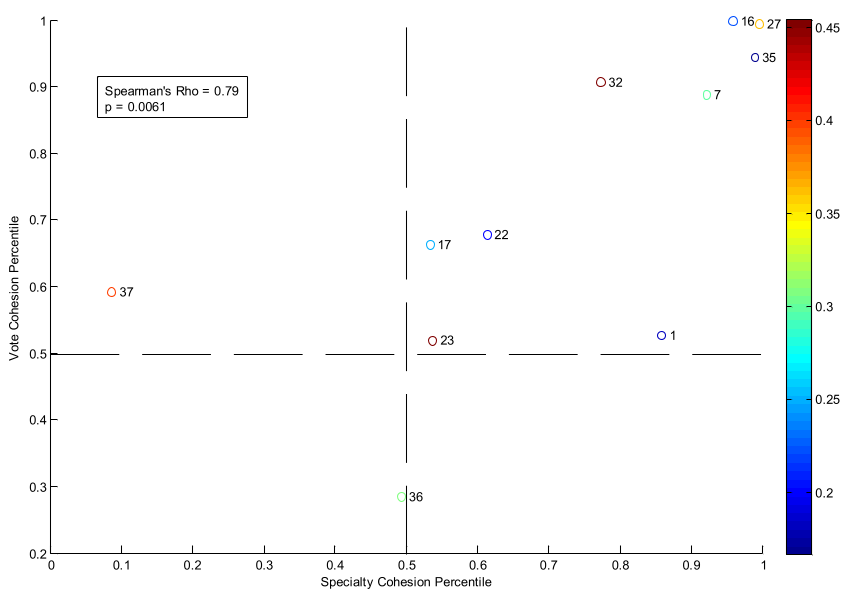
- Specialty Cohesion: Panelists from the same medical specialty (e.g., cardiologists vs. statisticians) use more similar language than would be expected by chance.
- Vote Cohesion: People who use similar language are significantly more likely to vote the same way.
The most striking finding is the correlation between the two (Spearman rho = 0.79). As experts' language converges around their specific medical training, their voting behavior converges as well.
Critical Analysis: Why This Matters
The "why" behind these results is rooted in the concept of Cognitive Salience. Professional training acts as an "institution" that provides a framework for interpreting ambiguous data. When a medical device shows mixed results (high risk but high reward), a surgeon might focus on one set of metrics while a general practitioner focuses on another, guided by what their specific training deems "important."
Limitations & Future Work
While powerful, the method has limitations:
- Transcript Constraints: It cannot capture "honest signals" like body language or tone (as noted by Pentland).
- Silence as Noise: If a member is quiet, the model lacks data to place them in the network.
- Ambiguity Outliers: The model struggled with two meetings involving "high data ambiguity," where even specialty ties couldn't predict the fragmented voting patterns.
Conclusion
This research moves the study of expert committees from qualitative anecdotes to quantitative data science. It suggests that if you want to understand a committee's decision, you must first understand the "linguistic manifold" of the specialties represented. For policymakers, this highlights the importance of panel composition—not just in terms of who is present, but what "languages" they bring to the table.