
Exploring Social Dynamics: Why Most "Social" Media Users are Actually Lurkers
Exploring social dynamics in online media sharing
This paper presents an empirical analysis of social dynamics on YouTube during its early growth phase. Using a dataset of over 57,000 users, it investigates how community features like friending, subscriptions, and commenting correlate with content consumption and creation.
TL;DR
In a seminal 2007 study of early YouTube, researchers discovered that the "Social" in Social Media is heavily skewed. While thousands of videos are consumed, only a tiny fraction of users actually upload content or use social features like friending and commenting. This paper reveals the stark contrast between passive consumption and active community building, providing a blueprint for how search and recommendation systems must handle sparse data.
The Motivation: Are We Actually Social?
Back in 2006, platforms like YouTube and Flickr were heralded as the "Social Web." However, the authors—Martin Halvey and Mark Keane—suspected that our online behavior might be less about "networking" and more about "consuming." The core problem they addressed was the lack of empirical data on user behavior: Do people actually use the social tools provided, or are these features just digital clutter? Understanding this is vital for building Collaborative Search systems that rely on user metadata to rank results.
Methodology: Mining the YouTube Goldrush
The researchers crawled over 100,000 pages, focusing on 57,588 users. They looked at a variety of metrics:
- Consumption: Views and Favorites.
- Creation: Uploads.
- Social Connection: Friends, Group memberships, Subscriptions, and Comments.
By tracking these over time (between June and September 2006), they could see not just a snapshot, but how interaction grew as users became more familiar with the platform.
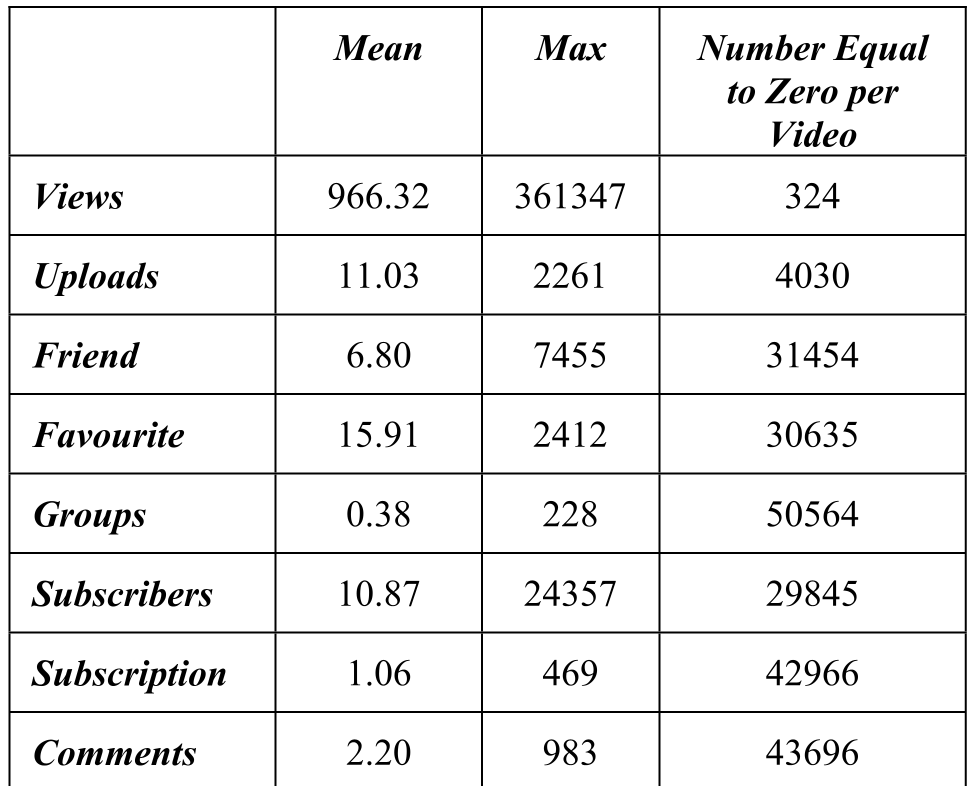
Core Insight: The Participation Gap
The data revealed a massive disparity in how people use the platform:
- Passive vs. Active: The mean number of views was 966, while the mean number of uploads was a mere 11.
- Social Sparsity: For most social features, the "Number Equal to Zero" was staggering. Over 31,000 users had zero friends, and over 43,000 had never left a comment.
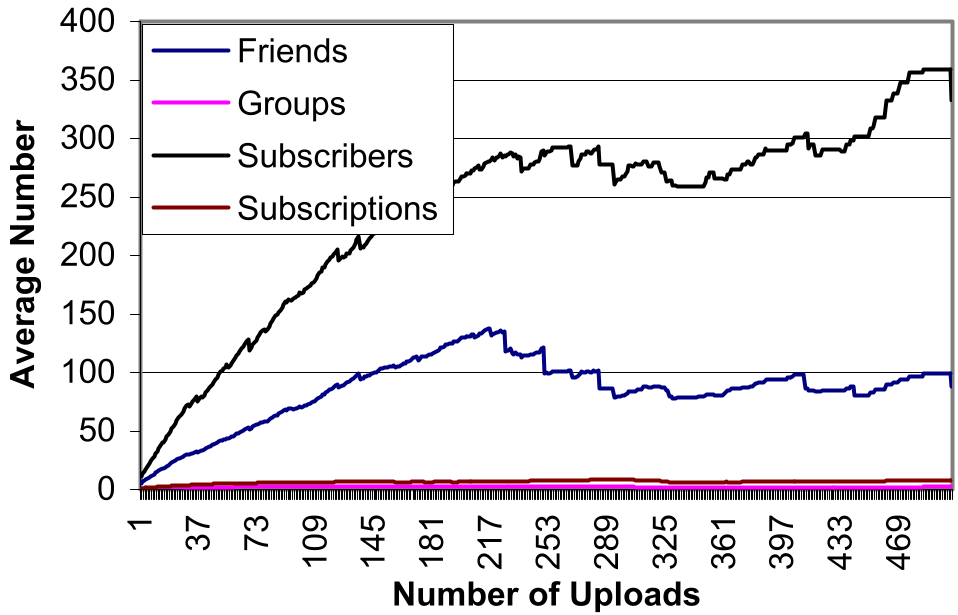
- The "Power User" Effect: Those who did use social tools used them intensely. Figures for friends and subscribers showed that social connectivity actually scales with content creation—the more you upload, the more you are pulled into the social fabric.
Distribution of Views: Search vs. Browsing
One of the most technically interesting findings involves the Zipf Distribution. In standard web browsing, a few pages get nearly all the hits (Power Law). However, YouTube's view distribution showed a "curvature" that didn't fit the standard Zipf model.
This deviation suggests that YouTube users in 2006 weren't just clicking related links (browsing); they were using the search bar. Because search allows users to find "niche" content more efficiently than browsing, the distribution of views was more spread out among top-tier users than expected in a pure "winner-takes-all" browsing environment.
Critical Analysis & Conclusion
Takeaways
- Personalization Difficulty: Because social data is so sparse, developers cannot rely solely on social graphs to personalize experiences for the average user.
- Search is King: The distribution analysis proves that search intent is a more powerful signal for media discovery than social links for the majority of the population.
Limitations
This study represents a "frozen" moment in 2006. Today, algorithms (like the TikTok "For You" feed) have largely replaced the "active search" behavior noted by the authors with highly optimized "passive browsing."
Future Outlook
The paper laid the groundwork for understanding Social Search. It suggests that the future of the web lies in bridging the gap between the "Power Creators" (who provide the metadata) and the "Lurkers" (who consume it). As we move into an AI-driven era, leveraging the sparse social signals of the majority remains one of the greatest challenges in Information Retrieval.