
Social Web Services: Why Your API Needs a Social Life
Social Engineering of Communities of Web Services
The paper introduces a "social engineering" framework for Web service communities, shifting the view of services from isolated components to social entities. It proposes five distinct social network types (Supervision, Competition, Substitution, Collaboration, and Recommendation) to manage service interactions and utilizes graph mining to assign behavioral attributes like selfishness and unpredictability.
TL;DR
Web services are no longer just code endpoints; they are members of a digital society. This paper proposes a framework to engineer Communities of Web Services using five social network structures. By mining these networks, the system can identify "selfish" or "unpredictable" services, ensuring higher reliability through a concept called Coopetition—where services compete for selection but cooperate during failures.
Problem & Motivation: The Loneliness of the Modern API
In the standard SOA (Service-Oriented Architecture) paradigm, a Web service is treated like a vending machine: you call it, it performs, and it returns a result. If it fails, the system breaks or searches for a replacement from scratch.
The authors argue this is "anti-social." Real-world services operate in groups. They share common goals (Communities) and experience complex relationships:
- Competitive: Multiple services offering the same weather data.
- Collaborative: A payment service working with a shipping service.
- Substitutionary: A backup service waiting for a peer to crash.
The missing link is a way to capture and track these interactions over time to predict which services are actually "good citizens" of the web.
Methodology: The Five Pillars of Service Socializing
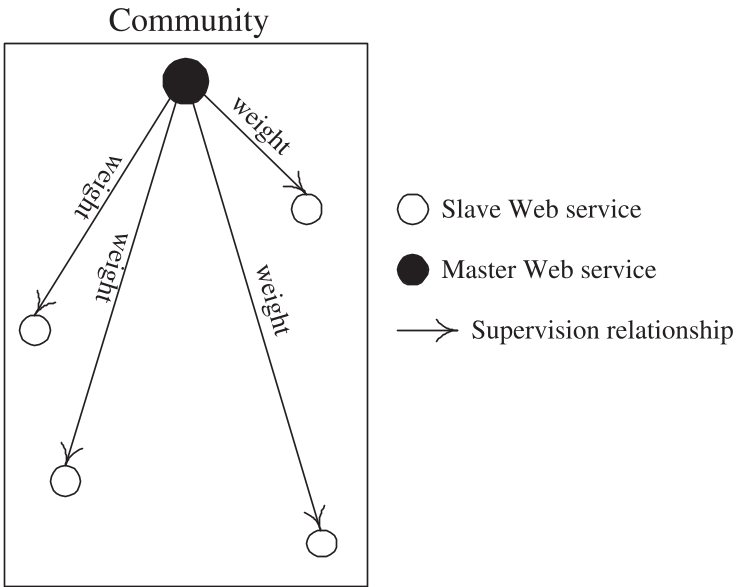
The paper structures services into communities led by a Master (representative) and executed by Slaves (concrete implementations). They define five types of social networks divided into Intra-community and Inter-community connections.
1. The Internal Logic (Intra-Community)
- Supervision Network: Master-Slave relationships. The weight (Supervision Level) is calculated based on Trust and Responsiveness.
- Competition Network: Peer-to-peer edges between services with similar functions.
- Substitution Network: A safety net for high availability.
2. The External Logic (Inter-Community)
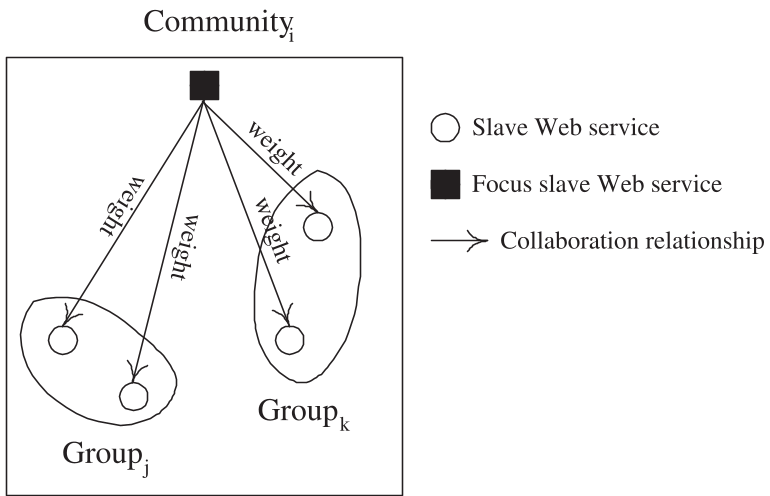
- Collaboration Network: Tracks previous joint participations in complex workflows.
- Recommendation Network: Enables services to "vouch" for others, reducing semantic conflicts during composition.
Mining Behavioral "Personalities"
A unique contribution is the Social Network Mining section. The authors define:
- Selfishness: Measured by an income/expense ratio. A service is selfish if it receives rewards (income) for tasks but avoids penalties (expenses) by rejecting difficult substitution requests.
- Unpredictability: Defined as a consistent contradiction between a service's Expected Response (based on Trust/Responsiveness) and its Actual Response.
Experiments: The Price of Selfishness
Using the MASON simulation library, the authors tested how service failure and substitution acceptance affect the community.
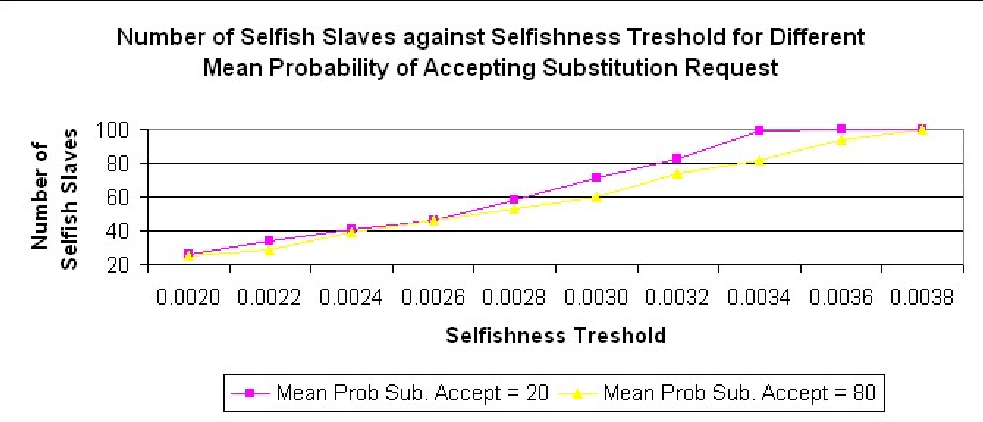
The results reveal a fascinating dynamic:
- Substitution Probability: If services are less likely to accept substitution requests, the community's "health" declines faster, and more services are flagged as selfish even at low thresholds.
- Failure as Opportunity: Counter-intuitively, in high-failure environments, reliable services accumulate "Income" (social capital) faster by handling more substitutions, making them stand out as elite members of the community.
Critical Insight & Conclusion
The "Social Engineering" approach transforms Web service management from a static lookup problem into a dynamic behavioral analysis problem.
The Takeaway: By quantifying "Selfishness" and "Trust," system architects can move beyond simple QoS (Quality of Service) metrics like latency. We can now build "Social middleware" that automatically ejects toxic services and promotes those that play well with others. This is the blueprint for a self-healing, self-organizing Web.
Limitations: The model assumes a centralized "Master" for each community, which may become a bottleneck or a single point of failure. Future work should explore decentralized community management using peer-to-peer consensus.