
SEC: Shielding P2P Live Streaming from Pollution via Social Trust
A Social-Enhanced Data Verification Framework against Pollution Attacks in P2P Live Streaming
The paper introduces SEC (Social-Enhanced hash-based Cross-verification), a framework designed to defend swarm-based P2P live streaming systems against content pollution attacks. It leverages a novel inter-chunk hash verification mechanism combined with social network trust relationships and an AIMD-based reputation system to achieve SOTA resilience and delivery ratios.
TL;DR
P2P live streaming is efficient but notoriously easy to "poison" with fake data. This paper presents SEC, a framework that uses a clever circular hashing scheme and social network metadata (like Facebook friendships) to identify and isolate malicious nodes. It achieves high delivery ratios (92%+) with near-zero overhead, outperforming traditional mesh-based checks.
Background: The Hidden Danger in Swarm Intelligence
Swarm-based P2P systems (like PPLive or BitTorrent) thrive on the "upload while you download" mantra. However, this architectural openness is a double-edged sword. A single malicious "polluter" claiming to have the latest chunks can trick thousands of peers into downloading garbage data. Because peers propagate what they receive, a network of 3,000+ nodes can collapse in under 40 minutes.
Existing solutions are often too slow (heavy cryptography) or too weak (easily fooled by colluding attackers). The authors of SEC recognized that we need a check that is as fast as the stream itself and a trust model that isn't purely based on network behavior.
Methodology: Circular Hashing and Social Reinforcement
1. Hash-based Cross-Verification
Instead of checking a chunk against a central server, SEC groups chunks together. Each chunk carries the abridged hash of another chunk in its group.
- The Logic: If Chunk A has the hash for Chunk B, and Peer X receives both from different sources, it can verify if they match.
- Subgrouping: Nodes are sorted into subgroups. The largest subgroup is assumed to be "clean," and the outliers are flagged as polluted.
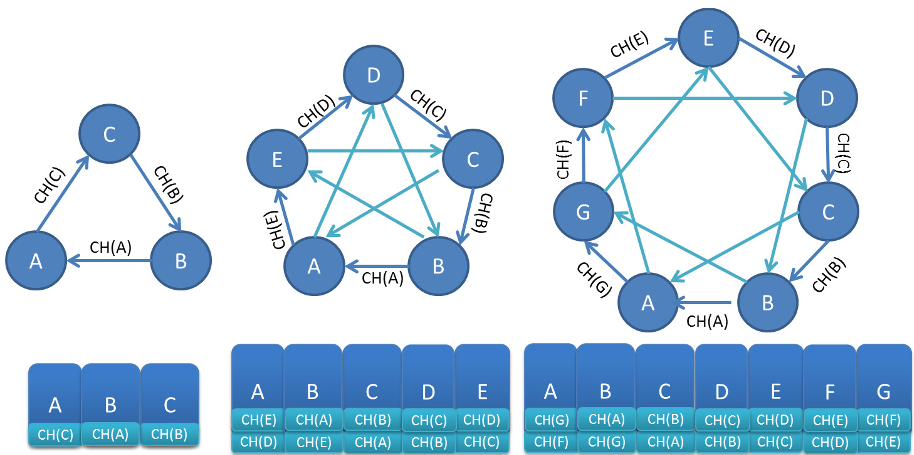 Fig 1: Circular inter-chunk verification networks with varying group sizes (3, 5, and 7).
2. The Social Edge
The unique "Social-Enhanced" aspect leverages real-world friendships. Since friends in real life are less likely to attack each other, SEC:
- Prioritizes chunk requests from "Social Friends."
- Allows unverified chunks to be forwarded only if they come from a trusted friend, maintaining high data availability without risking widespread pollution.
3. AIMD-based Reputation
Borrowing from TCP's congestion control, SEC uses an Additive Increase/Multiplicative Decrease (AIMD) reputation score.
- Reward: Successful verification adds a fixed score.
- Punishment: Failure results in a multiplicative drop.
- Threshold: Once a peer falls below the threshold, they are blacklisted and friends are alerted.
Performance: Surviving the "Pollution Company"
The authors tested SEC against "colluding polluters"—malicious nodes that coordinate to send the same fake hashes to bypass simple checks.
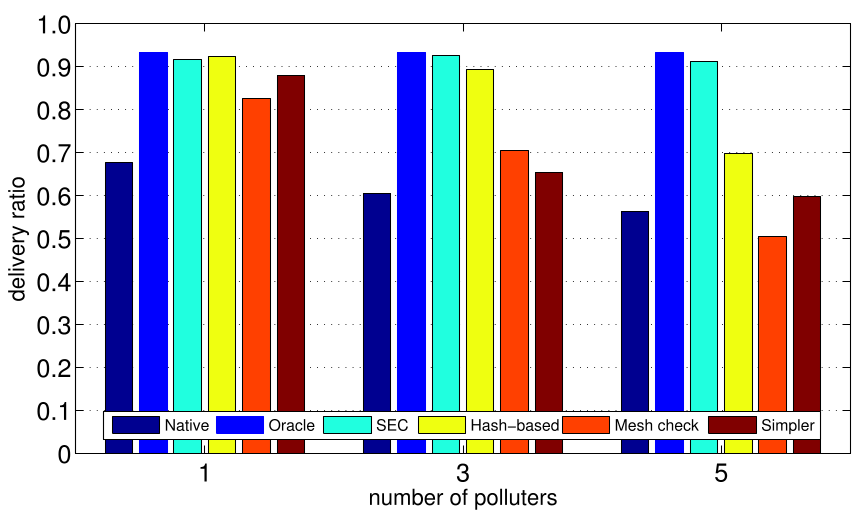 Fig 2: In collusive environments, SEC maintains a significantly higher delivery ratio than Mesh check or basic Hash schemes.
Key Metrics:
- Speed: SEC converges 3.8x to 6x faster than competing schemes.
- Accuracy: Achieves a 98.79% True Positive rate in identifying polluters.
- Efficiency: The overhead is just 5.41% (total traffic), nearly identical to an "Oracle" system with no defense at all.
Critical Analysis & Conclusion
SEC's genius lies in its Zero-Knowledge pragmatism—it doesn't try to prove why a chunk is right; it uses a consensus of cross-references and social trust to filter out noise.
Limitations: The system relies on the assumption that the majority of peers are innocent and that social networks are available. In an "isolated" P2P environment without social metadata, the performance would degrade toward the "Hash-based" baseline.
Future Outlook: In an era of deepfakes and automated botnets, SEC provides a blueprint for "Socially-Aware" security. Integrating such frameworks into modern decentralized protocols could solve the age-old problem of Byzantine failures in high-bandwidth applications.