
Defining the Richter Scale for Social Outbreaks: Magnitude via Background and Engagement
Social Event Magnitudes via Background Influences and Engagement Capacities and its Applications
The paper introduces "Social Event Magnitude," a novel metric to quantify activity levels in social networks by fusing text-based background influence and interaction-based engagement capacities. This method leverages non-backtracking matrices and spectral algorithms to achieve state-of-the-art efficiency and accuracy in online event detection.
TL;DR
How do we measure the "size" of a social media storm? This paper proposes Social Event Magnitude, a metric that treats digital outbreaks like earthquakes. By combining the Background Influence of keywords (using non-backtracking matrices) with the Engagement Capacity of users (using cooperative game theory), the authors create a high-precision, real-time detection system that outperforms traditional clustering methods.
Background Positioning
In the landscape of social computing, we usually view events either as Anomalies (detecting weird spikes in text) or Popularity Processes (tracking retweets via Hawkes processes). This paper bridges the gap. It is a "SOTA Refinement" work that introduces a more rigorous algebraic toolset—specifically spectral analysis on non-backtracking matrices—to solve the persistent problem of data sparsity in social streams.
Problem & Motivation: The "Hub" Problem
Most event detection algorithms fail when data is sparse. If you use a standard adjacency matrix for keywords, a few "hubs" (words used frequently but irrelevantly) dominate the eigenvalues. This is the Localization Effect: your spectral algorithm "sees" the hubs but misses the actual emerging cluster of a real event.
The authors' insight is twofold:
- Structural Integrity: Use Non-Backtracking matrices to ignore simple "back-and-forth" walks, which eliminates the noise created by high-degree hubs.
- Synergy: Background info (text) isn't enough; you need to measure "Cooperation" (Engagement). An event isn't just a lot of people talking; it’s a lot of people responding to each other.
Methodology: The Core Engine
The algorithm decomposes social interactions into two distinct matrices:
1. The N-CharW Matrix (Textual Influence)
It builds a co-occurrence graph of keywords. To avoid the aforementioned localization, it transforms this into a Non-Backtracking Matrix.
- Physical Intuition: If a keyword A leads to B, and B leads back to A, it’s often noise. By preventing backtracking, the spectral algorithm focuses on the true flow of information.
2. The N-SocE Matrix (Social Cooperation)
This uses Engagement Capacities based on the Shapley value from game theory. It calculates how much a specific user's post contributes to a "coalition" of discussion.
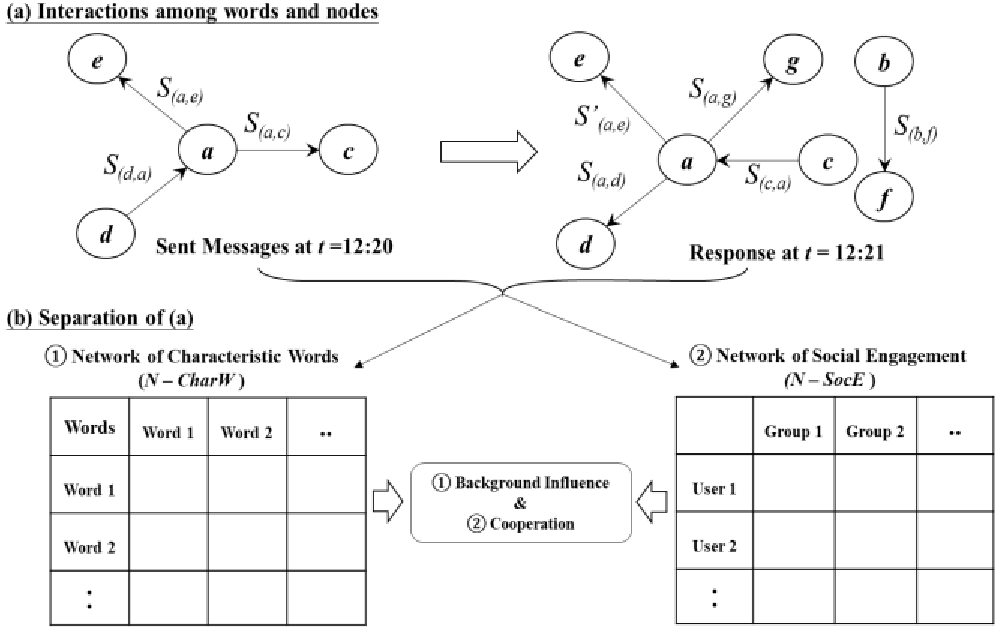 Figure: The interaction and separation of words (Influence) and nodes (Engagement).
The Magic Formula: The "Magnitude" is simply the product of the leading eigenvalues () of these two components.
Experiments: Measuring the Charlottesville Riot
The authors tested this on the Charlottesville Riot Twitter dataset and the Enron Email corpus.
- Long-Tailed Distribution: Just like earthquakes, most social interactions have low magnitude. Only a few reach the "outbreak" level.
- Performance: The Magnitude method achieved an Average Precision of 0.92, significantly higher than simple weighted-similarity clustering.
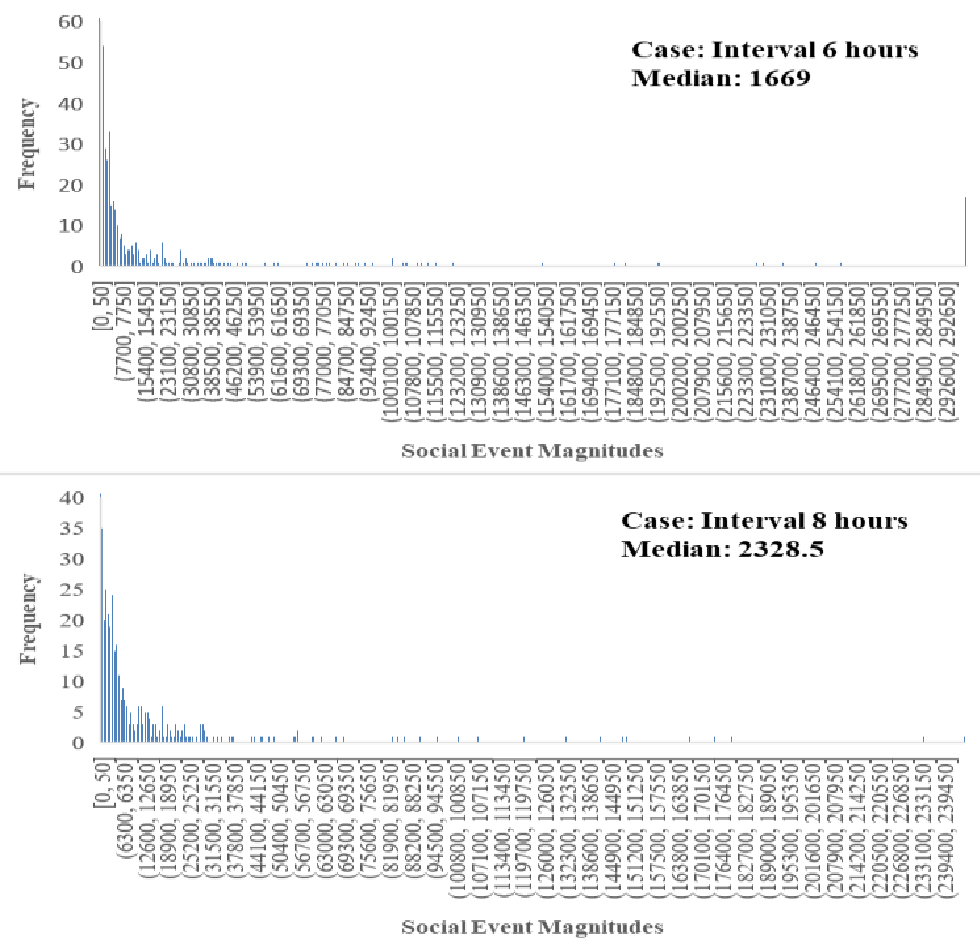 Figure: Visualizing Social Event Magnitudes. Multiple peaks above the trend line clearly indicate the phases of an outbreak.
Key Ablation Insight
In short time windows (e.g., 30 seconds), Background Influence (keywords) is the dominant detection signal. However, as the window extends to 3 minutes, Engagement Capacity becomes significantly more accurate. People need time to interact before the "social cooperation" signal becomes clear.
Critical Analysis & Conclusion
Takeaway: This paper provides a "Richter Scale" for social media. By using , researchers can categorize events by intensity (Scale 1-10).
Limitations:
- The current model is sensitive to the text similarity threshold ().
- It struggles with non-textual data like images and videos, which are increasingly critical in modern social outbreaks.
Future Outlook: The next step for this tech is Heterogeneous Network Fusion—predicting how a magnitude-5 event on Twitter might trigger a magnitude-7 response on decentralized platforms or news cycles.