
Social Events and Social Ties: Decoding Human Connections Through Photo Metadata
Social events and social ties
This paper introduces a robust framework for automatically detecting social events and inferring interpersonal ties from unstructured personal photo collections. By leveraging spatio-temporal metadata, the method clusters personal events into social events and achieves a 78.76% accuracy rate in social event detection and a high true positive rate for social tie reconstruction.
TL;DR
Researchers from the University of Trento have developed a method to automatically reconstruct your social life using nothing but the GPS and timestamps of your photos. By grouping "personal events" into "social events," the system can predict if you know someone with over 76% accuracy if you've crossed paths at just two events. This work moves away from heavy visual analysis toward a lean, metadata-driven approach for social network discovery.
Background Positioning
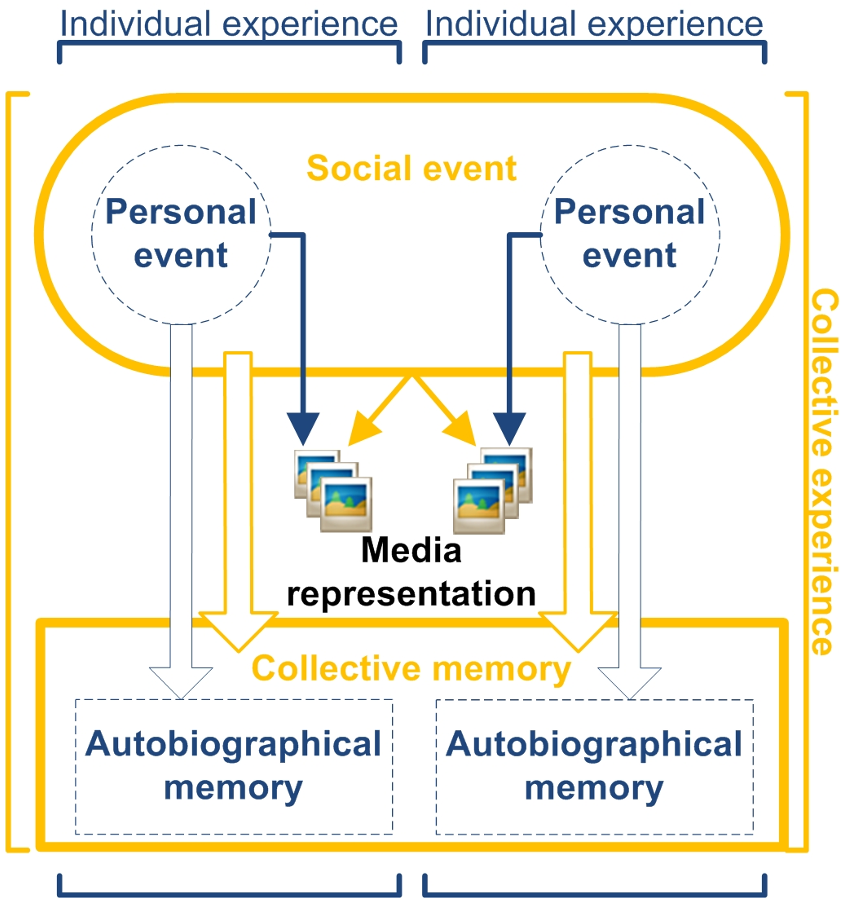
In the landscape of Multimedia Retrieval (ICMR), this paper (2013) stands as a seminal bridge between Personal Information Management and Social Network Analysis. While predecessors focused on "what" is in the photo, this work focuses on the "contextual footprint"—positioning events as the fundamental unit of human memory and social interaction.
The Core Problem: The Context Gap
The massive influx of multimedia data on platforms like Flickr and Facebook is often "context-poor." While humans remember life as a chain of events (a wedding, a trip, a concert), digital systems often see only a stream of unsorted files.
- Prior Work Limitations: Often relied on "machine tags" (user-provided labels) which are rarely present, or complex visual/textual analysis that fails when photos are blurry or captions are missing.
- The Insight: Social events are simply the convergence of multiple personal experiences. If we can define the boundaries of a personal event through time and space, we can mathematically overlap them to reveal a shared social reality.
Methodology: From Pixels to Social Ties
The authors propose a hierarchical pipeline that mirrors human cognitive processing:
1. Personal to Social Event Detection
The algorithm represents an event as a pair of temporal () and spatial () information.
- Temporal Similarity (): Measures the intersection over union of time periods.
- Spatial Similarity (): Uses the Haversine distance to find the minimum distance between sets of geographical points.
2. The Social Tie Discovery
The most striking part of the methodology is the "Degree of Co-participation." The authors hypothesize that the existence of a social tie () follows a logarithmic relationship with the number of shared events ():
Experiments & Results
Validating on a massive dataset of 1.8 million images from Flickr, the results were definitive.
- Social Event Accuracy: The system achieved a 78.76% correct detection rate. Errors were mostly "under-joining" (splitting one event into two) or "over-joining" (merging two separate events in the same locality).
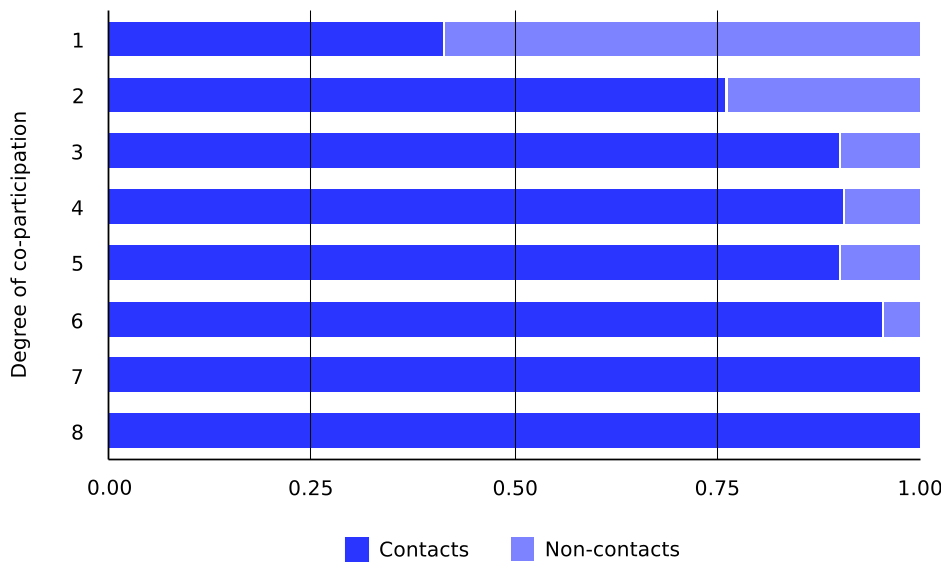
- Predicting Friendships: As shown in the data below, the "Degree of Co-participation" is a powerful predictor. If you share one event with a stranger, there’s a 41% chance they are a contact. Share three? That probability surges to 90.22%.
Key Evidence: Social Closeness
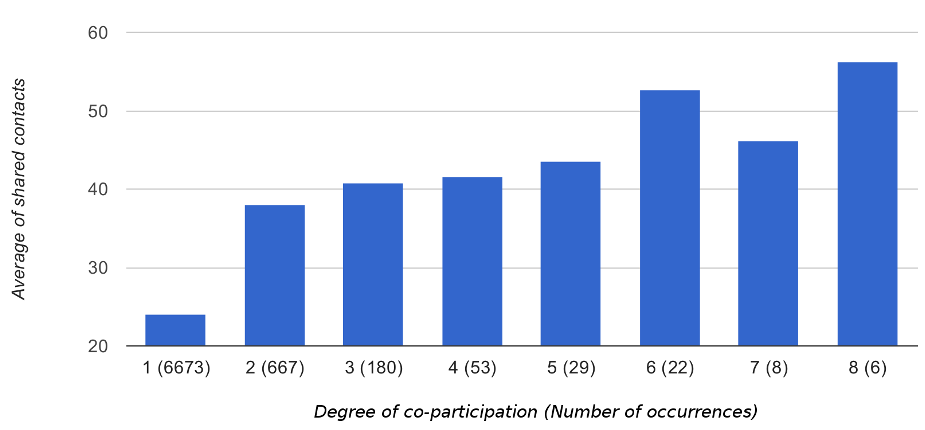
The research also found a direct correlation between the number of shared events and the number of mutual friends (social closeness), proving that events are not just coincidences but "suitable containers of social information."
Critical Insights & Conclusion
Takeaway
The genius of this approach lies in its simplicity. By ignoring the "visual noise" and focusing on the spatio-temporal anchor, the system achieves SOTA-level social discovery without the computational cost of Computer Vision. It highlights that "co-participation" is an incredibly strong signal of shared interest (e.g., aircraft shows, concerts).
Limitations
- GPS Privacy: The method relies on geotagged data, which is increasingly restricted or stripped by modern platforms for privacy reasons.
- Incomplete Ground Truth: As the authors admit, many social ties in the "real world" aren't reflected in one's digital contact list, meaning their 45% true positive rate for ties is likely a conservative estimate.
Future Outlook
This paves the way for "Cold-start" friend recommendations. Even if you are new to a platform, simply uploading your historical photos could allow the system to map your entire real-world social circle based on the events you've attended.