
Social Evolutionary Games: Engineering the Coevolution of Reputation and Topology
Social evolutionary games
This paper introduces the Social Evolutionary Games (SEG) framework to model the structural and behavioral coevolution of social networks. Using Prisoner's Dilemma and Public Goods games, it demonstrates how agents optimize for short-term utility and long-term reputation to shape network topology.
TL;DR
How do massive social networks like Facebook or Twitter evolve their complex structures? This paper proposes Social Evolutionary Games (SEG), a framework where agents balance short-term greed (utility) with long-term social status (reputation). By playing Prisoner's Dilemma and Public Goods games, agents rewire the network in real-time, leading to the emergence of familiar scale-free (power-law) topologies.
Background: Beyond Static Graphs
Classic evolutionary dynamics often treat the "playing field"—the network—as static. However, in the digital age, we choose our "neighbors" by following, unfollowing, and blocking. The authors identify a gap: existing models don't sufficiently account for how reputation acts as a long-term catalyst for network restructuring.
Methodology: The Dual-Engine of Evolution
The SEG framework operates on two distinct time scales governed by a ratio .
- Short-term Concern (Utility): Agents want to win. They look at their partners and use the Fermi update rule to imitate strategies that yield higher immediate cumulative payoffs.
- Long-term Concern (Reputation): Agents want to be associated with "good" partners. Reputation () is updated based on historical cooperative behavior, adjusted by a memory decaying rate ().
Dynamic Rewiring
Unlike global optimization models, SEG assumes myopia. Agents only see their immediate and next-nearest neighbors.
- Step 1: Sever a link with the partner having the lowest reputation.
- Step 2: Establish a new link with a high-reputation agent found via local search (probability ) or a random agent.
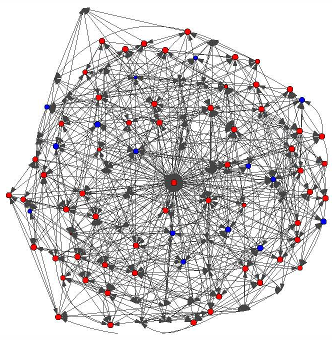 Figure 1: Evolution of the network from t=0 to t=1000. Notice the emergence of "hubs" (agents with high degrees).
Experimental Insights: Spontaneous Complexity
The most striking result is that this simple behavioral loop generates a power-law degree distribution, a hallmark of real-world social systems where a few "influencers" hold the majority of connections.
The "Deterring Effect" Paradox
Interestingly, the results show that increasing the frequency of partner adjustment () isn't always beneficial for the community. In both Public Goods Games (PGG) and Prisoner's Dilemma (PDG), if agents switch partners too rapidly, the overall fraction of cooperators () can actually decrease. This suggests that stable, long-term "social pressure" is required for cooperation to take root; if everyone is constantly "running away" from defectors rather than influencing them, the social fabric thins.
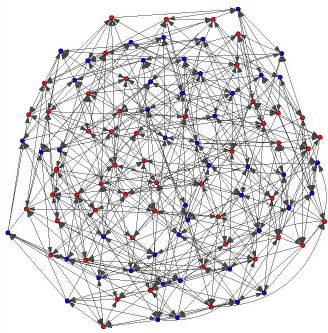 Figure 2: Fraction of cooperators relative to the temptation to defect (b) and the mutation factor (r).
Critical Analysis & Conclusion
This work elegantly bridges game theory and network science. By grounding network growth in individual incentives (Utility vs. Reputation), it moves away from abstract "preferential attachment" toward a more sociological explanation of social structure.
Limitations: The model assumes a fixed number of agents () and doesn't account for the "cost" of maintaining too many links, which in real life leads to Dunbar's number limits.
Takeaway: The future of social platform design may lie in fine-tuning (reputation-based visibility) and (ease of switching) to foster cooperation and prevent the "dead areas" where defection thrives.