
The $(n\{m\}, k)$-Hypercube: Structuring Mobile Social Networks Through Social Feature Priority
The Social Feature-Based Priority Relation Graph of Mobile Social Networks
The paper introduces a social feature-based priority relation graph for Mobile Social Networks (MSNs), modeled as an -hypercube. By mapping erratic mobile contact spaces into a structured feature-based priority relation (FPR) space, the authors establish a static framework for efficient data delivery routing.
TL;DR
Mobile Social Networks (MSNs) are notoriously difficult to bridge due to their dynamic and unpredictable nature. This paper proposes a paradigm shift: instead of tracking where users are, we should track who they are. By defining a priority relation graph based on shared social features (like occupation or affiliation), the authors construct an -hypercube topology. This structured approach allows for efficient data routing and provides a theoretical safety net for maintaining large-scale communications in disaster scenarios with minimal infrastructure.
Problem & Motivation: The Chaos of Contact Space
In a typical MSN, data is delivered via a "store-carry-forward" mechanism. Current State-of-the-Art (SOTA) methods often rely on meeting probabilities or social popularity metrics (e.g., BUBBLE Rap). However, these methods suffer from two major flaws:
- High Overhead: They require constant collection of state information and contact histories.
- Unstructured Dynamics: The "contact space" is erratic; if a user changes their routine, the routing table collapses.
The authors observe that social features are "searchable" and stable. People with common attributes (internal social features) contact each other more frequently. Existing feature-based models only considered cases where users differ by exactly one feature—a limitation that fails to represent the density of real-world social cliques.
Methodology: Building the FPR-Space
The core innovation lies in the Feature-based Priority Relation (FPR) space.
1. The Grouping Hypothesis
Individuals with identical "key features" (extracted via data mining) are treated as a single "group" or node. This converts the mobile space into a static feature space.
2. The -Hypercube
The authors define the priority relationship as follows: two groups have a link if and only if they differ in no more than positions (where ).
- : Number of key features.
- : Number of categories per feature.
- : Degree of flexibility in the priority relationship.
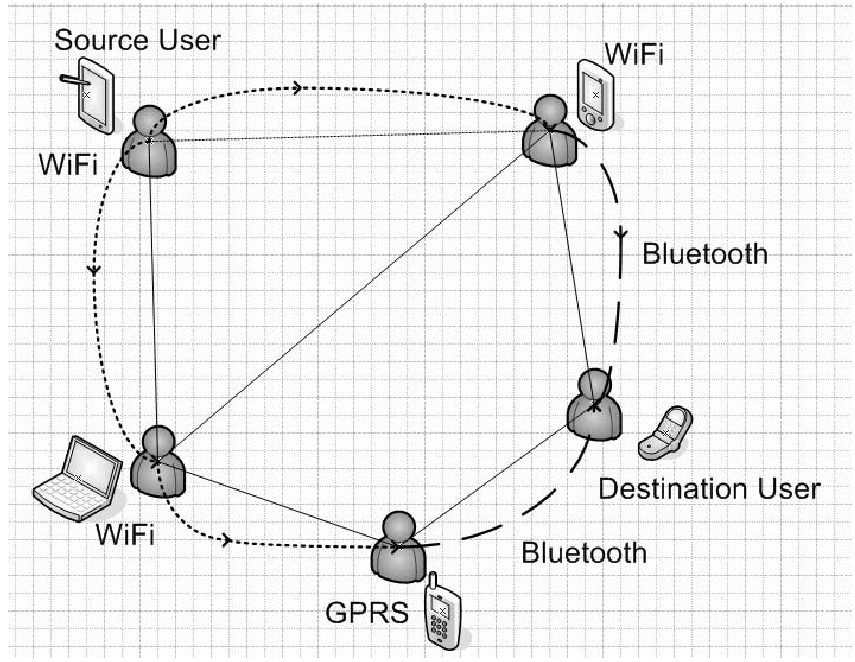 Fig 1. High-level MSN architecture showing the transition from social relations to data forwarding.
As shown in the graph theory derivation, this structure is a regular graph. By increasing , the network becomes more robust, creating a "priority relation graph" that serves as the fundamental framework for routing.
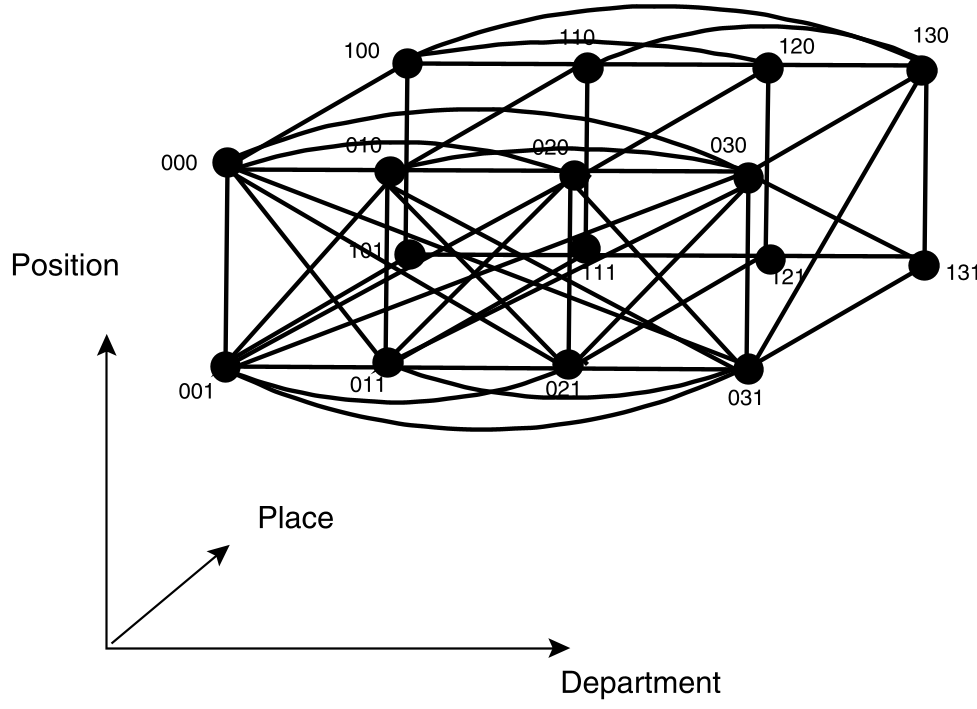 Fig 2. An example of an IT business network mapped onto the priority relation graph, categorizing users by Position, Department, and Place.
Resilience: Pairable Graphs and Disaster Recovery
A standout contribution of this paper is the application of Combinatorial Network Theory to real-world disasters. The authors prove that the -hypercube is an -pairable graph.
Why does this matter? According to the properties of pairable graphs:
- Any spanning tree () of the graph can be augmented with just one external edge to form a cycle of significant length ().
- In a disaster where infrastructure is damaged, you don't need to fix every link. You only need to repair a specific subset of communication links to guarantee a large-area circuit.
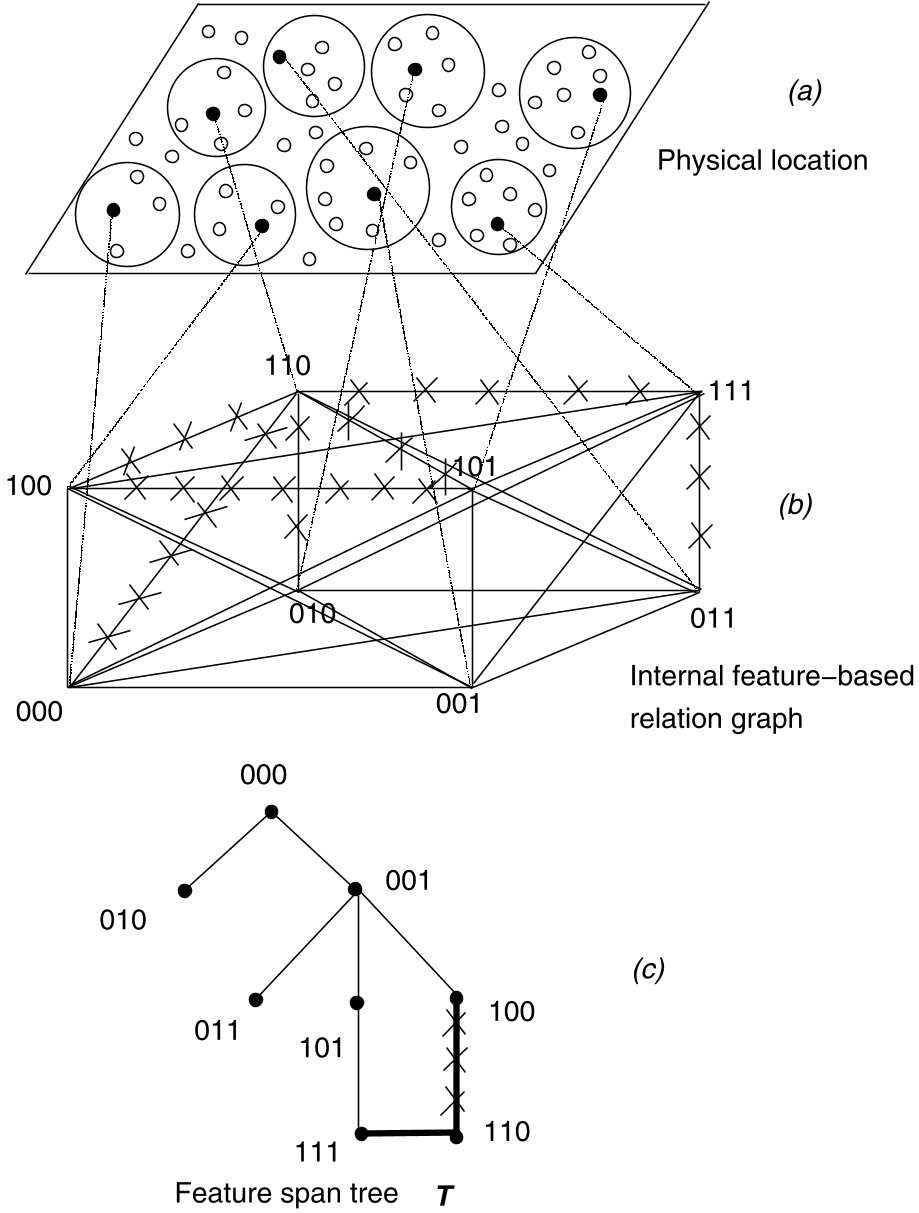 Fig 3. Visualization of disaster network recovery: repairing a specific spanning tree to restore wide-area connectivity.
Critical Analysis & Conclusion
The strength of this work lies in its mathematical rigor—transforming "social feel" into a concrete hypercube topology. By moving from a 1-distance hypercube to a -distance -hypercube, the authors provide a more realistic model for social density.
Limitations: While the theoretical framework is sound, the paper assumes that "key features" are easily identifiable and independent. In reality, features like "Occupation" and "Affiliation" are often highly correlated. Furthermore, the paper leaves the actual implementation of multi-path routing algorithms to future work.
Future Outlook: This structured approach opens the door for Malicious User Diagnosis. Because the graph is regular and structured, "odd" behavior in the data flow can be mathematically pinpointed as an anomaly in the hypercube, potentially solving a major security bottleneck in decentralized MSNs.