
Social Fingerprinting: Unmasking the New Wave of "Human-Like" Spambots via Digital DNA
Social fingerprinting: detection of spambot groups through DNA-inspired behavioral modeling
This paper introduces "Social Fingerprinting," a novel spambot detection technique that models social media user behaviors as Digital DNA sequences. By applying bioinformatics-inspired string analysis, specifically Longest Common Substring (LCS) metrics, the authors achieve state-of-the-art results in identifying sophisticated "third-generation" spambots that mimic human behavior on an individual level.
TL;DR
The "Social Fingerprinting" framework treats social media behavior as a biological sequence. By encoding user actions into "Digital DNA" strings, the authors leverage bioinformatics algorithms to spot the synchronized patterns that even the most advanced, human-mimicking spambots cannot hide. The result? A detection accuracy that crushes traditional machine learning models.
The Evolution of the Spambot: From Obvious to Invisible
We are currently facing the third generation of spambots.
- 1st Gen: Obvious bots frequently posting repetitive, low-quality spam links.
- 2nd Gen: More subtle, using basic NLP to vary text.
- 3rd Gen (Current): These accounts look like us. They have stolen profile pictures, diverse bios with thousands of real followers, and post popular quotes or engage in "human-like" conversation.
When you look at a single account from this new wave, traditional classifiers see "Human." The authors argue that the only way to catch them is to stop looking at the individual and start looking at the collective behavior.
Methodology: Coding Behavior as DNA
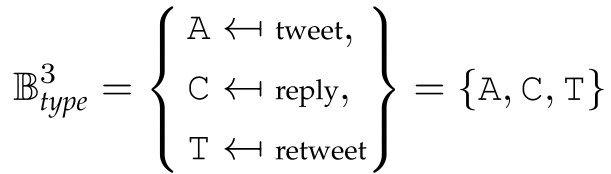
The core innovation is the Digital DNA (dDNA). The authors map social actions to an alphabet:
- A = Tweet
- C = Reply
- T = Retweet
A user's timeline becomes a string: AAACATCAAC....
To find the bots, they use the Longest Common Substring (LCS). The intuition is profound: humans are unpredictable and unique, meaning two random humans will rarely share a long string of identical action sequences. Bots, however, are governed by algorithms. Even if they try to look human, a group of bots managed by the same "Bot-master" will eventually show synchronized motifs in their DNA.
Detecting Patterns: The LCS Curve
The researchers plot LCS Curves. On the x-axis is the number of accounts (k); on the y-axis is the length of the longest substring common to at least k accounts.
- Humans: The curve drops exponentially.
- Bots: The curve stays high, forming "plateaus."
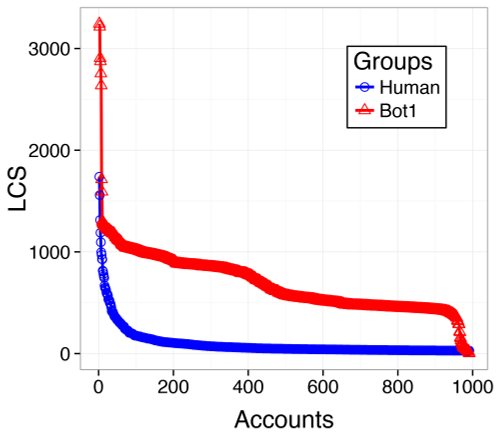 Figure: The stark difference between the collective behavior of bots (Bot1/Bot2) and genuine human accounts.
The paper proposes two ways to use this for detection:
- Supervised: Using a training set to find the optimal split point on the curve.
- Unsupervised: Using the discrete derivative of the curve. A "steep drop" in the LCS curve indicates the transition from the bot group to the human group.
Experimental Results: A Total Shutdown
The authors tested Social Fingerprinting against three state-of-the-art baselines. While traditional models like Yang et al. (which relies on account features) struggled with a low Matthews Correlation Coefficient (MCC ~0.04), Social Fingerprinting achieved an MCC of ~0.95.
| Method | Precision | Recall | Accuracy | MCC |
|---|---|---|---|---|
| Social Fingerprinting (Sup) | 0.982 | 0.977 | 0.977 | 0.955 |
| Yang et al. | 0.563 | 0.170 | 0.506 | 0.043 |
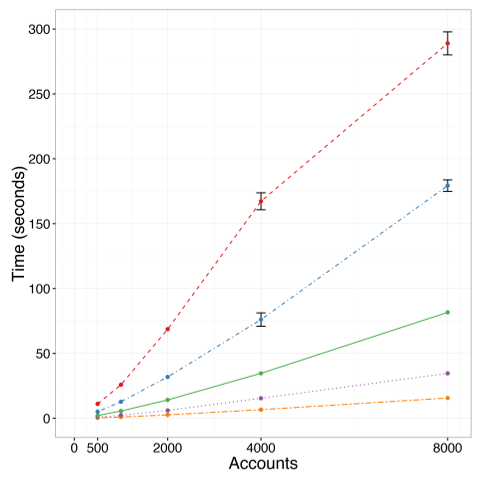
The beauty of this method lies in its efficiency. Biological DNA analysis algorithms have been optimized for decades; applying them here allows for linear time and memory complexity, making it viable for the "humongous and ever-growing" data of Online Social Networks (OSNs).
Critical Insight & Future Outlook
The "Social Fingerprinting" approach proves that synchronicity is the bot's Achilles' heel. Even if a bot mimics human text perfectly, the mechanical nature of its "operant sequence" is mathematically detectable when viewed as part of a cluster.
However, the war continues. The authors acknowledge that bots could adopt evasion techniques, like randomly shuffling their action sequences to break substrings. To counter this, they suggest moving from substrings (exact matches) to subsequences (partial matches), which would track the underlying behavioral "melody" even if some notes are changed.
Conclusion
Social Fingerprinting is a masterclass in cross-disciplinary innovation. By borrowing the "microscope" of bioinformatics and applying it to the "macro" problem of social botnets, the researchers have provided a lightweight yet incredibly powerful tool to protect the integrity of digital discourse.