
Beyond Linear Motion: Mastering Multi-Human Tracking with SFM and OCSVM
Social Force Model based MCMC-OCSVM Particle PHD Filter for Multiple Human Tracking
The paper introduces a Social Force Model-based MCMC-OCSVM Particle PHD Filter for multi-human tracking. It combines a novel exponential-term Social Force Model (SFM) for motion prediction with a One-Class Support Vector Machine (OCSVM) for robust measurement updates, achieving state-of-the-art performance in varying target counts and occlusions.
TL;DR
Tracking humans in a crowded mall or busy street isn't just about physics; it's about social behavior and noise filtering. This paper introduces the SFM-MCMC-OCSVM-PHD Filter, a framework that uses a Social Force Model to predict human intent and a One-Class SVM to purge measurement noise. The result? A massive 59.7% improvement in tracking accuracy over traditional methods.
Background: The Chaos of Crowds
Multi-object tracking (MOT) is notoriously difficult when the number of targets changes dynamically. While the Probability Hypothesis Density (PHD) filter is the gold standard for tracking an unknown number of targets without explicit data association, it has two Achilles' heels:
- Naive Prediction: It usually assumes targets move independently (e.g., constant velocity), ignoring that people swerve to avoid collisions.
- Clutter Sensitivity: Background subtraction often creates "ghost" targets, leading the filter to hallucinate new people where there is only shadow or noise.
The "Social" Prediction: SFM-MCMC
To solve the prediction problem, the authors move away from simple linear models. Instead, they implement a Social Force Model (SFM).
Physics Meets Psychology
The SFM treats humans as particles influenced by "energies":
- Repulsion: Staying away from others to avoid collisions.
- Attraction: Moving toward a specific destination.
- Directionality: Preferring to move in the direction one is facing.
By using an exponential-term energy function, the authors calculate a "Social Force Likelihood." This likelihood is then used in a Markov Chain Monte Carlo (MCMC) resampling step. Instead of spreading particles randomly, the MCMC chain pushes them toward states that are socially plausible, creating a much more accurate "prior" for the filter.
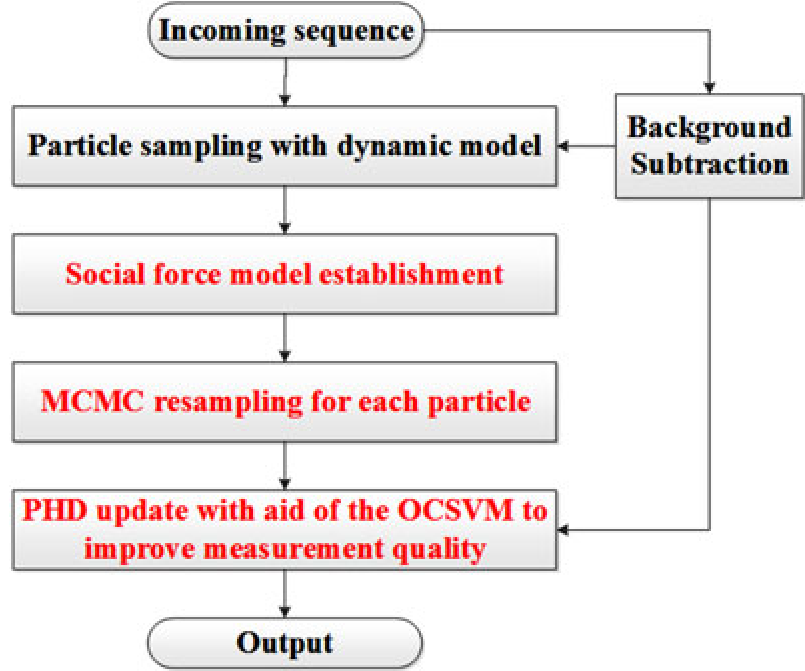 Figure 1: The proposed tracking framework, integrating SFM prediction and OCSVM measurement filtering.
The "Smart" Update: OCSVM Filtering
Common background subtraction (like the Codebook method) is prone to "salt and pepper" noise. The authors' masterstroke is moving the recognition task into the update loop.
Instead of feeding raw foreground pixels into the PHD filter, they extract Color Histograms and Histograms of Oriented Gradients (HOG). These are fed into a One-Class Support Vector Machine (OCSVM).
- The OCSVM is trained only on "human" features.
- During the tracking update, it assigns low probability scores to particles that don't "look" like humans (e.g., moving shadows or tree branches).
- This effectively prunes the measurement set before it can corrupt the tracking state.
Experimental Results: SOTA Performance
The model was put to the test against datasets like PETS2009 and CAVIAR.
Significant Precision Gains
The metric OSPA (which measures both how close the tracker is to the person and how well it counts the number of people) showed a dramatic drop—lower is better—from 21.93 (Traditional PHD) to 8.83 (Proposed).
 Figure 2: Visual tracking results showing the filter successfully handling multiple targets through occlusions.
Ablation Insights
- SFM-MCMC alone improved performance by 38.25%.
- OCSVM alone improved performance by 43.36%.
- Combined, they reached a synergistic 59.73% improvement.
While the OCSVM adds about 36% to the processing time per frame, the authors argue that the trade-off is well worth it for the leap in stability and accuracy.
Critical Insight & Conclusion
Most trackers treat "motion" and "appearance" as separate modules. This paper proves that behavioral context (SFM) is just as critical as appearance. By embedding social intelligence into the MCMC resampling process, the tracker doesn't just "see" humans; it "anticipates" them.
Future Outlook: The methodology here provides a roadmap for autonomous vehicles and robotics. If a robot can predict social forces, it can navigate crowds more naturally, rather than treating humans as mere static obstacles.
Takeaways
- Social context matters: Humans don't move in straight lines when crowded.
- Filter your inputs: A "smart" measurement update using OCSVM can compensate for "dumb" sensor noise.
- PHD Filters are evolving: Integrating MCMC makes them far more robust for high-density scenarios.