
Beyond Consensus: Leveraging Intergroup Influence for Sequential Group Recommendations
A Social Framework for Set Recommendation in Group Recommender Systems
This paper proposes a novel social framework for Group Recommender Systems (GRS) that identifies influential groups within a social network to guide the decision-making of "susceptible" groups. The framework specifically targets the recommendation of ordered sets of items (e.g., sequences of leisure activities) rather than single objects, leveraging intergroup social dynamics.
TL;DR
Most Group Recommender Systems (GRS) treat a group as an isolated island, trying to balance the internal whims of its members. This paper proposes a paradigm shift: Intergroup Social Influence. By identifying "Influential Groups" in a social network and showcasing their successes to "Susceptible Groups," the proposed framework helps groups make faster, more confident decisions regarding complex sequences of activities.
Problem & Motivation: The "Isolation" Trap
In the world of Recommender Systems, we have moved from suggesting a single book to a single person to suggesting a movie to a group of friends. However, current GRS approaches often hit a wall because they only look inward. They focus on aggregation functions—how to mathematically blend User A's love for horror with User B's preference for comedy.
The author highlights two major gaps:
- Ignoring the Social Web: In reality, groups are influenced by other groups. We look at what "the cool kids" or "the experts" did before making our own collective choice.
- The Complexity of Sequences: Recommending a single item is easy; recommending a sequence (e.g., a three-course dinner followed by a specific concert and a late-night lounge) requires maintaining a logical flow that satisfies the group throughout the entire experience.
Methodology: The Social Framework
The core of the proposal is a four-tiered architecture designed to bridge social theory with algorithmic execution.
1. Identifying the Influencers
Instead of looking for influential individuals, the system seeks Influential Groups.
- Technique: Using hard and soft clustering for community detection.
- Metrics: Betweenness and closeness centrality are used to find groups that act as "information bridges" or "authorities" within the network.
2. Differentiated Preference Modeling
The paper argues that influential groups and susceptible groups should not be modeled the same way. Influential groups are "creators" of trends, while susceptible groups are "consumers." The framework suggests a dynamic model where a group’s "susceptibility parameter" is updated every time they adopt an influencer's recommendation.
3. Architecture & Visualization
The methodology emphasizes that the interface is just as important as the algorithm.
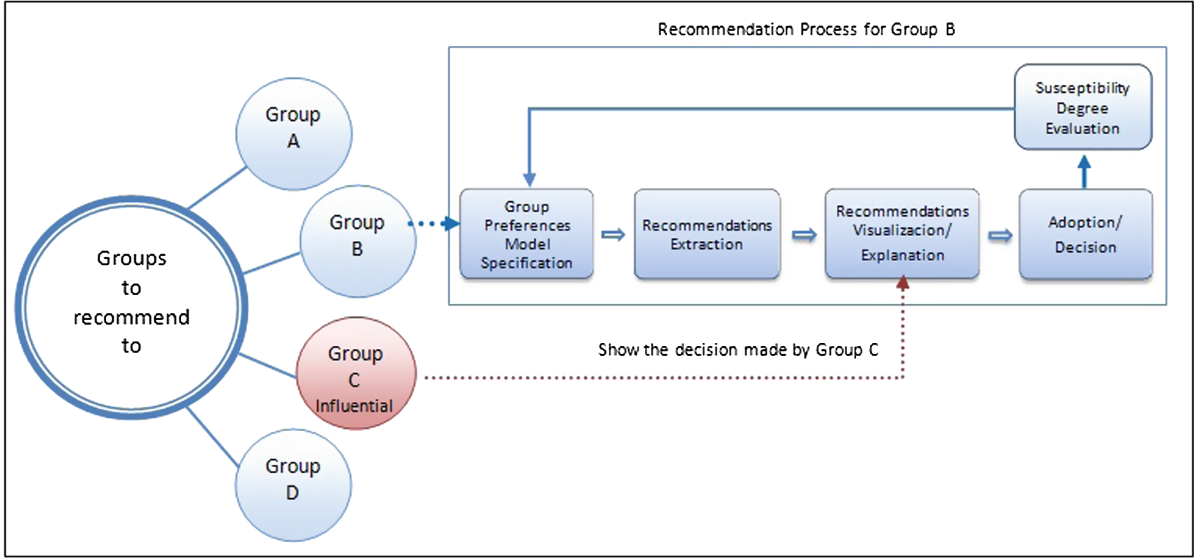 Figure 1: The proposed framework highlighting the flow from group identification to recommendation.
Experiments: Validation via Social Data
The researcher proposes using Meetup datasets. This is a strategic choice because Meetup inherently contains:
- Established Groups: Pre-defined social units with common goals.
- Sequential Events: A history of past activities that can be modeled as ordered sets.
- Social Links: Data on members who belong to multiple groups, facilitating the study of cross-group influence.
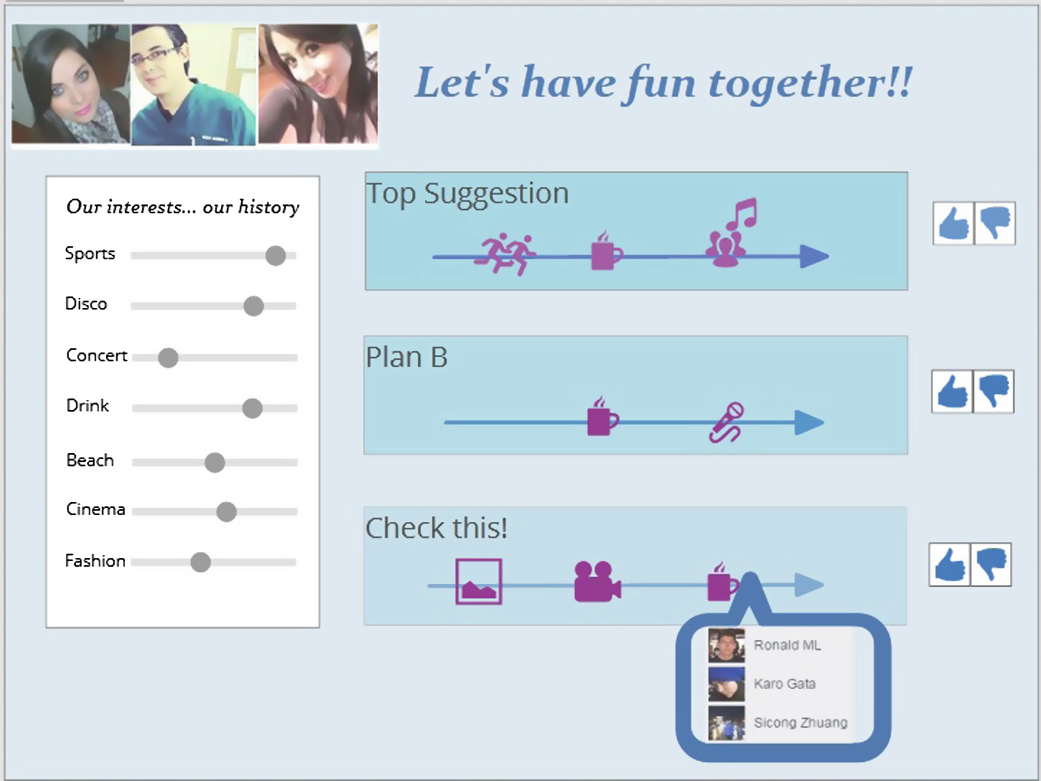 Figure 2: Conceptual UI showing how "Influential Group" choices are presented to provide social context.
Critical Analysis & Future Outlook
The brilliance of this work lies in its application of Self-Categorization Theory. It recognizes that when people are in a group, their individual preferences often shrink, and their "group identity" takes over.
Limitations:
- Privacy: Tracking intergroup influence requires a high degree of data transparency across the social network.
- Manipulation Risk: The author wisely asks: Does showing an influential group's choice help or manipulate? Over-reliance on influencers could lead to a "filter bubble" where groups stop exploring niche interests.
Takeaway: This research moves GRS from a purely mathematical optimization problem to a socio-technical one. By treating groups as nodes in a larger social graph, we can unlock more human-centric recommendations.