
SocialHBC: Turning the Human Body into a Secure, High-Speed Data Bus
SocialHBC: Social Networking and Secure Authentication using Interference-Robust Human Body Communication
This paper introduces SocialHBC, an interference-robust Human Body Communication (HBC) system that utilizes the human body as a low-loss conducting medium for secure and energy-efficient data transfer. The core contribution is an Integrating Dual Data Rate (DDR) receiver that acts as an adaptive notch filter, specifically designed to suppress omnipresent FM interference.
TL;DR
SocialHBC is a paradigm shift in wearable connectivity. By using the human body as a wire rather than an antenna, it enables ultra-low-power (ULP) communication that is physically secure—data only moves when you touch. The breakthrough lies in a Dual Data Rate (DDR) integrating receiver that nullifies FM radio interference, allowing 100 Mbps data rates even when interference is 200x stronger than the signal.
Background & Motivation: The "Body-as-Antenna" Problem
As wearables proliferate, we face a paradox: WBANs (like Bluetooth) are energy-hungry because they fight high path loss through air and skin. Moreover, they radiate personal data in all directions, inviting eavesdropping.
Human Body Communication (HBC) solves this by treating the body as a conductor (baseband) rather than a radiator (RF). However, a ~6ft human is a perfect antenna for the FM radio band (88-108 MHz). Previous solutions used energy-inefficient frequency hopping or bulky filters to avoid this "noise." SocialHBC takes a different path: it uses the math of integration to make the noise disappear.
Methodology: The Resettable Integrator as a Notch Filter
The author's core insight is elegant: if you integrate a sine wave (interference) over exactly one or more of its periods, the result is zero.
The Mathematical Intuition
By using NRZ (Non-Return-to-Zero) signaling, the receiver integrates the incoming signal over a bit period . If is tuned to match (where is the interference period), the destructive interference component vanishes. Since one phase of the clock is resetting while the other integrates, a Dual Data Rate (DDR) structure is employed to ensure no symbols are missed.
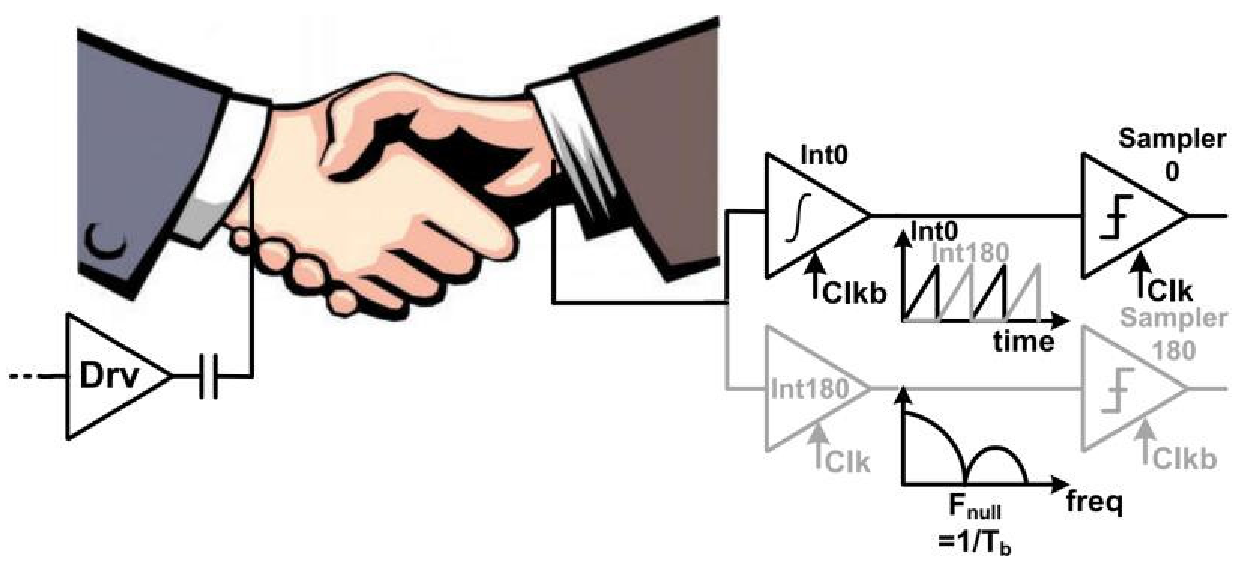 Figure 1: The Transceiver Architecture featuring the DDR Resettable Integrator and Sampler.
Applications: From Handshakes to Human Intranets
The paper categorizes the impact into three distinct pillars:
- Social Networking via Handshake: Exchanging LinkedIn or Facebook profiles instantly through a physical handshake, ensuring the exchange is intentional and private.
- Secure Authentication: A smartwatch acts as a "physical key" that only unlocks a terminal when the user physically touches it.
- Ultra-Low Power BAN: Connecting various on-body sensors with orders of magnitude less power than Bluetooth, as there is no need for power-hungry RF up-conversion.
Experiments & SOTA Results
The effectiveness of the notch filter was tested under extreme conditions. Even with a Signal-to-Interference Ratio (SIR) of -23 dB, where the FM noise completely closes the "eye diagram" of a standard receiver, the SocialHBC integrated eye remains open and clear.
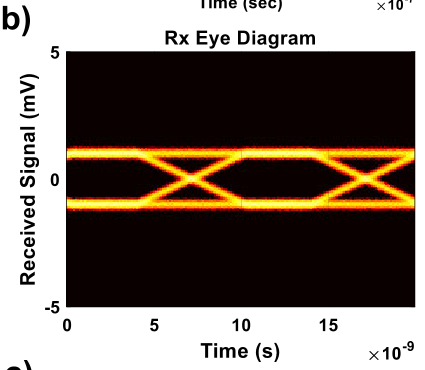 Figure 2: Performance comparison showing that while the raw NRZ eye diagram (top) is destroyed by interference, the integrated eye diagram (bottom) remains robust.
Key Quantitative Achievements:
- Interference Rejection: >20 dB suppression in the 88-108 MHz band.
- Data Rate: Demonstrated at 100 Mbps.
- Resilience: Operates successfully at -23 dB SIR.
Critical Analysis & Conclusion
The beauty of SocialHBC is its simplicity; it replaces complex signal processing with a fundamental circuit property (integration). By making the "notch" adaptive based on the bit rate, it circumvents the need for fixed, bulky hardware filters.
Limitations:
- The system still requires the interferer to be somewhat consistent (CW or AM/FM).
- Physical security is high, but "touch" is a binary gate; it doesn't prevent an attacker from snooping if they manage to make physical contact (though the paper argues is much lower than ).
Final Takeaway: SocialHBC paves the way for a "Human Internet" where our bodies are the secure, energy-efficient backplane for the next generation of wearable intelligence.