
The Social Hourglass: Shifting from Static Profiles to Dynamic Interaction Sensors
The Social Hourglass: An Infrastructure for Socially Aware Applications and Services
The paper introduces "The Social Hourglass," a modular architectural framework designed to decouple social signal collection from socially aware applications. It features social sensors, a personal aggregator, and a Social Knowledge Service (SKS) to provide a scalable, user-controlled infrastructure for inferring trust and social relationships.
TL;DR
"The Social Hourglass" is a pioneering architectural framework that treats social interactions—rather than static "friend" lists—as the primary fuel for intelligent applications. By decoupling data collection (Social Sensors) from data usage, it enables a new generation of apps to "feel" the strength and context of human relationships while keeping the user in control of their digital identity.
Strategic Position: This work moves beyond the "walled garden" model of social networks, proposing a decentralized middleware layer that bridges the gap between raw digital traces (logs, IMs, games) and high-level social inferences (trust, proximity, cooperation).
The Vital Shift: Why Static Profiles Fail
Most current socially aware applications suffer from two major flaws:
- Vertical Integration: An app like Yelp or Facebook only knows about your interactions within its own walls. It lacks the "big picture" of your social life.
- Binary Relationships: "Friend" or "Not Friend" is a poor metric for trust. Real relationships have intensity, frequency, and context.
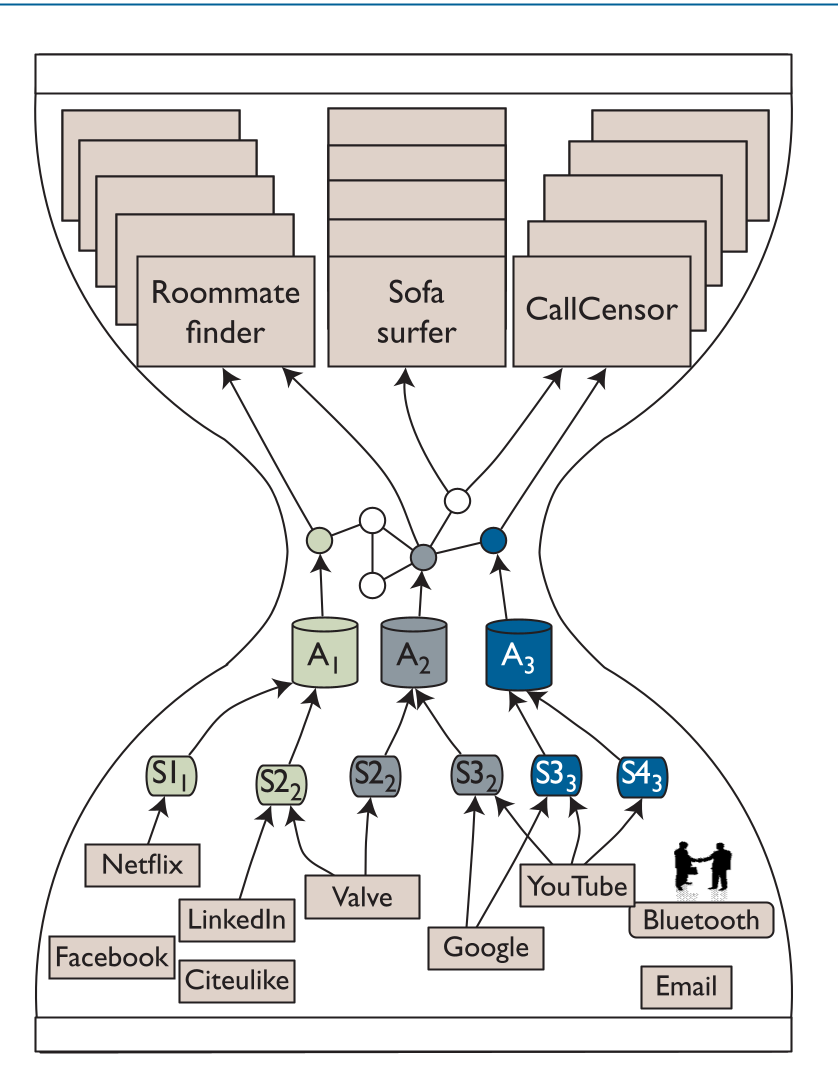
The authors argue for an "Hourglass Architecture," mirroring the Internet’s core design. Just as IP connects many physical layers to many applications, the Social Hourglass connects diverse "Social Signals" to an evolving set of services.
Methodology: The Three Pillars of Social Awareness
The architecture is split into three distinct layers that process raw data into actionable knowledge:
1. Social Sensors
These are lightweight applications that interpret raw data—like phone logs, IM chats, or gaming events—and convert them into [Ego, Alter, Type, Weight] tuples.
2. The Personal Aggregator
This is the "Brain" of the system. Usually running on a user's device, it fuses signals. For example, it might decide that a "Friend" label from Google Chat is more important for a "Work" context than a "Friend" label from Skype. It also handles Identity Management, linking different handles (e.g., a Twitter handle and a work email) to the same physical person.
3. Social Knowledge Service (SKS)
Processed data is sent to the SKS (specifically a P2P system called Prometheus), which maintains a global social graph. It provides an API for applications to query "k-hop neighborhoods" or "social strength" without the app ever seeing the raw, private logs of the user.
Proof of Concept: Team Fortress 2 as a Social Lab
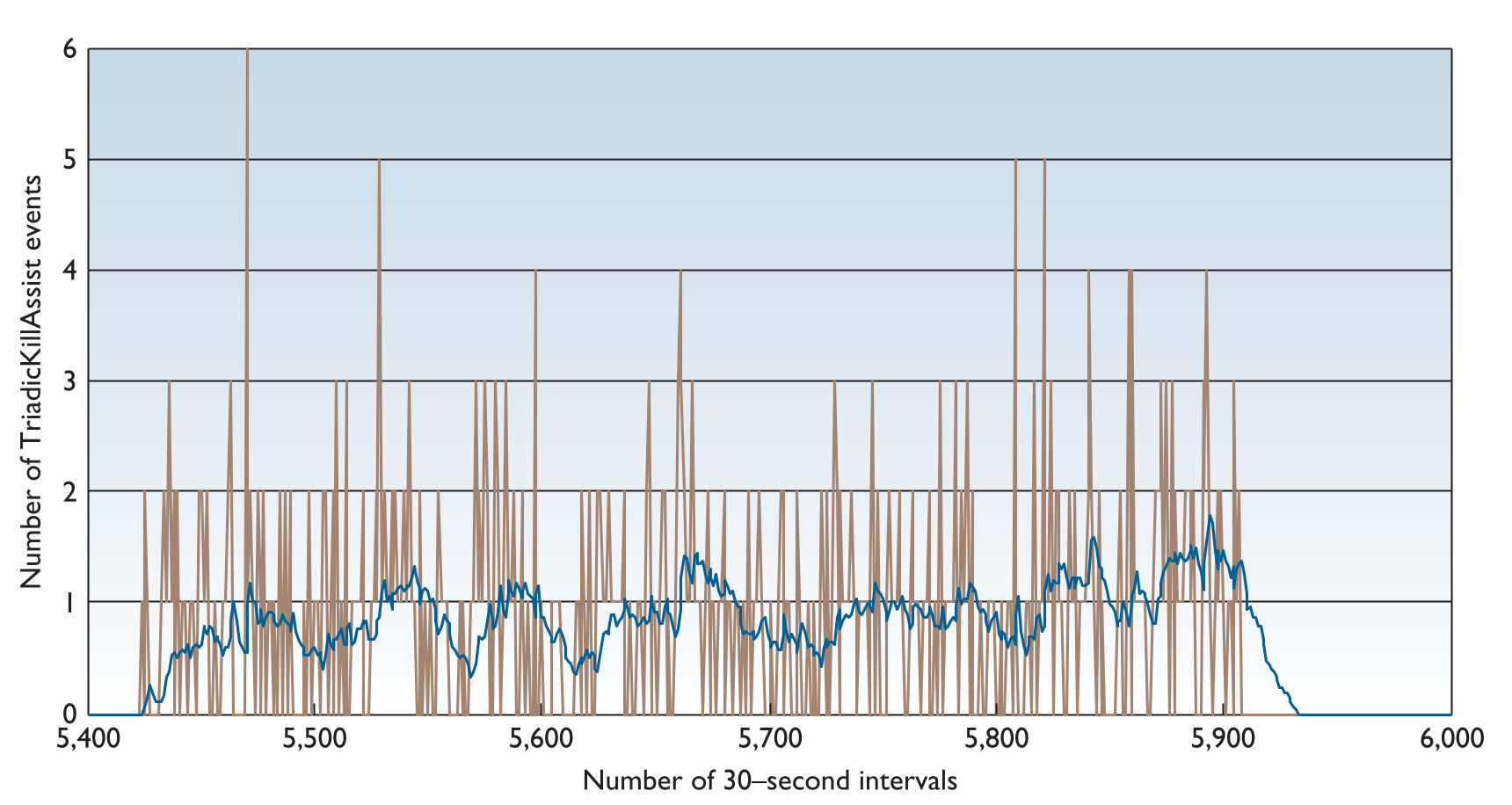
To prove the system works, the authors implemented a sensor for the game Team Fortress 2 (TF2). Gaming is an ideal proxy for real-world social behavior because it involves cooperation (healing teammates) and conflict (killing enemies).
Key Insights from the Experiment:
- Activity vs. Declaration: They found that 80 times more people interacted in the game than were actually "friends" on the Steam platform. Interaction data is a much richer data source.
- Adaptive Sampling: To avoid overloading game servers, the authors used NLMS (Normalized Least-Mean Square) adaptive filters to predict when social activity would occur. This allowed the sensor to "pull" data only when necessary.
Critical Analysis: Privacy and Scalability
The "Hourglass" approach offers a sophisticated answer to the Privacy Paradox. Instead of a central authority (like Meta) owning the entire graph, the user's aggregator filters and encrypts data before it reaches the SKS.
Limitations:
- Bootstrap Problem: The system requires "Community-accepted standards" for sensor outputs to work across different platforms.
- Maintenance: Users might find the "cognitive load" of managing their personal aggregators too high without better automation.
Conclusion: A Future of "Socially Informed" Systems
The Social Hourglass provides a blueprint for a decentralized social web. By treating sociality as a layer of infrastructure rather than a destination, it opens the door for applications that can automatically silence personal calls during professional meetings or find trustworthy "friends-of-friends" for couch-surfing based on shared gaming habits.
Takeaway: The future of Social Tech isn't in building better "Profiles"; it's in building better "Sensors" and "Aggregators" that respect user sovereignty.