
PRR: Bridging the Semantic Gap in Social Image Recommendation via Path Relevance
Social Image Recommendation Based on Path Relevance
The paper introduces Path Relevance Recommendation (PRR), a social image recommendation framework that integrates heterogeneous social data (user relationships, tags, and image content) using a unified attributed network. By transforming attributes into structural nodes and employing a Random Walk with Restart (RWR) mechanism, the system achieves SOTA performance on the FlickrImageNetwork (FIN) dataset.
TL;DR
Recommending images in social networks is notoriously difficult due to extreme data sparsity (too many images, too few "likes"). This paper proposes PRR (Path Relevance Recommendation), which treats images, users, tags, and visual features as nodes in a single, massive Unified Attributed Network. By using a weighted Random Walk, the system navigates this graph to find "relevant" images, proving that structural connectivity can overcome the limitations of traditional Matrix Factorization.
Problem & Motivation: The Sparsity Trap
Traditional recommendation systems usually fall into two camps:
- Collaborative Filtering (CF): "Users who liked this also liked that." It fails when the user-item matrix is nearly empty (sparsity).
- Content-Based Filtering (CBF): "You like cats, here is another cat." It often lacks personalization and fails to capture the "human signal" of social trends.
The authors argue that social image data is hyper-sparse. Most users only interact with a tiny fraction of the 100,000+ images available. Furthermore, existing Context-Aware Recommendation (CAR) models that use Matrix Factorization explode in complexity as you add more factors (tags, relationships, etc.).
Methodology: The Unified Attributed Network
The core innovation lies in the Unified Attributed Network (). Instead of keeping image features in a separate matrix, the authors transform them into nodes.
1. Discretizing Continuous Features
Visual features (the 4,096-dim DeCAF features) are continuous. To fit them into a graph, the authors use a binning/clustering approach to create attribute nodes. This allows the graph to represent visual similarity as "shared neighbors."
2. Path Relevance via Random Walk
The distance between a user and an image is calculated as Path Relevance (PR). This is effectively a Random Walk with Restart (RWR). It captures the probability that a surfer starting at user will end up at image , considering all possible paths (through common tags, mutual friends, or similar visual content).
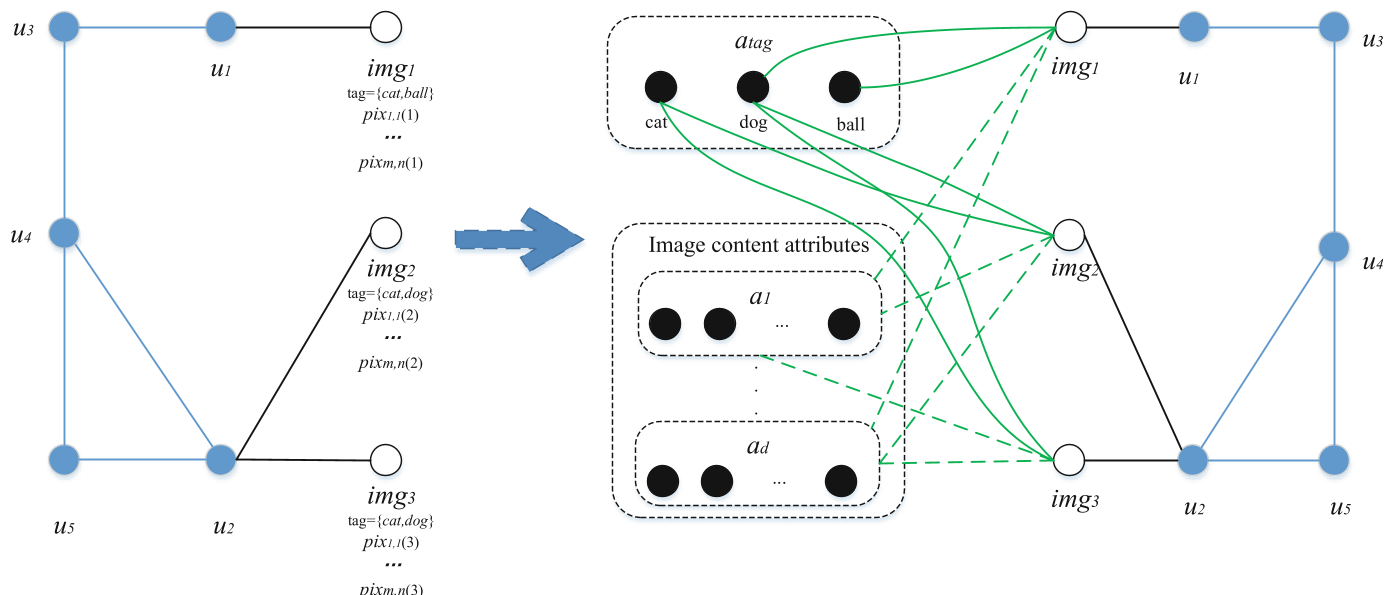 Figure 1: Transformation from a standard attributed network to a Unified Attributed Network where tags and features become structural nodes.
3. Adaptive Edge Weighting
Not all links are equal. A "friendship" link might be more or less important than a "shared tag" link. The authors propose an Approximate Weight Self-Adjustment algorithm. It uses a "majority vote" logic: if two images liked by the same user share an attribute, the weight of that attribute's edge type is increased in the next iteration.
Experiments: Superiority in the "Long Tail"
The authors tested PRR on a custom dataset, FIN (FlickrImageNetwork), containing 100k images.
Key Findings:
- Information Sensitivity: Adding Social Relationships (S) and Tags (T) significantly improved the Hit Rate Score (HRS) from 0.75 to 0.89.
- Robustness to Sparsity: As shown in the comparison below, while Matrix Factorization methods (PMF, SoRec) crashed in performance as the dataset became sparser, PRR remained stable.
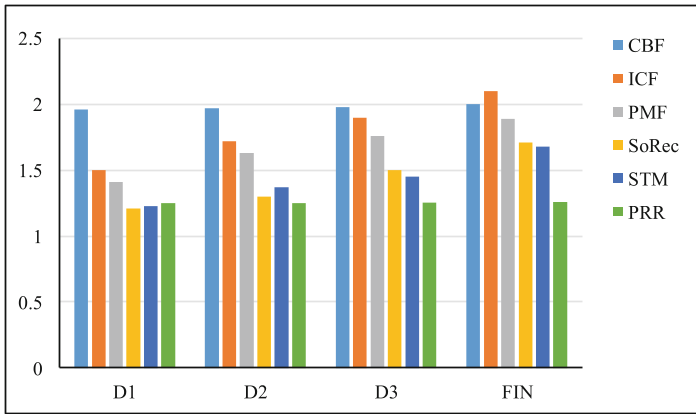 Figure 2: Method comparisons across different densities. PRR maintains a high Hit Rate (HRS) even when data is extremely sparse.
Critical Analysis & Conclusion
Takeaway
PRR proves that structural relevance on a heterogeneous graph is a powerful alternative to latent-space embeddings for social media. By converting content attributes into nodes, the model naturally handles multi-modal data without the linear growth in parameters seen in matrix factorization models.
Limitations
- Computational Complexity: RWR on a large graph is expensive ( theoretically, though optimized here). For a billion-scale network, even the optimized version might struggle without massive distributed graph processing.
- Coarse Attribute Nodes: The binning of 4,096-dim features into discrete nodes might lose fine-grained visual nuances compared to modern end-to-end deep representational learning (like Vision Transformers).
Future Outlook
The logical next step is exploring Graph Convolutional Networks (GCNs) which can learn these edge weights and node embeddings end-to-end, rather than relying on iterative majority-vote adjustments.