
Social Incentive Optimization: Engineering "Likes" to Save the Ecosystem
Social Incentive Optimization in Online Social Networks
The paper introduces "Social Incentive Optimization," a recommendation framework for LinkedIn designed to encourage content producers (actors) by promoting their posts to connections (viewers). It utilizes a greedy submodular optimization algorithm paired with Doubly Robust Estimation to maximize long-term actor engagement while maintaining viewer experience.
TL;DR
LinkedIn researchers have pioneered a shift in recommendation logic: instead of just showing you what you want to see, they show you what your friends need you to see. By optimizing for "Social Incentives" (likes/comments), this framework increased the retention of infrequent content creators by 2.75% with virtually no impact on overall platform engagement.
Background: The Invisible Stakeholder
In the world of Recommender Systems (RS), the "Viewer" is usually king. Algorithms are typically tuned to maximize the viewer's Click-Through Rate (CTR). However, this creates a vacuum on the production side. If a user shares a thoughtful post but receives zero feedback (no likes, no comments), they are far less likely to share again. This "lonely sharer" problem leads to a decaying ecosystem.
The authors argue that social interactions are not just outcomes; they are incentives. The goal is to maximize the utility of the Actor (the producer) by influencing the Viewer (the consumer) to provide feedback.
The "Why": Causal vs. Correlational Feedback
Why is this hard? Because "active users get more likes" is just a correlation. To build an effective optimizer, we need to know: If I force a viewer to see this post and they like it, does it actually CAUSE the actor to share more?
The authors used Doubly Robust Estimation (DRE) to solve this. This technique combines:
- Propensity Scores: Correcting for the bias that certain actors are naturally more "recommendable."
- Outcome Models: Predicting the likelihood of future sharing based on user features.
Methodology: Submodular Optimization
The paper formalizes "Social Incentive Optimization" as a constrained optimization problem.
The Framework
- Goal: Maximize the total "Actor Utility" (expected future shares).
- Constraint: Don't spam the "Viewer" (limit the number of promoted items).
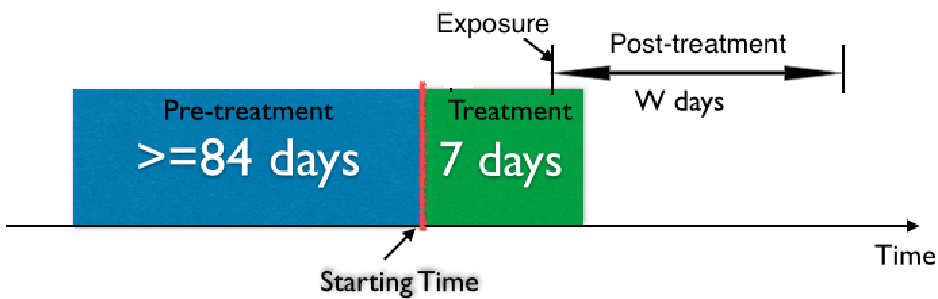 Caption: The study lifecycle—from identifying an infrequent sharer to measuring their "post-treatment" activity.
The utility function is shown to be monotone submodular, meaning the "law of diminishing returns" applies: the first "like" a user gets provides a massive boost to their morale, but the 100th "like" provides less incremental value. This allows the use of a high-efficiency Greedy Algorithm to find the optimal recommendation plan.
Critical Evidence: Do Incentives Drive Growth?
The results from the causal analysis are striking. As shown in Figure 3, the probability of a user sharing content again increases almost linearly with the number of social incentives they receive (up to a certain point).
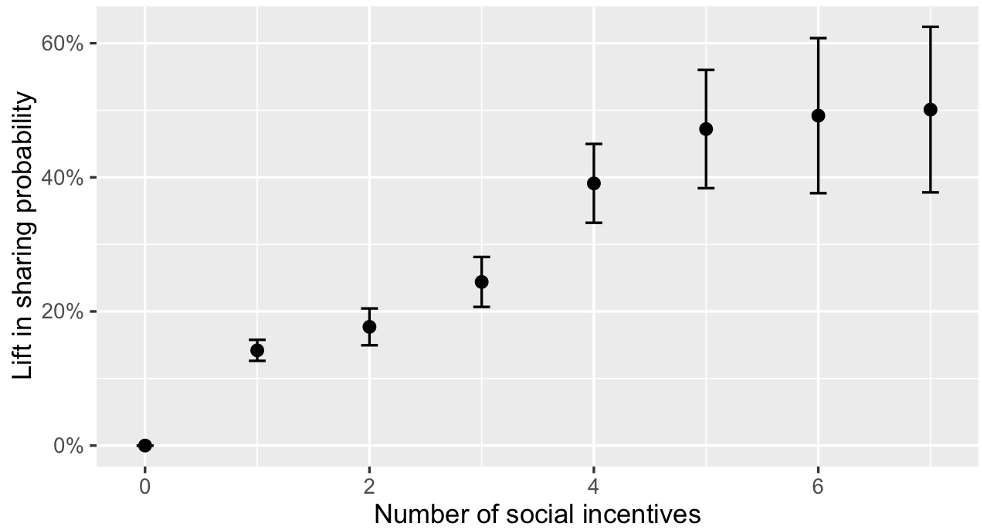 Caption: The lift in sharing probability is significant as the number of social incentives (n) increases.
In online A/B testing on LinkedIn:
- Sharer Retention: +2.75% in the likelihood of infrequent sharers posting again.
- Viewer Experience: Only a -0.5% (statistically insignificant) drop in CTR.
This proves that the system can afford to be "altruistic"—trading a tiny bit of viewer relevance for a massive gain in producer retention.
Depth Insight: The "Second-Degree" Impact
This work is unique because the system doesn't directly reward the user (e.g., giving them points or money). Instead, it manipulates the social environment to trigger a natural human response to social validation. It is "second-degree" incentivization.
One fascinating find (Figure 4) is that comments have the highest impact on future sharing, while likes and shares are roughly equal. This suggests that the algorithm should prioritize putting creators in front of viewers who are likely to engage in "high-effort" feedback like commenting.
Conclusions & Future Directions
The "Social Incentive Optimization" framework is a masterclass in holistic platform design. By moving from a viewer-centric model to an ecosystem-centric model, LinkedIn successfully addressed the "cold start" and "retention" problems of content creators.
Future Work: The authors point out a remaining challenge: connection strength. Feedback from a "Strong Connection" (a close friend) has a much higher impact than from a "Weak Connection" (Figure 5). Incorporating the quality of the relationship into the incentive model is the next logical step for this research.
Takeaway for Tech Leads: If your platform relies on user-generated content, don't just optimize for the reader. If you don't optimize for the writer's "clout," eventually there won't be anything left to read.