
Social Inference: The Hidden Privacy Killer in Mobile and Social Apps
Social Inference Risk Modeling in Mobile and Social Applications 1
This paper introduces a theoretical framework for modeling Social Inference Risk in Mobile and Ubiquitous Social Computing (USC). It utilizes information entropy to predict how background knowledge and shared data can lead to the unintended disclosure of a user's identity across Computer-Mediated Communication (CMC) and location-aware applications.
TL;DR
Even if you never share your name, your "social footprint"—what you say in a chat or where you stand in a gym—can reveal exactly who you are. This paper develops a mathematical framework based on Information Entropy to predict "Social Inference" risks, proving that in typical campus settings, there is a 50% chance your identity can be cracked just by the patterns of your interaction.
The Problem: Access Control is Failing Us
We often think of privacy as a "lock and key" problem: if I don't give you my name, you don't know who I am. However, the rise of Ubiquitous Social Computing (USC) has created a new threat: Social Inference.
Prior work focused on database security (preventing hacks) or static k-anonymity (masking records). But social apps are dynamic. The authors identify two chilling categories:
- Instantaneous Social Inferences: Identifying a "nearby" anonymous user by simply looking around and seeing who is holding a phone.
- Historical Social Inferences: Observing that a specific nickname always appears at the gym when the same staff member is working.
The core issue is Background Knowledge. You don't need a database to de-anonymize someone; you just need context.
Methodology: Quantifying "Uncertainty"
The authors argue that privacy is essentially Entropy. When an attacker knows nothing, entropy is max. As they collect pieces of information (), entropy drops.
The paper formalizes this using the reduction in conditional entropy: Where is your identity. If falls below a certain threshold—calculated by , where is your desired "crowd size" (degree of anonymity)—you are no longer private.
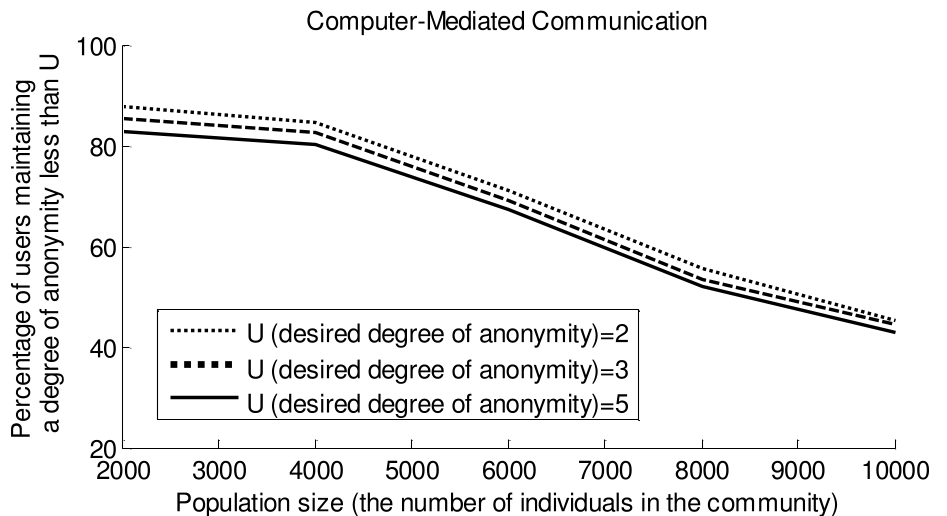 Figure 1: This simulation shows that even in large populations (10,000), the risk of having a unique profile that drops entropy below the threshold remains remarkably high.
Experiments & Real-World Findings
The researchers conducted a dual-pronged study: a lab chat study (292 subjects) and a mobile field study (165 subjects).
- In Chat (CMC): Users frequently leaked enough "style" and "profile" info to be identified. Entropy was the only consistent predictor of whether someone could guess their partner's identity.
- In Proximity Apps: In 46% of cases, users could narrow a "nearby nickname" down to 1 or 2 real people in their physical vicinity.
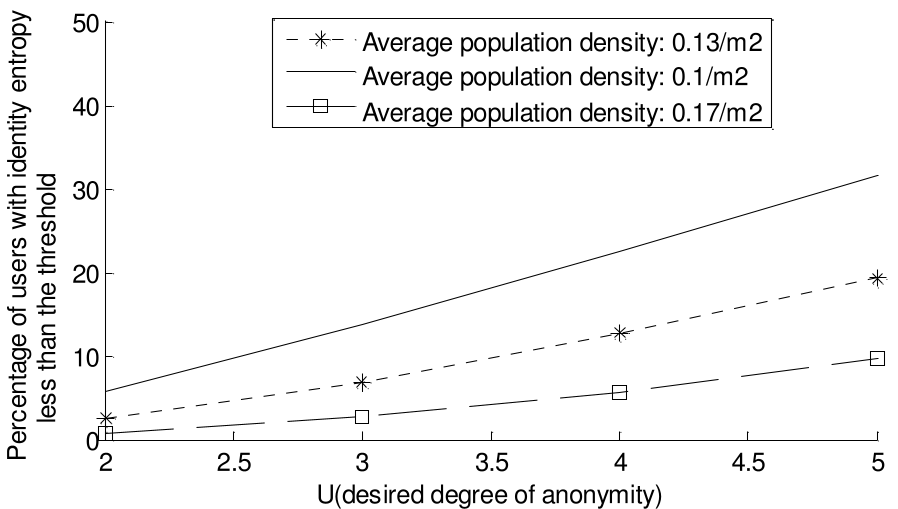 Figure 2: Risk of identity inference for proximity-based apps. As the "crowd" (mean population density) increases, the risk drops, highlighting that density is a primary defense against social inference.
Critical Insight: Why Users Can't Protect Themselves
One of the paper's most salient conclusions is that users are terrible at judging inference risk. Even whenAlice thinks she is being vague (e.g., "I'm a Hispanic female on the soccer team"), she doesn't realize that her background knowledge is unique within the context of the chat.
Design Implications for Future Tech:
- Automated Limits: Apps should calculate entropy in real-time. If you're about to send a message that makes you "too unique," the app should warn you.
- Granularity Control: For location apps, the system should "blur" your location (e.g., showing you on a specific floor rather than a specific room) if the room is currently too empty to provide anonymity.
- Visualization: Instead of a "Private/Public" toggle, users need a "How Unique Am I?" meter.
Conclusion
This work shifts the privacy conversation from "Who has access?" to "What can be deduced?" In our increasingly hyper-connected world, our biggest privacy threat isn't a hacker stealing a password; it's the mathematical certainty that our public patterns reveal our private selves.
Takeaway: In a campus of 10,000, you are 50% more "visible" than you think you are.