
SIAN: Decoding the Power of Social Influence in Friend-Enhanced Recommendation
Social Influence Attentive Neural Network for Friend-Enhanced Recommendation
2021-01-01
Summary
Problem
Method
Results
Takeaways
Abstract
The paper introduces Friend-Enhanced Recommendation (FER), a scenario where items are recommended alongside a "Friend Referral Circle" (FRC) showing which friends interacted with the item. To address this, the authors propose the Social Influence Attentive Neural network (SIAN), which leverages a hierarchical attention mechanism and a social influence coupler to model complex social dynamics.
## TL;DR
In modern social platforms like WeChat or YouTube, we don't just see a recommended article; we see that "3 of your friends liked this." This is **Friend-Enhanced Recommendation (FER)**. This paper presents **SIAN**, a neural network that treats these "Friend Referral Circles" (FRCs) as the primary engine for prediction. By using a hierarchical attention mechanism and a unique influence coupler, SIAN achieves SOTA performance by understanding *why* a specific friend's referral makes you click.
## The Shift in Recommendation Paradigm
Traditional recommenders ask: "Do you like this item based on your history?"
Social recommenders ask: "Do you like this item because your friends generally like similar things?"
**FER** changes the question to: "Do you like this item *specifically because Tom and Lily liked it*?"
In FER, the social factor is explicit and visible. The authors identify that a user's decision is driven by a trinity of factors:
1. **Item Interest**: The content itself.
2. **Friend Interest**: Habitual following of specific people.
3. **The Coupling**: The expert friend (Tom) liking a tech article carries more weight than a non-expert friend liking the same article.
## Methodology: Peer into the SIAN Architecture
SIAN moves away from the rigid "meta-paths" (pre-defined walk patterns in graphs) found in models like HAN. Instead, it processes data through two sophisticated modules.
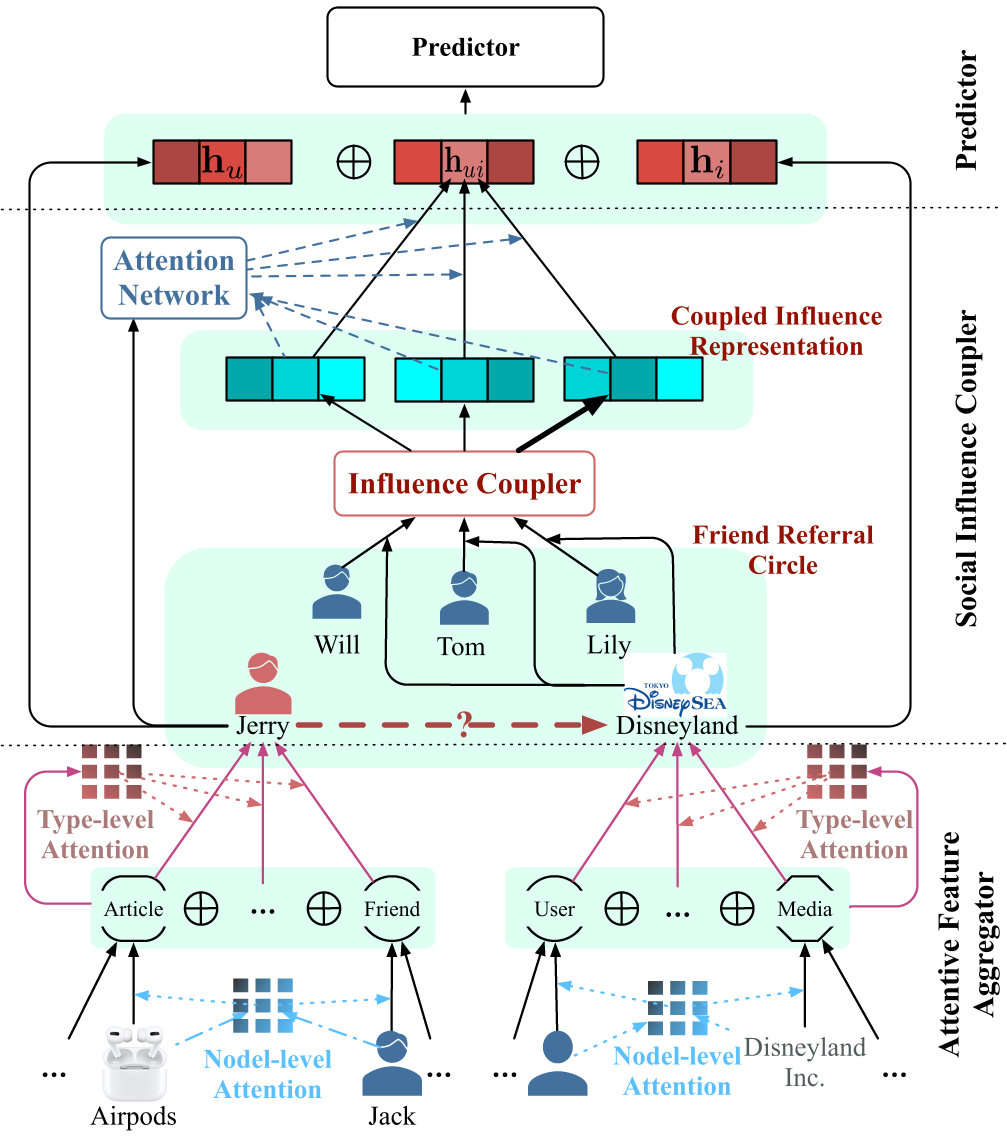
### 1. Hierarchical Attentive Feature Aggregator
To understand a user or an item, SIAN looks at its neighbors in a Heterogeneous Social Graph (HSG).
* **Node-Level Attention**: It assigns weights to individual neighbors (e.g., which specific articles a user liked are most representative of their current taste).
* **Type-Level Attention**: It weighs different *types* of info (e.g., is the "Friend" relationship more telling than the "Media" source?).
### 2. Social Influence Coupler
This is the "secret sauce." It doesn't just look at the friend; it looks at the **friend-item pair**.
* It creates a **Coupled Influence Representation** ($c_{\langle v,i \rangle}$) by fusing the friend's embedding with the item's embedding.
* It then calculates an **Attentive Influence Degree**, determining which friend in the referral circle actually triggered the user's attention.
## Experimental Insights: Does it Work?
The authors tested SIAN on Yelp, Douban, and a massive real-world dataset from WeChat (FWD).
| Dataset | Metric | SIAN (d=64) | Best Baseline |
| :--- | :--- | :--- | :--- |
| Yelp | AUC | **0.9571** | 0.8929 (DiffNet) |
| Douban | AUC | **0.9873** | 0.9634 (DiffNet) |
| FWD | AUC | **0.6928** | 0.6594 (DiffNet) |
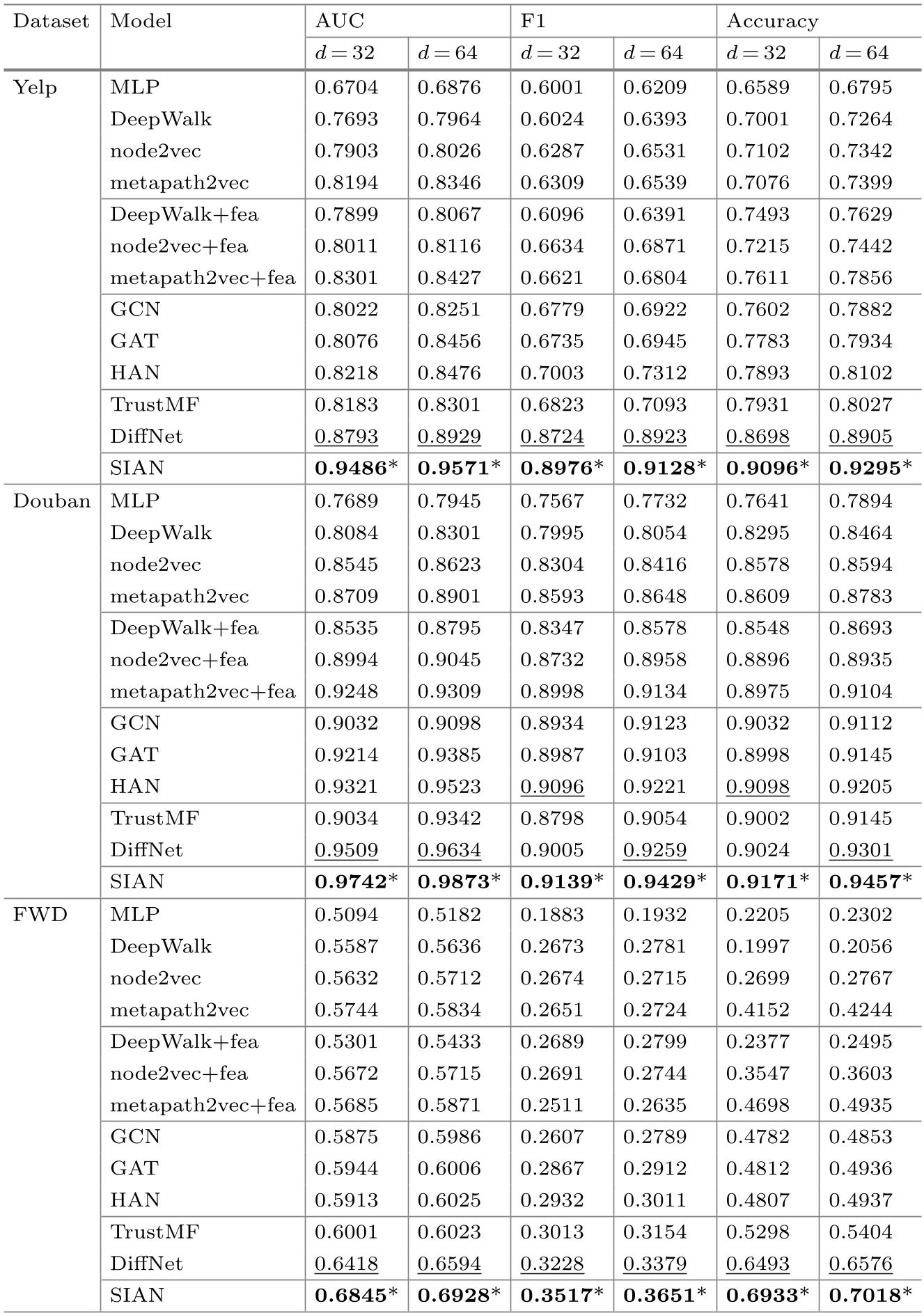
Beyond the raw numbers, the **Type-Level Attention analysis** revealed something startling: In FER scenarios, the model puts significantly more weight on "Friend" nodes than on the "Item" nodes themselves. This proves that in social-heavy environments, the messenger is often as important as the message.
## Sociological Discoveries: Who Influences You?
The paper provides a fascinating deep dive into social influence patterns:
* **Authority Wins**: Users are consistently more influenced by "High-Authority" friends, regardless of their own status. We tend to follow the "experts."
* **Similarity Matters**: For attributes like Gender, Age (Youth/Elderly), and Location, people are most influenced by those similar to themselves. This validates the "homophily" principle in a digital recommendation context.
## Critical Analysis & Conclusion
SIAN represents a significant step forward in making social recommendations interpretable. By explicitly modeling the FRC, it move's closer to "explaining" why a recommendation was made.
**Limitations**: The model assumes the FRC is known and fixed at the time of prediction. In a real-world cold-start scenario where no friends have yet interacted with a new item, the "coupling" benefit might diminish, potentially reverting the model to a standard HIN aggregator.
**The Takeaway**: For AI engineers, the lesson is clear: if your UI shows friend interactions, your backend model must treat those interactions as a "coupled" feature, not just another bit of metadata.