
Social Influencer Analysis: Beyond Citations with Factorization Machines
Social Influencer Analysis with Factorization Machines
This paper introduces a novel application of Factorization Machines (FM) to quantify latent social influence within collaboration networks, specifically focusing on academic co-authorship. By formulating reputation analysis as a Collaborative Filtering task, the method achieves state-of-the-art ranking performance on DBLP datasets compared to traditional citation-based metrics.
TL;DR
How do we measure an individual's true "reputation" when traditional metrics like citation counts only tell part of the story? This paper proposes using Factorization Machines (FM) to uncover latent social influence. By treating the collaboration network as a recommendation problem, the authors prove that an author's influence is often hidden in the patterns of their partnerships rather than just their raw output volume.
Motivation: The Blind Spots of Traditional Metrics
In the academic world, we usually rank "influencers" by three numbers:
- #Coauthors: Who do you know?
- #Papers: How much did you write?
- #Citations: How much did others quote you?
However, these are explicit metrics. They ignore the latent structure—the neighborhood effect where an author’s reputation is bolstered by the prestige and collaborative events of their community. Prior work often treated these as simple graph problems, failing to account for the content (text) of the work or the nuances of high-dimensional interactions.
Methodology: From Collaboration to Matrix Factorization
The core innovation lies in viewing "Influence" through the lens of Collaborative Filtering (CF).
1. The Influence Transformation
The authors define a function that converts a binary author-paper matrix into an "influence matrix."
- If author wrote paper , the value is 1.
- If author did not write it, but their co-author did, it is marked as a latent target (?).
- Otherwise, it is 0.
2. Factorization Machines (FM)
While standard Matrix Factorization might work, the authors chose Factorization Machines. Why? Because FMs allow for the inclusion of auxiliary information. In this case, the authors converted paper titles into a bag-of-words model, feeding textual features directly into the model to help the "latent factors" capture thematic influence.
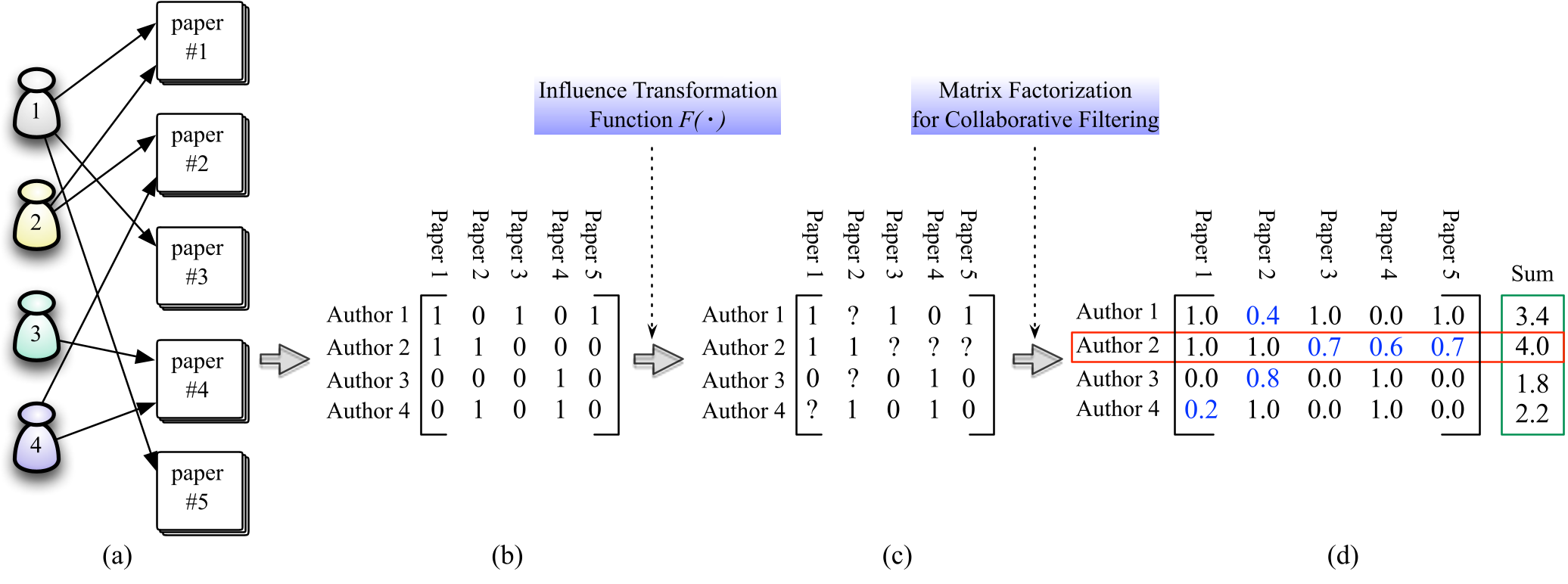 Figure 1: The process of transforming collaboration events into a matrix that FMs can use to predict influence scores.
Experiments & Key Findings
The study used a DBLP dataset centered on 20 top data mining researchers (ground truth from Microsoft Academic Search).
Identifying "Hidden" Influnecers
A startling result was the comparison of "Author 1" and "Author 2." Author 1 had more papers, but Author 2 had a higher latent influence score (4 vs 3.4). This suggests the model successfully captures quality and network position over sheer quantity.
Performance Gains
Incorporating text boosted the results significantly. The Kendall’s Tau metric (measuring rank correlation) jumped from 0.347 (citation baseline) to 0.409 (FM with text).
| Method | Spearman’s Rho | Kendall’s Tau |
|---|---|---|
| #Citation Baseline | 0.469 | 0.347 |
| FM (No Text) | 0.478 | 0.349 |
| FM (With Text) | 0.556 | 0.409 |
Critical Insight & Conclusion
This paper demonstrates that Factorization Machines are not just for suggesting movies or products; they are powerful tools for social topology. By modeling author reputation as a latent feature that interacts with paper content, we get a much more "honest" view of an individual's standing in a community.
Limitations: The dataset is relatively small (Data Mining community only). Future work needs to scale this to millions of nodes to see if the "neighborhood effect" holds across diverse academic disciplines.
Takeaway: If you want to find the true leaders of a field, don't just count their papers—look at the latent interactions within their collaborative ecosystem.