
The Price of Connection: A Three-Party Game Approach to IoT Privacy
Incorporating social interaction into three-party game towards privacy protection in IoT
This paper proposes a novel three-party game framework involving users, service providers, and adversaries to address privacy protection in the Internet of Things (IoT). By incorporating social interaction through an Agent-Based Model (ABM) and solving for the Nash Bargaining Solution, the research identifies optimal data trading strategies that balance service provider profit with user privacy concerns.
TL;DR
Is your social network a liability for your IoT privacy? This paper introduces a three-party game model involving Users, Service Providers, and Adversaries. By integrating Social Interaction (SI) and Nash Bargaining, the authors reveal how data trading between providers and hackers depends on the "social stickiness" of the platform and the sensitivity of the users.
Problem & Motivation: Beyond Two-Player Games
Most privacy research views the world as a duel: the User wants privacy, and the Provider/Attacker wants data. However, the modern IoT landscape—or the Social IoT (SIoT)—is far more complex.
- Interdependence: A user's decision to quit a service because of a privacy leak is influenced by whether their friends are staying.
- The Untrusted Middleman: Unlike traditional models, here the Service Provider isn't just a platform; they are a potential "seller" who might bargain with an adversary for extra profit.
The authors argue that ignoring these social tiers leads to a fundamental misunderstanding of how privacy leaks propagate and how the "market" for stolen data stays afloat.
Methodology: The Three-Party Game
The researchers split the interaction into two major components:
1. User Churn via Agent-Based Modeling (ABM)
Instead of assuming users are isolated agents, the authors use ABM to simulate a scale-free network.
- Utility Function: A user’s happiness depends on the number of friends () and the total network size (), versus the cost of privacy leakage ().
- Information Diffusion: When a leak occurs, the "news" spreads like a virus through a Weighted Cascade Model. If the resulting utility drops below zero, the user exits.
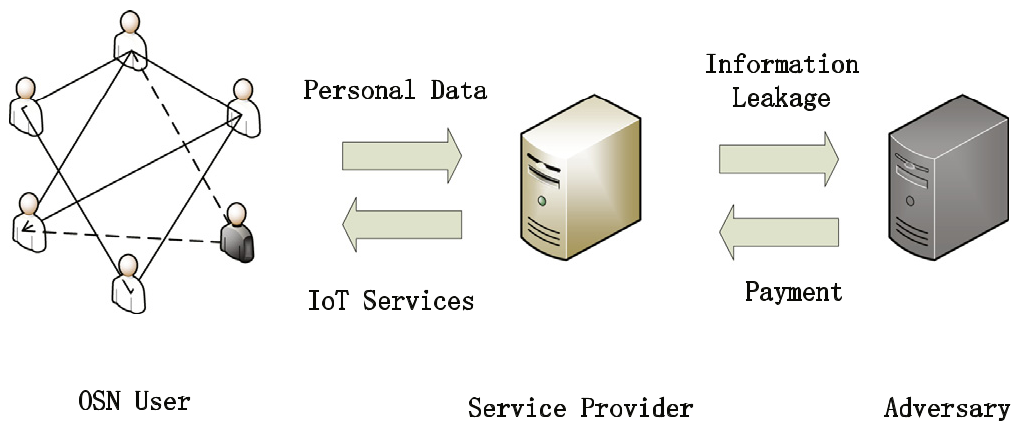 Figure 1: The interaction loop between IoT Users, the Service Provider, and the Adversary.
2. The Bargaining Room (Nash Equilibrium)
The "Bargaining" happens between the Service Provider (who owns the data) and the Adversary (who wants it).
- Scenario A (Negotiation): The adversary pays the provider for data at an accuracy level .
- Scenario B (Aggression): If bargaining fails and the cost of hacking is low, the adversary attacks the server directly.
The authors use Theorems 1 and 2 to solve for the Nash Bargaining Solution, optimizing the product of both parties' gains to find the most likely "deal" they would strike.
Experiments & Results: The "Panic" Threshold
The study conducted simulations with 3,000 nodes, testing different distributions of user privacy preferences (Beta, Gaussian, and Uniform).
Key Insights:
- Accuracy vs. Retention: As data accuracy () increases, the remaining user count () remains stable until a specific "breaking point," after which user churn accelerates exponentially.
- The Provider's Paradox: In some scenarios, if users are highly sensitive, the provider actually earns more profit by selling highly accurate data and accepting the massive loss of users, rather than trying to keep the users and selling low-quality data.
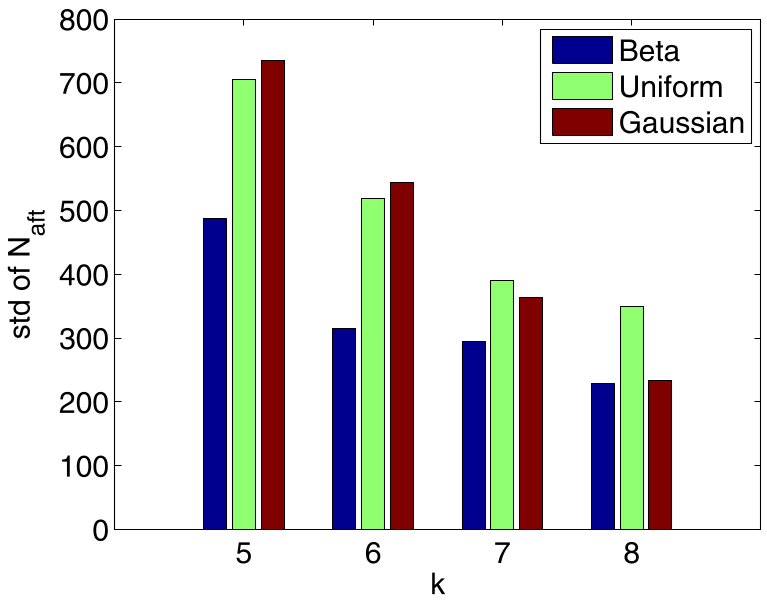 Figure 2: Impact of data accuracy () on user churn under different sensitivity levels ().
Critical Analysis & Conclusion
This work provides a sobering look at IoT economics. The "takeaway" is clear: privacy is a commodity.
Practical Implications:
- For Providers: Retention isn't always the most profitable route. If the adversary pays enough, "burning the platform" for a high-value data sale is a rational game-theoretic choice.
- For Policy: To protect users, we must either increase the adversary's attack cost (better security) or increase the provider’s value per user (better business models), making the "churn" too expensive to ignore.
Limitations:
The model assumes users eventually find out about the leak. In the real world, "silent leaks" exist where users continue to provide data because they are unaware of the breach. Incorporating "detection probability" into the game would be a valuable next step.
Conclusion: By the integration of social network theory into game-theoretic privacy modeling, this research provides a more realistic—and more cautious—framework for understanding why IoT privacy is so difficult to maintain in a connected world.