
Social-K: Solving Social Media Privacy with Circuit Logic
Social-K: Real-time K-anonymity guarantees for social network applications
This paper introduces Social-K, a novel real-time privacy framework that redefines K-anonymity specifically for Social Network APIs. Unlike traditional methods that perturb entire datasets, Social-K utilizes logic minimization algorithms (e.g., Quine-McCluskey) to ensure that any released profile data corresponds to at least distinct sets of individuals, essentially treating privacy as a Boolean satisfiability problem.
TL;DR
Social-K is a real-time framework that brings rigorous K-anonymity to social network APIs. Instead of blurring data (generalization) or fake data injection (perturbation), it uses Boolean logic minimization to ensure that released profile info matches at least distinct groups of users. For an average Facebook user, it provides these guarantees in about 1.3 seconds, proving that privacy doesn't have to break the API.
The Problem: Why Old K-Anonymity Fails OSNs
Historically, K-anonymity was designed for "dead" data—static files released for research. But today's data lives in the "live" ecosystem of Online Social Networks (OSNs) accessed via third-party APIs (Facebook, LinkedIn, etc.).
The authors identify three fatal flaws in applying old-school privacy to modern APIs:
- Dynamic Access: APIs serve tiny, specific slices of data, not whole tables.
- Identifier Uncertainty: In a social context, anything (a movie preference, a "Check-in," an interest) can be a quasi-identifier that reveals who you are.
- Accuracy Requirements: Applications like "SocialAwareFlicks" need exact data (e.g., the specific movie you like) to work; if you generalize "The Matrix" to "Sci-Fi Movie," the app's utility vanishes.
Methodology: Privacy as a Logic Gate
The core "Aha!" moment of Social-K is mapping the K-anonymity problem to Boolean Algebra.
1. The Directed Graph Approach
When an API query is made, Social-K builds a directed graph. Each column represents a data item requested, and nodes represent users who possess that attribute. Any path through this graph represents a "possibility" of who the data belongs to.
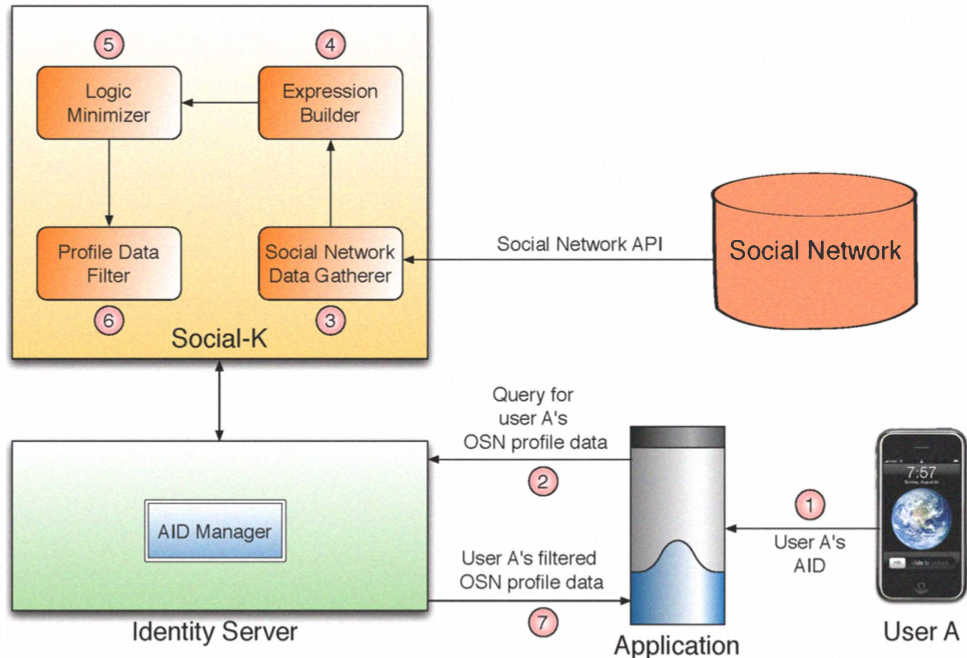 Figure 1: The Social-K pipeline from API query to filtered, anonymous response.
2. Logic Minimization
The resulting paths are turned into a Boolean expression (e.g., (Bill) OR (Joe AND Fred)). Using the Quine-McCluskey algorithm—a staple of computer chip design—Social-K simplifies this to the absolute minimum number of "Prime Implicants."
- If the number of simplified terms is , the data is safe to release.
- If not, the system uses Selective Withholding (dropping specific data points) until the threshold is met.
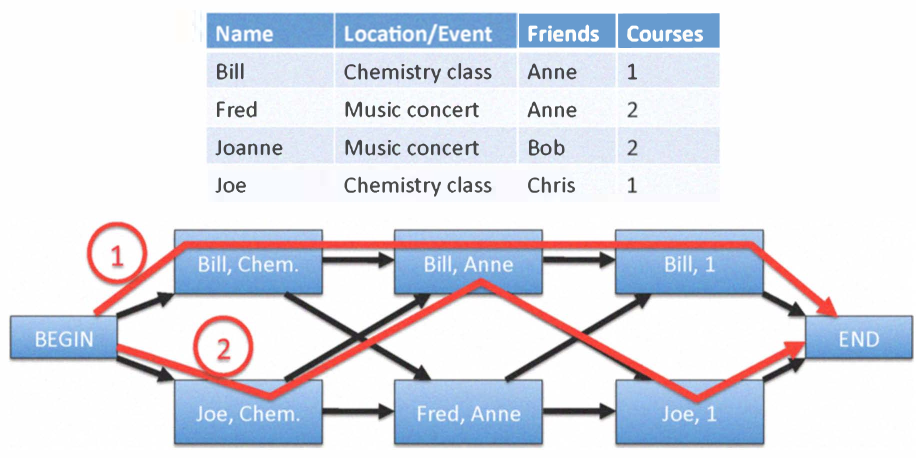 Figure 2: Turning a query for {Chemistry Class, Anne, 1} into a logic graph to find indistinguishable user sets.
Real-World Feasibility
The authors tested Social-K using real Facebook data. For a user with 222 friends, the system processed queries efficiently.
- Latency: Total time was ~1.37s. Interestingly, the bottleneck wasn't the complex math (Logic Minimizer), but the Social Network Data Gatherer (network latency from Facebook's servers).
- Scalability: The logic minimization time remains stable and fast (under 400ms) for expressions up to 450 terms, which covers most standard social profile queries.
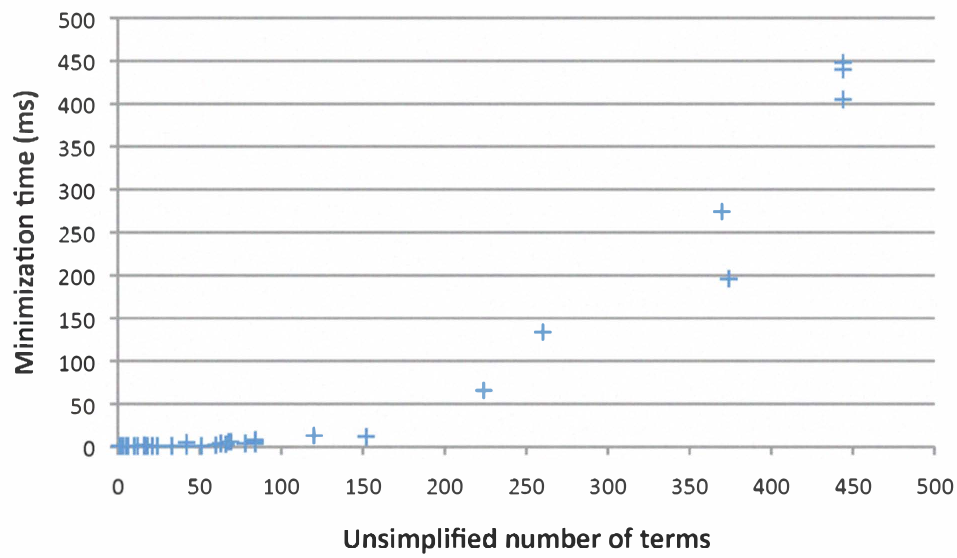 Figure 3: While input complexity (terms) increases, the logic minimization time scales efficiently for real-time use.
Critical Insights: Selective Withholding vs. Generalization
The traditional approach to privacy is "Generalization" (replacing "Spiderman" with "Action Movie"). Social-K argues this is often useless for modern apps. Instead, their Selective Withholding approach simply doesn't return "Spiderman" if it identifies the user too uniquely. This ensures that whatever data is received is 100% accurate, allowing the application to function correctly for the remaining attributes.
Limitations & Future Work
- Information Loss: Randomly withholding data might not be the most "optimal" way to maintain utility. Future work could involve more intelligent filtering.
- API Integration: Currently, this sits as a layer on top of Facebook. For maximum efficiency, this logic should be integrated directly into the social network's database engine.
Conclusion
Social-K proves that we don't need to choose between social connectivity and privacy. By reframing anonymity through the lens of circuit optimization, we can achieve mathematically provable privacy guarantees in the blink of an eye.