
The Wisdom of Crowds: Predicting Music Hits via Social Knowledge
Social Knowledge-Driven Music Hit Prediction
The paper introduces a social knowledge-driven framework for Music Hit Prediction, leveraging data from the Last.fm music social network rather than intrinsic audio features. By modeling the relationships between tracks, artists, albums, and user-generated tags, the authors achieve high-accuracy classification, significantly outperforming traditional audio-based "Hit Song Science" approaches.
TL;DR
Can we predict the next Billboard #1 hit before it even leaves the ground? While traditional "Hit Song Science" tries to find the magic formula in melodies and lyrics, this paper argues that music success is a social phenomenon, not a mathematical one. By analyzing just one week of data from Last.fm, the authors use social graph theory and "wisdom of the crowds" to predict chart-topping hits with over 80% accuracy—vastly outperforming models that only "listen" to the music.
The Motivation: Why "Hit Song Science" Fails
For years, the music industry has relied on analyzing low-level audio features: harmony, tempo, pitch, and rhythm. However, sociologists like Duncan Watts have long argued that success is often a result of preferential attachment—the "Rich-Get-Richer" effect. People don't just like music because it's "good"; they like it because other people like it.
The problem with prior work is that it treated songs as isolated objects. This paper shifts the paradigm by treating a song as a node in a massive social ecosystem of artists, albums, and user-generated tags.
Methodology: Mining the Social Graph
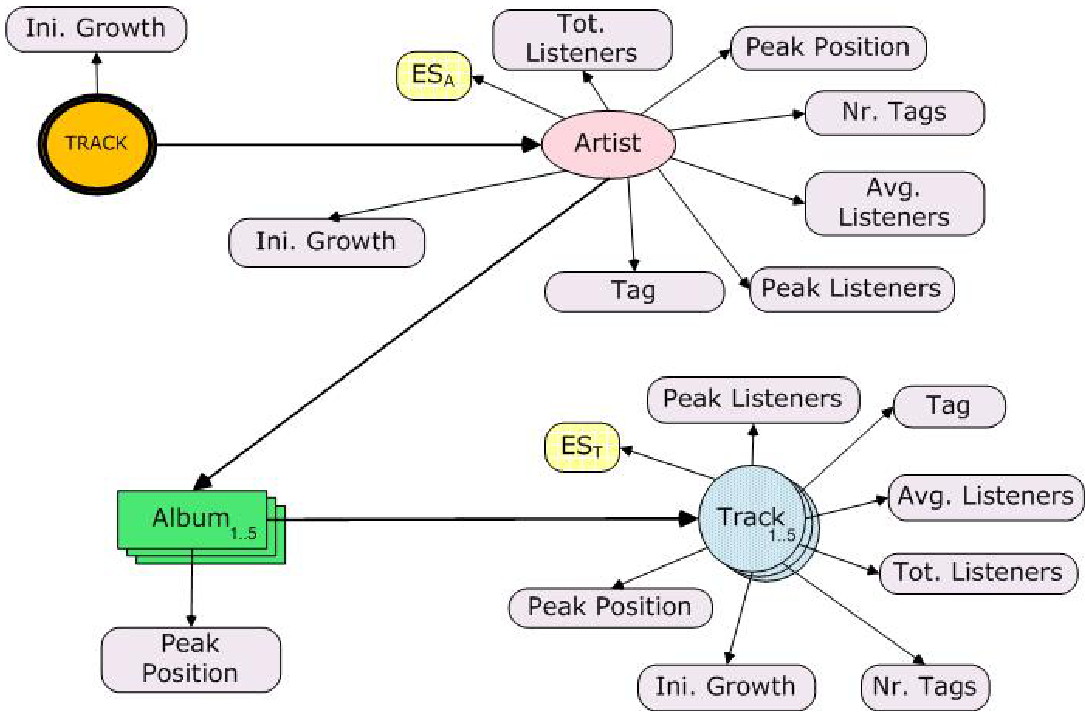
Instead of processing waveforms, the researchers built a "feature tree" (see below) centered on three entities: Artist, Track, and Album.
1. The Power of Tags and Graphs
A key innovation here is the use of the HITS algorithm (typically used for web page ranking). They created a tripartite graph where:
- Artists are linked to Tracks.
- Tracks are linked to Tags (e.g., "indie," "melancholic").
- Artists are linked to Tags.
By calculating Hub and Authority scores within this graph, they derived an Entity Score (ES). This score essentially measures a track's "social authority"—how well it resonates within the specialized niches of the music community.
2. Feature Architecture
The model relies heavily on "Initial Growth" (the number of listeners in the first week) and the historical performance of the artist.
Experiments and Results
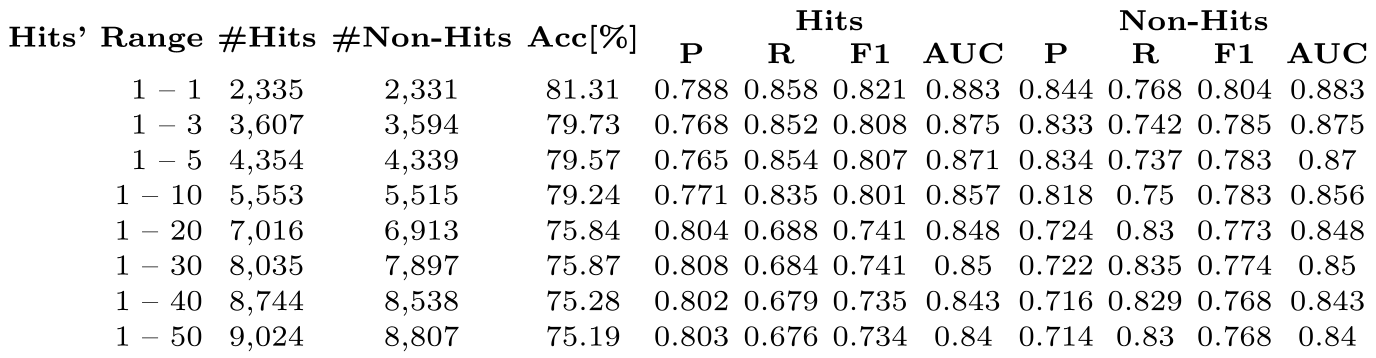
The researchers compared their social-driven model against the Billboard Charts (the ultimate ground truth). They trained several classifiers, including Bayesian Networks and SVMs, across different "Hit Ranges" (e.g., Top-1, Top-10, Top-50).
Key Findings:
- Top-1 Prediction: The model achieved an AUC of 0.883, which is functionally considered "good to excellent" accuracy.
- Social vs. Audio: Compared to early audio-based models (like those by Dhanaraj & Logan), this social approach delivered a 28% improvement in AUC.
- Threshold Testing: When tested against songs that peaked at Rank 7, the model correctly assigned them to the "Top-10" class while excluding them from the "Top-1" and "Top-5" classes, demonstrating high granularity.
Deep Insight: Success is Predictable, But Social
The most valuable feature in their model wasn't the genre or the mood—it was the Entity Score. This confirms the "Rich-Get-Richer" hypothesis. If an artist is already embedded in a high-quality social network of tags and listeners, their new release has a massive structural advantage.
The social annotations provided by Last.fm serve as a "semantic space" that captures what audio analysis misses: context. A song becomes a hit not just because of its beat, but because it fulfills a specific social need or trend identified by the "early-arriving individuals" in a social network.
Conclusion and Future Outlook
This paper proves that the "missing link" in music prediction was the user. While the study effectively used Last.fm data, the authors acknowledge that marketing spend and blog buzz are the next frontiers.
For the modern industry, the message is clear: Stop looking for the "perfect chord" and start looking at the "perfect network." As we move into an era of AI-generated music, the social context—who is listening and how they are tagging—will remain the ultimate arbiter of what becomes a hit.
Limitations
- Platform Dependency: The model relies on Last.fm, which may have a specific user bias (e.g., more "power users" than casual listeners).
- The "Cold Start": While it only needs one week of data, it still cannot predict a hit before it is uploaded to a social platform.
Future Work
The authors suggest a hybrid approach: combining these social metrics with Deep Learning audio analysis and natural language processing of music blogs to create a truly holistic hit prediction engine.