
Mapping the Collaborative DNA: Social Network Analysis of Wiki Interactions in E-Learning
Analysis of Social Learning Network for Wiki in Moodle E-Learning
This paper presents a Social Network Analysis (SNA) of collaborative interactions within the Wiki module of a Moodle E-Learning system. By modeling log activities (creating, editing, and updating) as a directed graph, the study identifies hidden behavioral patterns and participation levels among students and instructors.
TL;DR
This research dives into the "hidden" social interactions occurring within Moodle Wikis. Unlike forums where conversations are explicit, Wiki collaboration is often rhythmic and structural. Using Social Network Analysis (SNA), the study maps how students and instructors at Universiti Teknologi Malaysia (UTM) edit, update, and build upon each other's work, identifying key contributors and the chronological influence of early participants.
Background Positioning
In the academic landscape of E-learning research, significant attention has been paid to forums and chat logs. This paper shifts the focus to collaborative co-creation, positioning Wiki activity as a high-potential but under-explored data source for understanding student interaction patterns.
Problem & Motivation: The Silent Collaboration
Why is analyzing a Wiki harder than a forum? In a forum, a "reply" is a clear social link. In a Wiki, if Student B edits a paragraph originally written by Student A, the social "link" is implicit.
The researchers highlight a gap in current Learning Management System (LMS) analytics: while we can track who logged in, we often fail to see the topology of collaboration. They aim to uncover the underlying behavior of users within the E-Learning@UTM system to see if participation follows a decentralized community model or a top-down instruction model.
Methodology: From Logs to Adjacency Matrices
The core methodology involves transforming raw Moodle activity logs into graph-based representations.
1. Data Transformation
Log data involving updating, editing, and creating were captured over three months. These activities were converted into an Adjacency Matrix—a mathematical representation where rows and columns represent users, and the cell values indicate the frequency of interaction.
2. The Logic of the Edge
The researchers established a chronological dependency:
- The first user is referred to by the second.
- The third user refers to both the first and second.
- This creates a directed network representing the flow of information and revision.
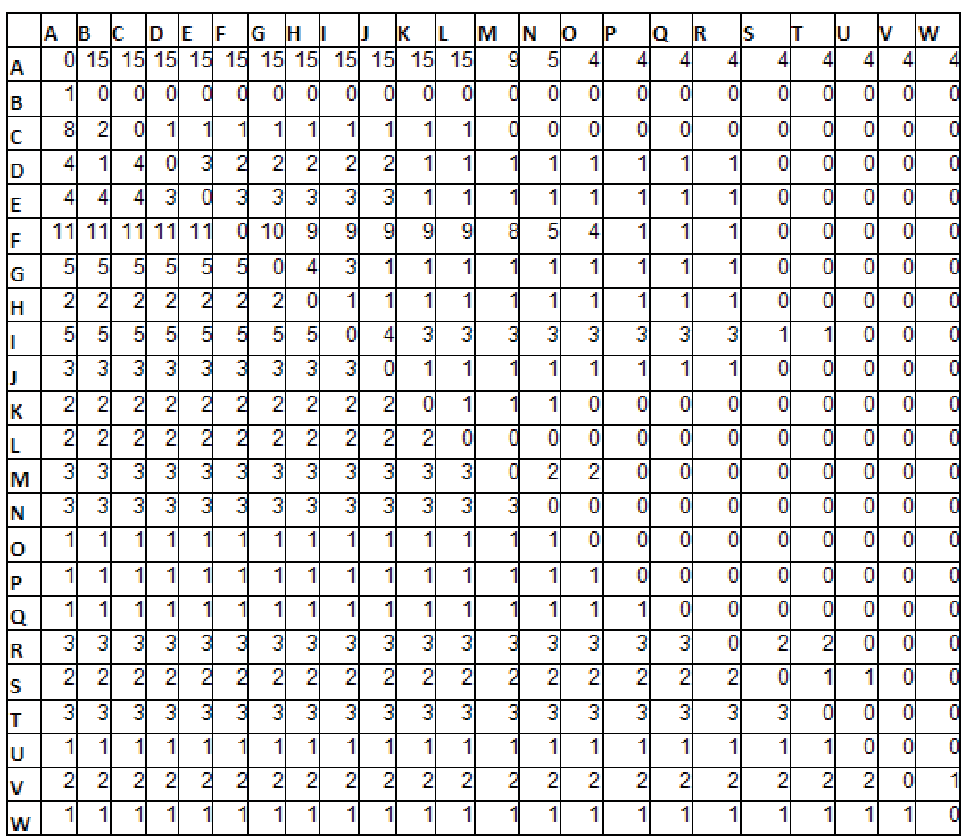 Table: The Adjacency Matrix used to quantify interactions between the Lecturer and 21 students.
Experiments & Results: Hubs and Authorities
By applying Degree Centrality measures, the study identified specific roles within the network:
- The Authority (Highest Out-degree): The Lecturer (User A) demonstrated an Out-degree of 215.0. This indicates that the instructor was the primary engine of the Wiki, constantly adding, modifying, and guiding the content.
- The Foundation (Highest In-degree): Student 2 (User C) reached an In-degree of 74.0. In this network model, a high In-degree suggests that this student’s contributions were the "base" upon which many others built their edits.
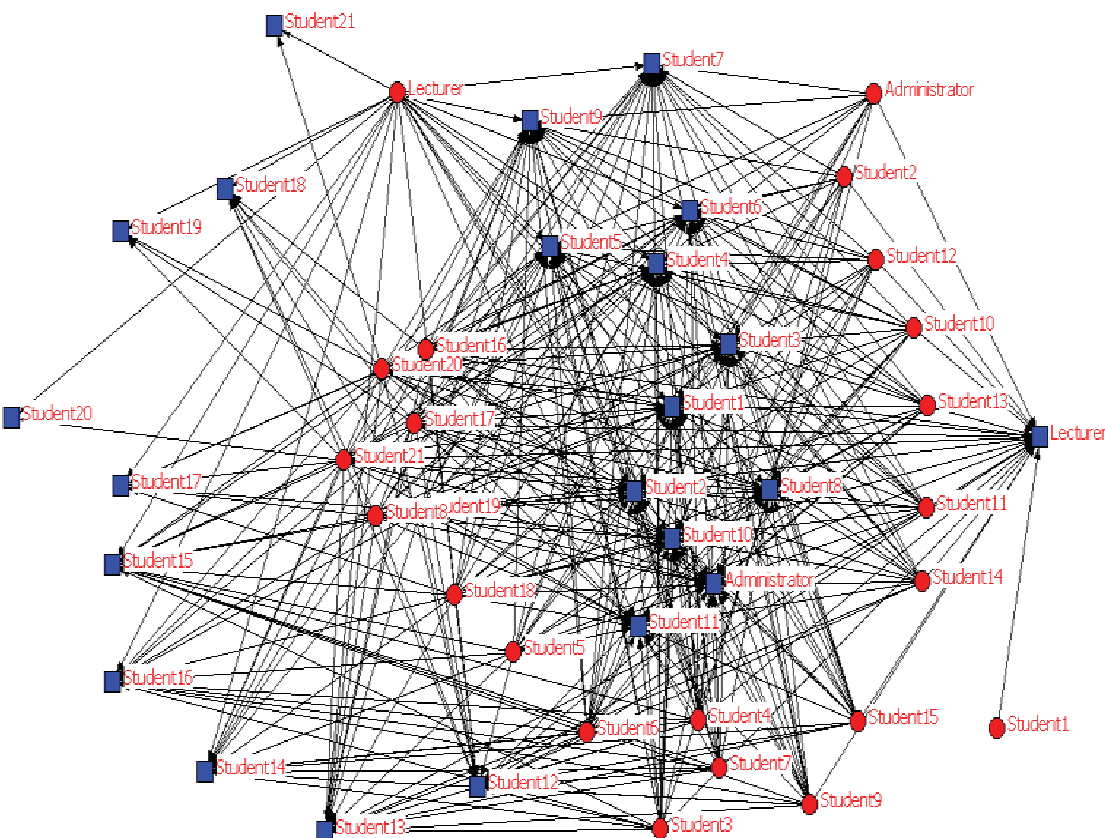 Fig: Graph representation of the Wiki social network using a 2-mode network visualization.
Statistical Insights
The variance in Out-degree (1973.13) was significantly higher than In-degree (586.43). This suggests that while everyone "received" information (built on top of older content) relatively consistently, the actual effort to contribute (Out-degree) was highly skewed toward a few hyper-active users.
Critical Analysis & Conclusion
The research provides a solid baseline for moving E-learning analytics from "activity tracking" to "social mapping."
Key Takeaways:
- SNA is viable for Wikis: It successfully identifies the most influential "authors" in a collaborative environment.
- Temporal Bias: The study admits a limitation—users who edit early in the semester naturally accumulate higher In-degrees because there are more subsequent users to "refer" to their work.
Future Outlook: To truly understand , the authors suggest that the next step is Content Analysis. It isn't enough to know that a student edited a page; we need to know what they added. Was it a substantive paragraph or just a typo fix? Combining SNA with Natural Language Processing (NLP) will be the future "gold standard" for evaluating online education.