
Crowdsourcing Connectivity: Enhancing Wireless Management through Social Networks
Social and location-based collaboration mechanism to manage wireless connectivity context data
This paper introduces a social and location-based mechanism for managing wireless connectivity by sharing "connectivity experiences" within online social networks. By mashing up network QoS data (throughput, latency, signal) with location-based social media, the system builds a collaborative connectivity graph to optimize handover decisions and network discovery.
TL;DR
In an era of ubiquitous mobile computing, managing wireless connectivity remains a challenge due to the dynamic nature of environments. This paper proposes a collaborative mechanism that treats "connectivity experiences" as social media. By sharing network performance data within social circles, users can achieve a 30% boost in signal quality and a 75% reduction in power consumption through intelligent, community-aware scanning.
Background: The Limits of Individual Intelligence
Most modern smartphones follow a simple rule: connect to the strongest signal available. While robust, this approach is "reactive" and "short-sighted." It doesn't know that around the next corner, the current signal will drop to zero while a much better Access Point (AP) is hidden behind a wall.
Existing solutions like BreadCrumbs use Markov models to predict movement, but these take weeks of individual data to become accurate. Public databases (wardriving) exist, but they suffer from the "updatability problem"—the environment changes faster than the database can be refreshed. This paper asks: What if our friends' recent experiences could guide our devices?
Methodology: Mining the Connectivity Graph
The core innovation is the transformation of raw Wi-Fi logs into a Connectivity Graph ().
1. From Paths to Graphs
Every user generates a Gpath—a directed graph where vertices are handover points and edges are the APs used. When multiple users in a social circle share their paths, the system merges them into a collective .
2. Complex Network Metrics
The authors apply graph theory to distill intelligence from the noise:
- Handover Areas: Identified by "vertex strength" (—the sum of weights of all edges connected to a point). High strength indicates a critical transition zone where the system should prepare for a switch.
- User Reputation: Calculated via "centrality degree." Essentially, if a friend’s device frequently shares high-quality AP data that matches the group’s reality, their data receives higher weight.
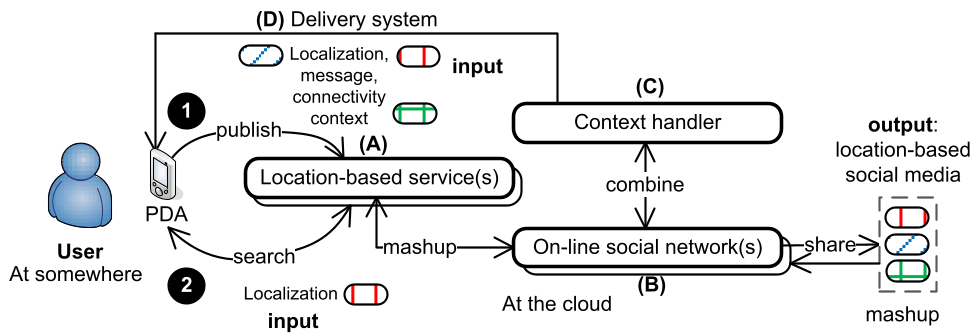 Figure: The interaction between location-based social media and the context manager.
Experiments: Real-World Gains
The authors tested the system in a 1,600m² university building over four months.
QoS Improvement
The collaboration didn't just provide a small boost; it showed a clear incremental learning curve. By the third month, the Social-based mechanism outperformed the standard Android/Windows selection by 30%.
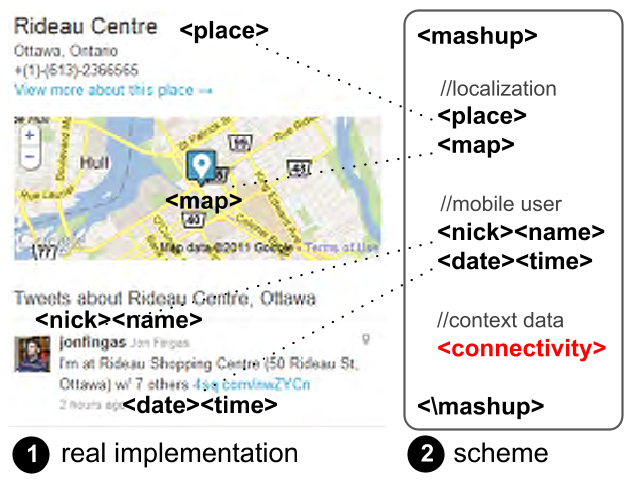 Figure: The Social-based approach (top line) consistently provides better signal quality compared to OS-default and basic predictors.
Efficiency: Saving Battery and Storage
Continuous scanning for Wi-Fi networks is a major battery drain. By using the graph to perform Pre-emptive Scanning—only looking for networks when the device knows it is approaching a known handover vertex—the system saved 75% in storage and significant power.
| Policy | Scan Interval (s) | Storage Size (Kbytes) |
|---|---|---|
| Continuous (>80%) | 15 | 8.44 |
| Pre-emptive (>80%) | 15 | 6.19 |
| Pre-emptive 80% | 250 | 2.81 |
Critical Insight: The "Social" Advantage
The brilliance of this work lies in using Online Social Networks (OSNs) as a filter for trust and relevance. Unlike a global public database, a social circle shares similar mobility patterns (e.g., colleagues at a university, friends at a mall). This "Social Inductive Bias" ensures that the context data shared is highly likely to be useful to the recipient, all while solving the update frequency problem through organic user activity.
Conclusion & Future Outlook
The paper successfully proves that wireless connectivity is not just a hardware problem, but a social coordination problem. By mashing up QoS data with location-based social media, we move from "isolated devices" to a "collaborative network."
As we move toward Vehicular Networks (V2X), the principles outlined here—using graph-based reputation and handover density—will likely become critical for maintaining high-speed links in dense urban canyons.
Limitations: The study notes that performance depends heavily on "collaboration intensity." If no one in your circle has visited a location recently, the system reverts to a standard predictor. Future research must address how to incentivize "exploration" in data-sparse areas.