
Facebook Ads: The New Frontier for Academic and Professional Promotion
Using Social Media Advertising to Increase the Awareness, Promotion and Diffusion of Public and Private Entities
This paper evaluates the effectiveness of Facebook advertising for public and private educational institutions. Using two case studies in Spain, it demonstrates how horizontal social networks serve as a cost-effective broadcasting tool for promoting intangible services like training courses and research seminars.
TL;DR
This study investigates the tangible impact of Facebook advertising for educational sectors, revealing that even with minimal budgets, public and private entities can achieve massive reach and engagement. By analyzing granular KPIs from two Spanish case studies, the authors prove that social networks outperform traditional media in cost-efficiency and audience segmentation for "intangible" services.
Background: Beyond the "Post and Pray" Strategy
In the digital age, simply having a social media profile is insufficient. The advertising landscape has shifted from total advertiser control to a shared ecosystem where "Word-of-Mouth" is digitized. This paper argues that for SMEs and research institutes, paid social media advertising is the only way to break through the noise of the "Millennial" generation's feed.
The Core Insight: Why Social Ads Work for Education
The authors base their strategy on the Uses and Gratifications Theory, suggesting that users engage with media to satisfy specific needs. Educational entities don't just sell a product; they provide "social capital." The logic is simple:
- Social Pressure: If a user "Likes" a course, their peers view it as a trusted recommendation.
- Algorithmic Advantage: High engagement improves the "Edgerank" score, lowering the cost of future impressions.
- Micro-Segmentation: Unlike TV or print, Facebook allows targeting specific cohorts (e.g., prospective students in Salamanca), reducing wasted spend.
Methodology and Performance Metrics
The study analyzed two distinct cases: a private training company and a university research group. Their performance was tracked across several Key Performance Indicators (KPIs).
Case Comparison Data
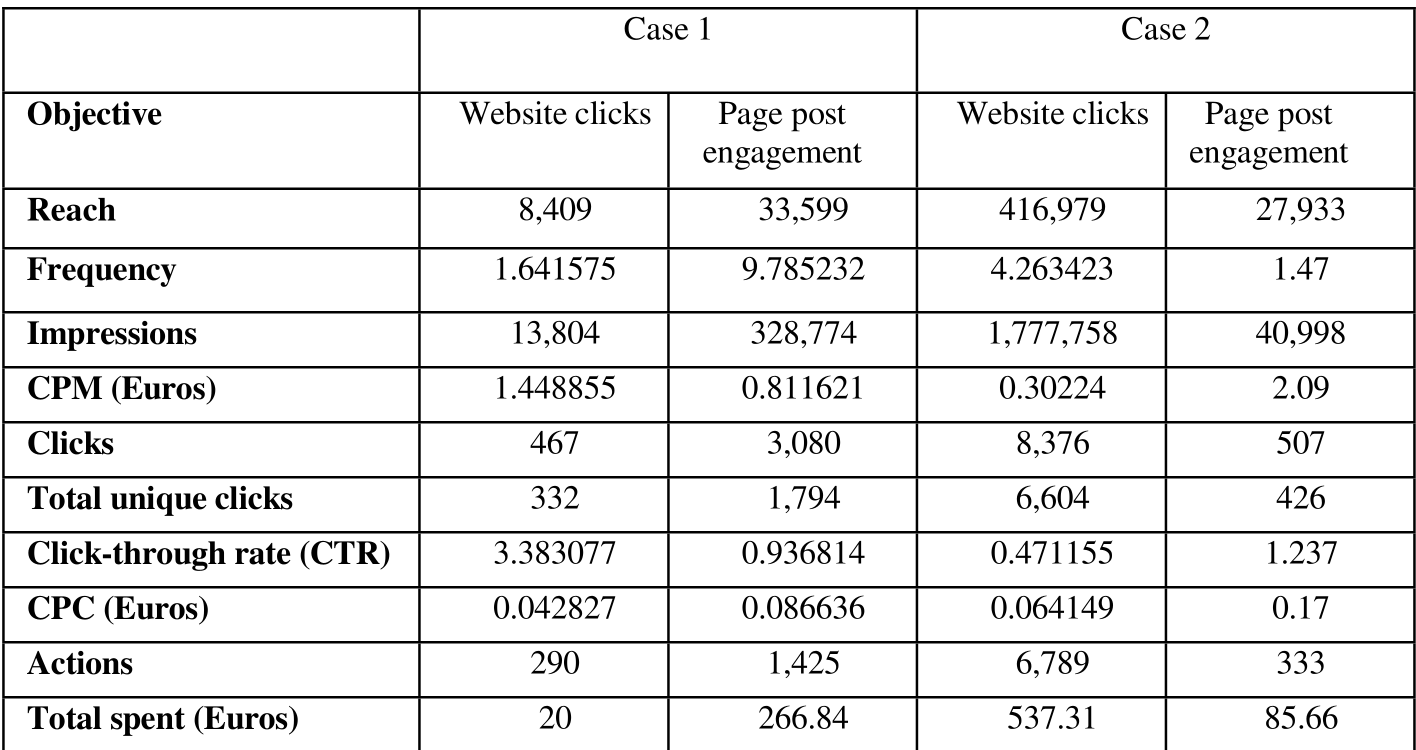
The table highlights a fascinating divergence:
- Case 1 (Private): Achieved a much higher CTR (3.38%) for website clicks on a small budget, suggesting highly relevant content for a niche audience.
- Case 2 (Public): Generated a massive Reach (416,979) and Impressions (1.7M), demonstrating how broad-scale awareness can be bought at a very low CPM (€0.30).
Critical Analysis: Why the Difference?
A key takeaway from the results is the importance of the Landing Page.
- Case 2 saw high actions because their website offered deep, valuable information once the user clicked.
- Case 1 struggled with lower "actions" despite high engagement, which the authors attribute to a landing page with "low information content."
This reflects an essential law of digital marketing: Advertising gets them to the door; content makes them stay.
Conclusion: A Roadmap for Institutional Growth
The study concludes that horizontal social networks (Facebook, Twitter, LinkedIn) are ideal for educational promotion because they are:
- Measurable: Every Euro spent is tracked via clicks and actions.
- Cost-Effective: CPCs were significantly lower than platforms like Google AdWords.
- Community-Driven: They facilitate co-creation and feedback, allowing institutions to monitor their digital reputation in real-time.
Limitations: The study is localized to Spain and focuses on 2013-2014 data. However, the fundamental principles of engagement-driven reach and segmentation-based cost-control remain the bedrock of modern social media strategy.
Future Outlook: For today’s technical and academic institutions, the challenge lies in moving from "text and image" ads to immersive video and "short-form" storytelling to capture the shrinking attention spans of the next generation of students.