
SocIoS: Architecting a Unified Semantic Bridge for the Fragmented Social Web
SocIoS: A Social Media Application Ontology
The paper introduces SocIoS, a common application ontology designed to unify the heterogeneous data models of various Social Networking Sites (SNS). By mapping diverse APIs (like Facebook, Twitter, and YouTube) into a singular semantic framework, it enables the development of cross-platform social applications through a unified "SocIoS API."
TL;DR
The social web is becoming increasingly "closed," with user data trapped in proprietary silos like Facebook, Twitter (X), and YouTube. SocIoS is a specialized application ontology that breaks these walls by providing a unified metadata schema. It maps diverse API objects into a single reference model, allowing developers to build cross-platform applications without writing unique code for every platform.
Background: The Cost of the "Closed Web"
While social media has revolutionized information sharing, it has created a fragmented digital landscape. From a developer's perspective, a "follower" on one platform is a "friend" on another, and a "photo" here is a "media item" there. This conceptual overlap, paired with technical divergence, makes building applications that aggregate social data incredibly expensive and complex.
The authors argue that the solution isn't just more APIs, but a semantic bridge—a flexible ontology that translates these disparate data models into a common language.
Problem & Motivation: Beyond FOAF and SIOC
Why not use existing standards like FOAF (Friend of a Friend) or SIOC (Semantically-Interlinked Online Communities)?
The authors identify a critical gap:
- FOAF is designed for abstract, often intangible relationships between people.
- SIOC focuses heavily on forum-based communities and lacks the broader SNS context.
- Neither is designed to serve as a technical wrapper for competitive, high-traffic APIs.
The motivation for SocIoS was to create a "tangible" ontology—one that mirrors the actual objects returned by web APIs while retaining the flexibility of the Semantic Web.
Methodology: Mapping the Social Universe
The team followed a two-step "Top-Down and Bottom-Up" approach:
- Top-Down (Requirements): They analyzed real-world scenarios in journalism and TV production (e.g., location scouting via social media) to determine what data users actually need.
- Bottom-Up (API Analysis): They conducted a deep dive into the APIs of OpenSocial, Facebook, Twitter, Flickr, and YouTube to identify semantic equivalents.
The SocIoS Core Architecture
At the heart of the resulting ontology are two central pillars: Person and MediaItem. Everything else revolves around these two entities.
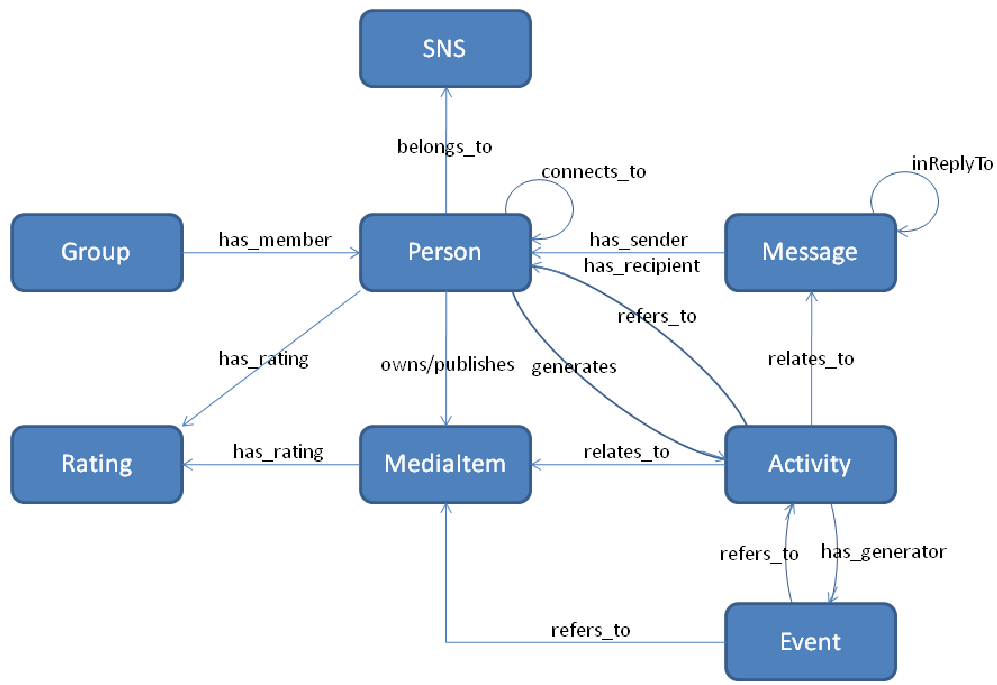
Fig 1: The simplified SocIoS ontology showing the interplay between Persons, MediaItems, and the SNS containers they inhabit.
Experiments & Semantic Alignment
The paper provides a comprehensive mapping table showing the lack of uniformity across major platforms. For instance, while "Location" is a first-class object in Twitter and Flickr, it is merely a property of a Person or Photo in Facebook and OpenSocial.
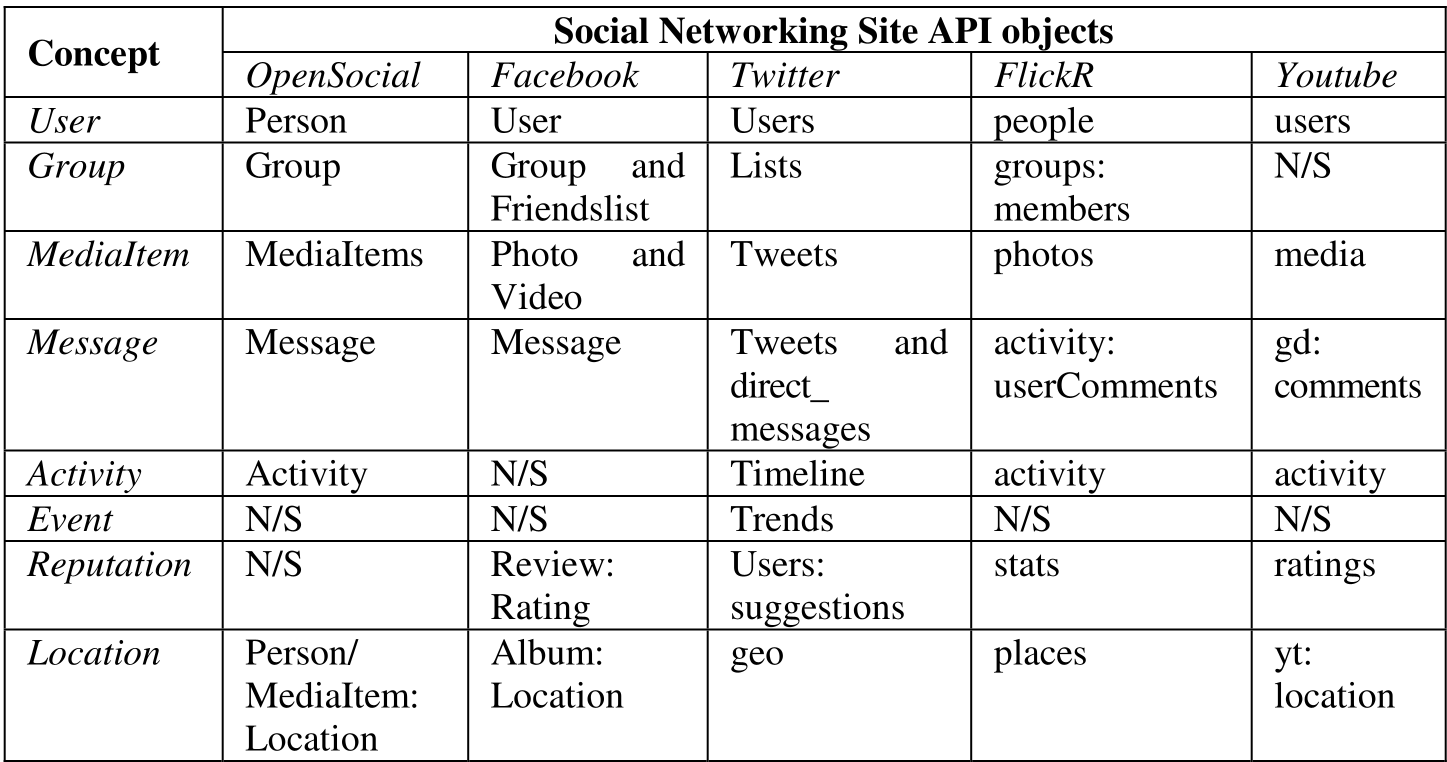
Table 1: Semantic equivalence mapping across major SNS APIs.
To ensure the ontology wasn't just another isolated standard, the authors linked SocIoS classes to existing Semantic Web entities:
- SocIoS:Person is a sub-class of
foaf:Person. - SocIoS:Message aligns with
sioc:Post. - SocIoS:Event maps to
LODE:Event.
Critical Insight: The "Adaptor" Strategy
The true power of this ontology lies in its role as a specification for SocIoS Adaptors. Instead of a developer learning five different authentication and data formats, they interact with the SocIoS API. The ontology acts as the internal logic for software wrappers that translate "Generic SocIoS User" into "Facebook User Instance" or "Twitter User Instance" dynamically.
Conclusion & Future Outlook
SocIoS demonstrates that semantic technologies can solve more than just data theory; they can solve interoperability. By creating a common denominator for social interactions, the project enables more creative "mix-and-match" application workflows.
Limitations: The paper acknowledges its dependence on third-party API stability. If a platform significantly changes its data hierarchy, the corresponding "adaptor" must be updated.
Future Work: As the social web moves toward decentralized protocols (like ActivityPub or AT Protocol), the SocIoS ontology offers a legacy-compatible framework to bridge the gap between "Old Social" (centralized) and "New Social" (decentralized) worlds.