
Example Overflow: Harnessing Social Media for Intelligent Code Recommendation
Example Overflow: Using social media for code recommendation
Example Overflow is a specialized code search and recommendation tool that bridges social media and software development by indexing Stack Overflow's Q&A data. It specifically extracts code snippets from "accepted answers" to provide high-quality, crowdsourced, and context-aware code examples through a unified web interface.
TL;DR
Example Overflow is a research prototype that transforms Stack Overflow's massive knowledge base into a streamlined code recommendation engine. By extracting snippets from accepted answers and using a weighted social-metadata search, it allows developers to find and compare high-quality code examples with zero context switching (0 average mouse clicks), significantly outperforming traditional repositories like Krugle or Koders.
The Problem: The High Cost of "Found" Code
Modern developers spend a significant portion of their time searching for "how-to" examples. However, existing solutions reside at two inefficient extremes:
- Traditional Code Search (Koders, Krugle): These index massive open-source repositories but lack quality filters. They often return a 1,000-line file when you only need a 5-line jQuery hover effect, forcing you to hunt through the file.
- Q&A Sites (Stack Overflow): While they offer high-quality, human-vetted answers, the code is "trapped" within discussions. Finding the best snippet involves clicking through multiple threads and scrolling past natural language blocks.
The core challenge is the context switch. Every click and new browser tab degrades the developer's "flow" and increases cognitive load.
Methodology: Socially-Aware Code Indexing
The authors built Example Overflow to treat code snippets as first-class citizens enriched by social metadata.
1. The Repository Pipeline
The system uses the Stack Overflow API to target specific domains (starting with jQuery). It follows a conservative quality heuristic: only extract snippets from "Accepted Answers." This ensures the code has been verified by the original asker as a working solution.
2. The Weighted Search Formula
Unlike simple keyword search, Example Overflow uses an Apache Lucene-based weighted formula to calculate the relevance score ():

By assigning higher weights (W) to segments like the Title and Tags () vs. the Question body (), the tool ensures that the intent of the question heavily influences the relevance of the code snippet.
3. The "Zero-Click" Interface
The UI is designed for comparison. Instead of a list of blue links, it renders the actual code of the top 5 results immediately.
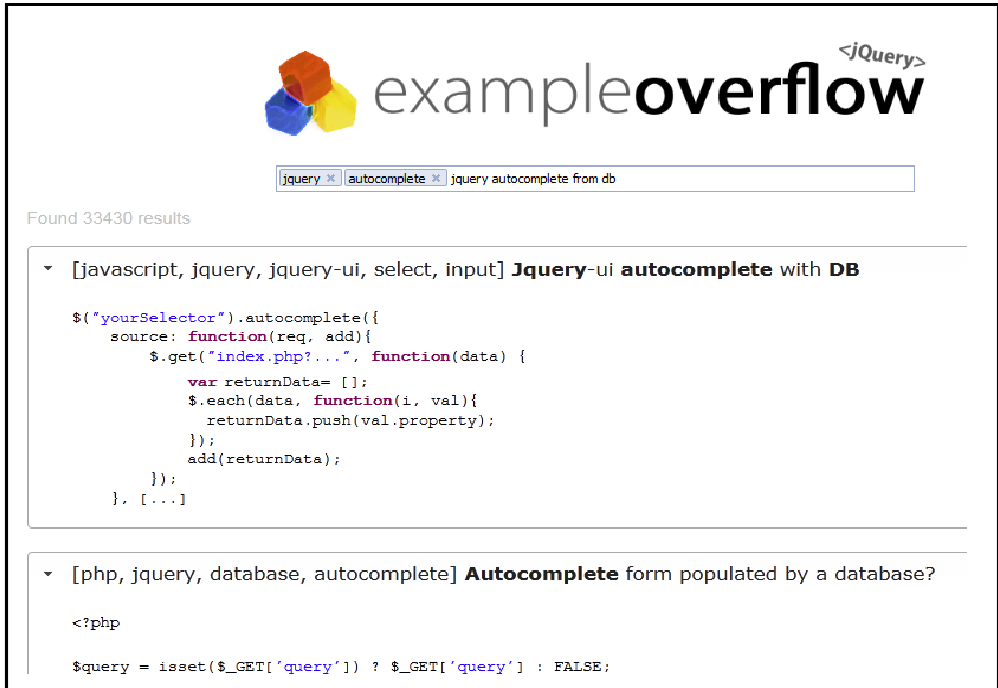
Performance: Better Results with Less Effort
The authors benchmarked the tool against 10 common jQuery tasks (e.g., "dynamic dimension," "autocomplete from db").
| Metric | Example Overflow | Google Search | Stack Overflow | Krugle |
|---|---|---|---|---|
| Avg. Result Rank | 1.6 | 1.7 | 3.8 | 19.1 |
| Avg. Mouse Clicks | 0 | 2.6 | 3.0 | 3.0 |
The data proves a dual victory: not only are the results more relevant (Rank 1.6), but the interaction cost is virtually eliminated. While Google might find a good result, it usually requires at least one click to view the content; Example Overflow presents it upfront.
Critical Analysis: A Double-Edged Sword
As a senior editor, I find the "Example Embedding" concept intriguing but risky. The authors admit that this paradigm can lead to "Frankenstein Code"—software comprised of disparate snippets that may not be properly tested or architecturally aligned.
Furthermore, while the 2012-era jQuery focus was a perfect sandbox, modern development faces much larger complexities (e.g., React hooks, state management) where a single snippet rarely tells the whole story. The "accepted answer" heuristic is a strong signal, but it doesn't account for "code rot" where an answer from 2014 might no longer follow modern best practices.
Summary & Future Outlook
Example Overflow successfully demonstrates that Context is King. By leveraging human curation (Stack Overflow's "Accepted" status) and a comparison-first UI, it solves the mechanical friction of code reuse.
The next frontier for this research involves IDE integration (e.g., a VS Code extension) and the use of LLMs to not just find, but adapt these crowdsourced snippets to the developer's local variable names and architectural patterns.
Reference: Zagalsky, A., Barzilay, O., & Yehudai, A. (2012). Example Overflow: Using Social Media for Code Recommendation.