
Unified Social Intelligence: Bridging Facebook and Twitter into a Strategic Data Warehouse
Data warehouse design from social media for opinion analysis: The case of Facebook and Twitter
This paper proposes a systematic six-step approach for constructing a social media-based data warehouse aimed at product opinion analysis. By integrating multi-source data from Facebook and Twitter through a novel mapping and multidimensional modeling process, the authors achieve a unified conceptual schema for Business Intelligence.
TL;DR
In the era of Web 2.0, customer feedback is scattered across a fragmented landscape of social platforms. This paper presents a rigorous methodology to extract, clean, and map data from Facebook and Twitter into a single Multidimensional Data Warehouse. By neutralizing platform-specific terminology (e.g., Retweets vs. Shares), the authors enable companies to perform holistic Opinion Analysis and product success prediction using an integrated BI approach.
The "Silo" Problem in Social Analytics
Most companies treat Facebook and Twitter as isolated silos. A "Like" on one and a "Favorite" on the other are technically different but semantically identical. Traditional Business Intelligence (BI) tools struggle with this Structural Heterogeneity. The authors argue that without a unified conceptual model, decision-makers are blind to the "big picture" of their brand's social health.
Methodology: From Raw JSON to Multidimensional Insight
The core innovation lies in the transition from semi-structured data to a structured analytical cube. The process follows a strict 6-step pipeline:
- Extraction: Leveraging Graph and Twitter APIs.
- Cleaning: Removing inconsistencies and duplicates.
- Mapping: The "Rosetta Stone" step—converting different platform schemas into a shared language.
- Schema Definition: Identifying Facts (the "verbs" of social media, like posting) and Dimensions (the "nouns," like User and Location).
- Loading: Transforming data for the DW.
- Reporting: Using MDX queries for high-level analysis.
Architectural Blueprint
The authors utilize a sophisticated mapping logic to ensure that complementary data (e.g., "Location" from Twitter and "Category" from Facebook) enrich the user profile rather than complicating it.
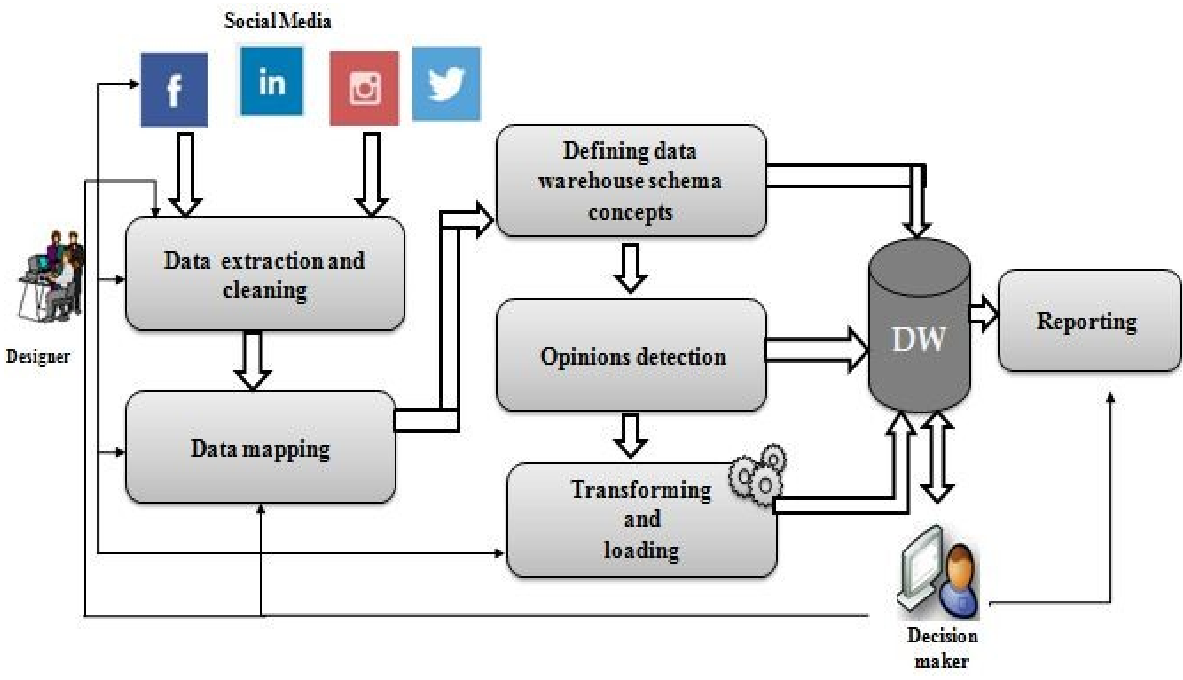 Fig 1: The proposed 6-step lifecycle of the social data warehouse.
Defining the "Rules of Engagement"
A standout feature of this research is the Rules of Fact & Measure Determination. For example:
- Rule RM5: If two measures (like Facebook Shares and Twitter Retweets) are semantically equivalent, they are aggregated into a new derived measure:
Sha-Retw. - Rule RF: Any object with high engagement (Likes/Shares) is automatically promoted to a "Fact" in the warehouse.
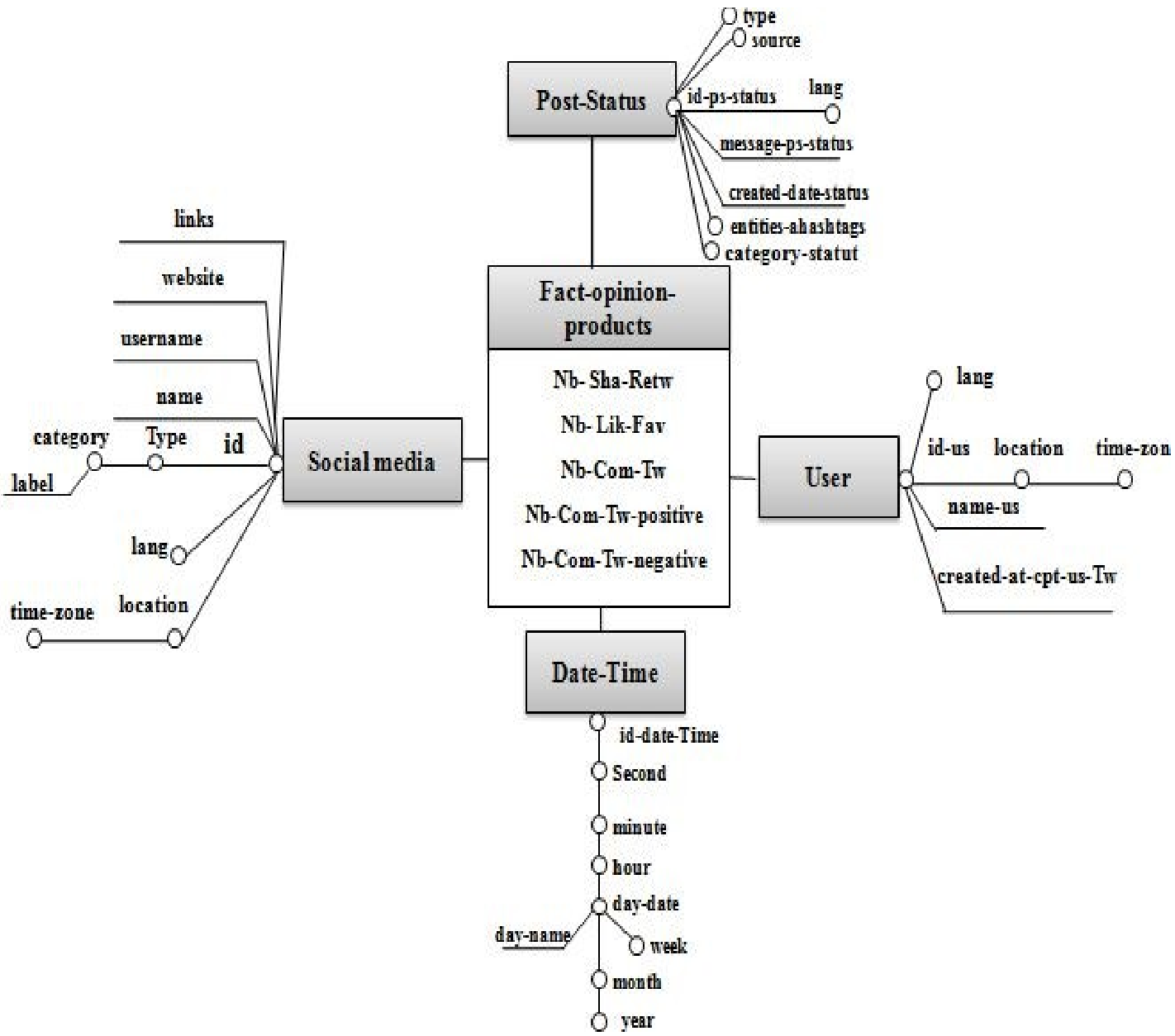 Fig 2: The final multidimensional schema, illustrating the interconnection between Social Media, User, and Time dimensions focused on Opinion Analysis.
Experimental Insight: The Power of Integration
The study demonstrates that by merging data, the "Nantucket" of social data becomes visible. By analyzing the User Dimension across both platforms, companies can track how specific demographics change their tone between the professional/public nature of Twitter and the community-centric nature of Facebook. The use of NOLAP (NoSQL OLAP) is suggested to handle the massive volume—320 million active users generating 600 million tweets daily.
Critical Perspective & Future Work
Strengths: Unlike previous works that are "platform-locked," this approach provides a generalized framework for multi-source integration. The categorization of semantic relations (Identical, Equivalent, Complementary) provides a clear logic for developer implementation.
Limitations: The "Opinion Detection" phase remains a "black box" in the conceptual model. While the paper defines where the results go, it doesn't detail the specific NLP algorithms used to classify sentiments in real-time. Additionally, the mapping is currently semi-automatic; as social APIs evolve, an AI-driven automated mapping layer would be the next logical step.
Conclusion
This work transforms the "Buzz" of social media into the "Records" of a data warehouse. It provides a vital bridge between social media marketing and traditional corporate decision-making, ensuring that every "Like" and "Retweet" counts toward a unified understanding of the customer.