
Social Media as the New Town Square: Decoding e-Participation via Machine Learning
Social media enabled e-Participation: a lexicon-based sentiment analysis using unsupervised machine learning
This study investigates citizen engagement in social media-enabled e-Participation within the Philippines, specifically focusing on the public debate over lowering the minimum age of criminal liability. It utilizes a lexicon-based sentiment analysis (VADER) and unsupervised machine learning (hierarchical clustering) on Facebook data to categorize public opinion and emotional drivers.
TL;DR
In the digital age, government portals are often ghost towns while Facebook groups are bustling with policy debates. This study dives into the Philippines' controversial house bill on criminal liability to understand why people participate and how they feel. By applying unsupervised machine learning and lexicon-based sentiment analysis (VADER) to thousands of Facebook comments, the researchers uncover a complex landscape where "Joy" and "Refutation" coexist, and where government "commitment" is the ultimate currency for engagement.
Background: The e-Participation Paradox
Electronic Participation (e-Participation) was promised as a revolution in democracy. However, the reality has been underwhelming. Most governments use social media as a one-way megaphone for announcements—a "passive engagement" model. This paper shifts the focus from the technology to the citizen, exploring the psychological and emotional underpinnings of why Filipinos engage in high-stakes political discourse online.
Methodology: From Unstructured Comments to Actionable Insights
The researchers treated social media as a massive, unstructured data source. Their pipeline involved:
- Data Scraping: Extracting nearly 4,000 comments from high-traffic pages (CNN Philippines, Rappler, etc.) using Nvivo.
- Lexicon-Based Sentiment Analysis: Utilizing VADER (Valence Aware Dictionary and Sentiment Reasoner). Unlike standard models, VADER is specifically tuned for social media "slang" and context.
- Unsupervised Machine Learning: Using Hierarchical Clustering to group similar opinions without prior labeling, allowing themes to emerge organically from the data.
 Figure 1: The research model depicting the flow from corpus preparation to AI-driven clustering.
The "Why" and "How": Key Findings
The study identified eight themes, ranging from "Expression of Refute" to "Trust on Government."
1. The Emotional Landscape
Surprisingly, while the topic was grim (criminal liability of children), 54% of the emotions identified were "Joy." This doesn't necessarily mean citizens were happy about the crime; rather, it reflects a culture of optimism and support for perceived justice or community safety.
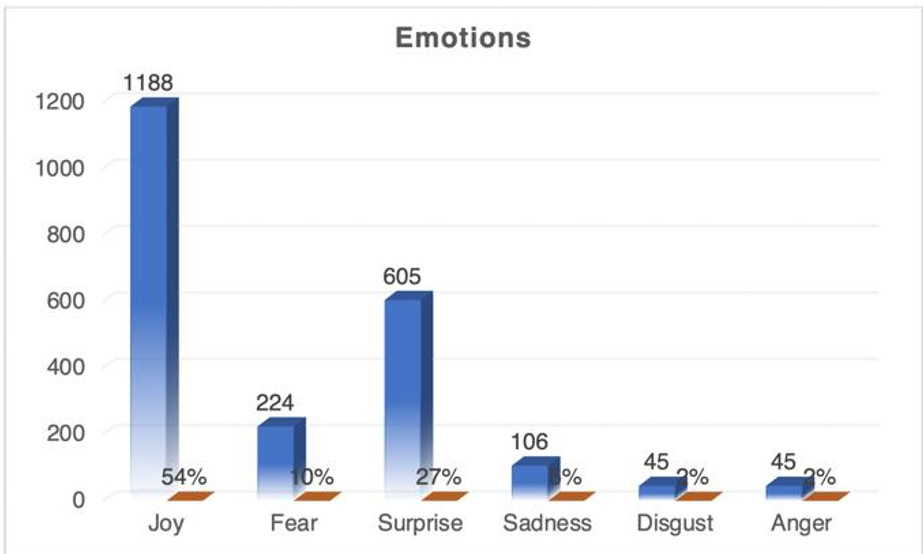 Figure 2: Emotional breakdown of the corpus showing the dominance of Joy and Surprise.
2. The Drivers of Engagement
Why do people bother to comment? The study points to three main pillars:
- Participatory Efficacy: People engage when they feel their knowledge matters.
- Perceived Value/Rewards: A "What's in it for me?" attitude, where users seek information or social validation.
- Government Commitment: The most critical factor. Citizens are far more likely to engage if they see active public officials responding and participating in the thread.
Critical Insights: Moving Beyond the "Like" Button
The research concludes that social media can enhance participation, but only if the government adopts a Socio-Technical System approach.
- The Power of Refute: 70% of the discourse was categorized as "Refutation." This suggests that social media is primarily a tool for resistance and checking government power.
- Mixed Sentiments: The "Compound Valuation" of 58% highlights that public opinion is rarely binary (for/against); it is a messy, multi-faceted spectrum of suggestions, fears, and hopes.
Conclusion and Future Outlook
The takeaway for policymakers is clear: Presence is Policy. If government agencies want to move beyond information dissemination, they must cultivate a "bi-directional" communication line. The study recommends the development of AI-driven social computing applications to capture these "digital heartbeats" in real-time before passing legislation.
Limitations: The study acknowledges that VADER and clustering models can struggle with the nuances of the Filipino language and local idioms. Future research should integrate Large Language Models (LLMs) specifically fine-tuned for regional dialects to achieve higher precision.
Editor's Note: This paper is a significant step in applying modern NLP techniques to Electronic Governance, proving that the scale of social media data can be tamed to reveal the "voice of the people."