
CNNS: Distilling Intelligence for Cyber-Forensics and Terrorist Detection
Social Media Image Retrieval using Distilled Convolutional Neural Network for Suspicious e-Crime and Terrorist Involvement Detection
This paper introduces a unified framework for social media image retrieval targeting e-crime and terrorist activities (e.g., ISIS logos, Guy Fawkes masks). It utilizes a Distilled Convolutional Neural Network (CNNS) that transfers knowledge from a large pre-trained model to a reduced-size architecture, achieving SOTA performance on small-scale, domain-specific datasets.
Executive Summary
TL;DR: Researchers at the University of Alabama at Birmingham have developed a unified framework using Knowledge Distillation to detect suspicious imagery (ISIS logos, hacker masks) on social media. By shrinking a standard CNN and transferring "knowledge" from a teacher model, they solved the dual challenge of extremely limited training data and high visual diversity, outperforming both traditional geometric methods and heavy-duty deep learning models.
Academic Positioning: This work bridges the gap between general-purpose Deep Learning and specialized Cyber-Forensics. It moves away from handcrafted feature engineering (like GHT or SURF) toward a compressed, transfer-learning-based architecture designed for high-efficiency retrieval.
The Problem: Niche Data vs. Deep Learning's Appetite
Detecting criminal behavior on social media isn't like identifying cats or dogs. Cyber-investigators face two brutal bottlenecks:
- Data Scarcity: While Facebook has billions of photos, verified images of specific "carder" (credit card fraud) logos or specific terrorist insignias used in the wild are rare—often fewer than 250 manual annotations are available.
- Visual Noise: These objects appear in low-res profile pictures, occluded by faces, or distorted on waving flags.
Previous attempts relied on the Extended General Hough Transform (GHT). While GHT is great for shapes, it requires heavy manual customization for every single object (e.g., one algorithm for masks, another for logos). It lacks a Unified Framework.
Methodology: Small is Beautiful (and Smarter)
The authors propose a "Distilled" CNN. Instead of training a giant model (which would immediately overfit on their 200 images), they use a Teacher-Student approach:
- The Teacher (CNN0): A full-sized AlexNet-style model pre-trained on the massive ImageNet dataset.
- The Student (CNNS): A reduced network with exactly half the number of kernels per layer.
- Knowledge Distillation: The student doesn't just learn "Hard Labels" (Is this an ISIS logo? Yes/No). It learns the "Soft Targets" from the teacher—the subtle probability distributions across 1,000 ImageNet classes. This captures the generic visual logic the teacher has perfected.
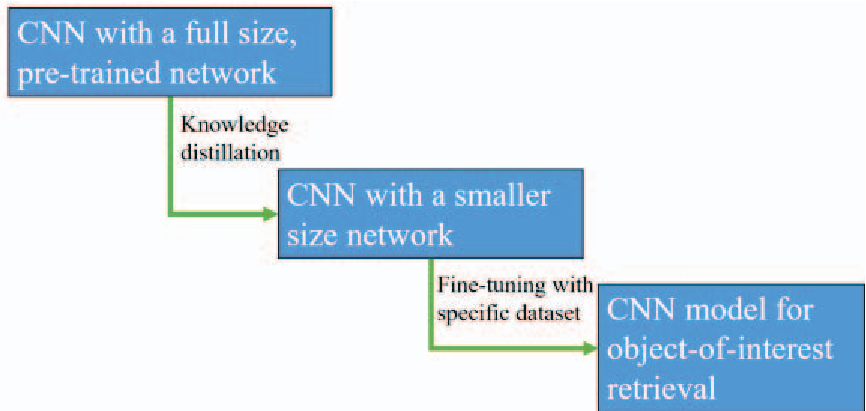
The authors then replace the final layers with Adaptation Layers specifically for their binary task: Is this suspicious or not?
Experimental Results: Precision and Efficiency
The framework was tested on three high-stakes datasets: ISIS logos, VISA logos, and Guy Fawkes masks.
Key Findings:
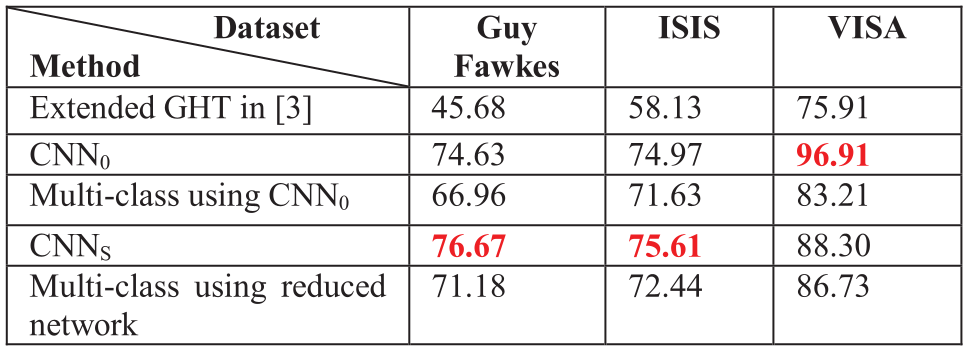
- Accuracy Boost: On the ISIS dataset, the distilled CNNS achieved a Mean Average Precision (mAP) of 75.61%, significantly higher than the traditional GHT (58.13%).
- Speed & Training Efficiency: Because the model has 50% fewer parameters, fine-tuning time dropped from 218 minutes to only 108 minutes on an Nvidia Tesla K40M.
- Superiority Over Full Models: Counter-intuitively, the smaller CNNS often outperformed the full-sized CNN0. Why? Because with limited data, a larger model is more prone to "memorizing" the noise rather than learning the features.
Critical Insights: Why it Works
The success of this method lies in Inductive Bias. By reducing the model size, the authors forced the network to prioritize the most essential features (the "distilled" essence).
- Unified vs. Custom: Unlike GHT, which needed OCR for credit cards but failed on distorted ISIS flags, the CNN-based approach treats pixels as raw data, learning that a "logo" is a concept that transcends simple line matching.
- Binary vs. Multi-class: The study found that training separate binary classifiers for each crime type (e.g., one for masks, one for ISIS) performed better than one "catch-all" multi-class model. This is likely due to the "negative class" in social media being so vast and diverse that it's easier for a model to learn what one specific thing looks like rather than learning everything at once.
Conclusion & Future Outlook
This paper demonstrates that in the world of specialized security, bigger is not always better. By distilling a large teacher model's intelligence into a compact student, we can build tools that are fast enough for real-time social media monitoring and robust enough to work with limited forensic data.
Future Directions: The next step involves automated parameter tuning and exploring even further "slimmer" models to see where the performance trade-off begins. As social media becomes a primary front for e-crime, such distilled models will be critical for rapid-response detection systems.