
Social Sensing: Turning Twitter into a Global Disaster Detection Network
Pulling Information from social media in the aftermath of unpredictable disasters
The paper presents a real-time web-based system for the detection and monitoring of unpredictable disasters using Twitter data under the "Human as a Sensor" paradigm. It employs a modular pipeline featuring machine-learning classifiers for noise filtering and burst detection algorithms for event identification, specialized in early damage assessment and situational awareness.
TL;DR
In the chaotic aftermath of earthquakes and floods, traditional sensor networks often lag or lack density. This paper introduces a modular system that transforms Twitter users into "social sensors." By utilizing advanced noise filtering and burst detection, the system can detect major earthquakes in real-time and even quantify their damage intensity with surprising accuracy (3.8% error rate), offering a vital tool for first responders.
Problem & Motivation: The Noise in the Signal
When a disaster strikes, social media activity spikes. However, for a rescuer, most of this data is "background radiation." A tweet saying "I'm shaking with excitement" is noise during an earthquake search. Previous systems like EARS or TED struggled to separate linguistic metaphors and historical references from actual eyewitness reports. The authors realized that to make social sensing "actionable," they needed to solve two problems: extreme noise filtering and quantitative damage estimation.
Methodology: The Social Sensing Pipeline
The authors propose a modular pipeline designed for domain-independence, meaning it can be adapted from earthquakes to flash floods with minimal reconfiguration.
1. The Filtering Logic
Instead of simple keyword matching, the system uses a J48 Decision Tree. It looks for linguistic "fingerprints" of panic:
- Length: Eyewitness reports are usually short and urgent.
- Style: Frequent use of slang, offensive words, and minimal punctuation often characterizes a user in a state of shock.
- Features: 24 structural features (mentions, RTs, URLs, etc.) are filtered down to the most influential 7-9 per language using Information Gain.
2. Burst Detection (The "Sensor" Trigger)
The system monitors the frequency of relevant tweets using a sliding window. An alert is triggered when the short-term arrival rate (1 minute) exceeds the long-term baseline (1 week) by a factor of ten.

3. Quantitative Impact Assessment
Perhaps the most innovative part is the use of Multiple Linear Regression. By extracting features like the spatial distribution of tweets around an epicenter and the "longest streak" of high-frequency messaging, the model can estimate the intensity of the disaster on a 1-10 scale, matching professional USGS surveys.
Experiments & Results: Real-World Scrutiny
The researchers tested the system on the 2012 Emilia earthquake and the 2014 Genoa flood.
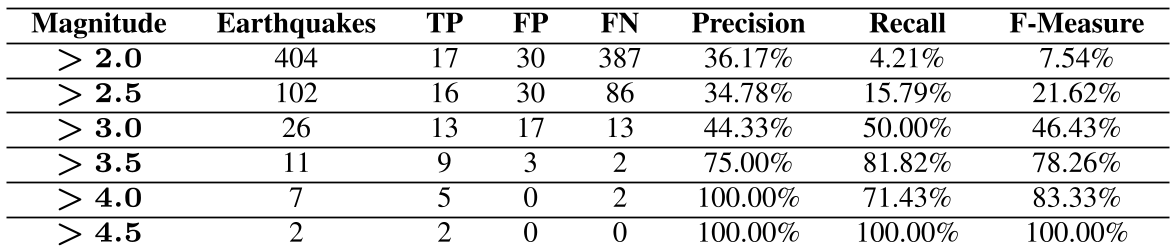
- Detection Performance: For earthquakes magnitude >3.5, the F-Measure surpassed 75%, reaching 100% for events >4.5. This proves that while humans are poor sensors for "mirco-quakes," they are incredibly reliable for impactful events.
- Damage Prediction: The regression model achieved an R² of 0.7769 in Central & South America, showing a strong correlation between "Twitter volume/content" and physical "infrastructure damage."
Deep Insight & Conclusion
This study moves the needle from "Social Media as a News Source" to "Social Media as a Scientific Instrument." While traditional seismographs measure ground motion, social sensors measure human impact.
Limitations: The system still relies heavily on text. The authors acknowledge that the next frontier is multimedia analysis. A photo of a collapsed bridge is worth a thousand tweets, but automatically verifying and geolocating such images in real-time remains a significant computer vision challenge.
Future Outlook: The shift toward Crisis Mapping via Named Entity Recognition (NER) will allow this system to point rescuers to specific street corners, potentially saving lives in the critical "golden hour" post-disaster.