
Beyond Sentiment: Mining Explicit Preferences for Behavioral Prediction
Using explicit linguistic expressions of preference in social media to predict voting behavior
The paper introduces a novel framework for predicting user behavior by mining explicit linguistic expressions of preference (e.g., "I am voting for...") from social media. It validates this approach using the "Tweetcast Your Vote" system, which achieved high accuracy in predicting individual voting decisions during the 2012 U.S. Presidential Election by combining natural language processing with social network analysis.
TL;DR
Researchers from Northwestern University have developed a method to bypass the need for proprietary consumer data by mining "explicit linguistic expressions of preference" from Twitter. By identifying users who openly state their intentions (e.g., "I'm voting for X") and analyzing their social graphs and language patterns, they can predict the behavior of "silent" users with up to 91% accuracy.
Background Positioning: This work bridges the gap between text-based sentiment analysis and collaborative filtering, moving from "what people feel" to "what people will do" using public social signals.
The Problem: The Proprietary Data Wall
In the world of predictive modeling, "preference data" is the gold standard. Companies like Amazon or Netflix have an unfair advantage because they own the transaction history of their users. For researchers and smaller players, this data is locked behind a paywall.
The authors argue that we don't need private data if we can intelligently mine public self-disclosures. The challenge is that most social media users are noisy, and only a small fraction explicitly state their choices. How do we turn that loud minority into a training set for the silent majority?
Methodology: The "Tweetcast" Pipeline
The authors' approach is elegantly simple but technically rigorous. It involves a "Label-Attribute-Model" workflow:
- Mining the Labels: Instead of manual annotation (which is slow) or general sentiment analysis (which is vague), they used targeted regex patterns to find "Declarations of Intent." For example, searching for variants of "I am voting for [Candidate]."
- Feature Extraction: They didn't just look at words. They extracted:
- N-grams: Standard text features.
- Metadata: Hashtags, User Mentions, and Websites (parsed at the host level to capture source bias).
- Network Graph: The list of "friends" (who the user follows).
- Predictive Modeling: They used Support Vector Machines (SVM) via LIBLINEAR, finding that normalized binary feature vectors outperformed traditional TF-IDF weights.
 Fig 1: The Tweetcast Your Vote interface, showing the feature-level evidence for a prediction.
Key Insights: Network Over Content
The results from the 2012 election dataset yielded a fascinating discovery: social network data is a much stronger predictor than text.
The svm-friends model outperformed content-based models by a significant margin. This suggests that while language can be noisy—filled with sarcasm, slang, or intentional obfuscation—our choice of "social diet" (who we follow) is a much cleaner signal of our underlying biases and preferences.
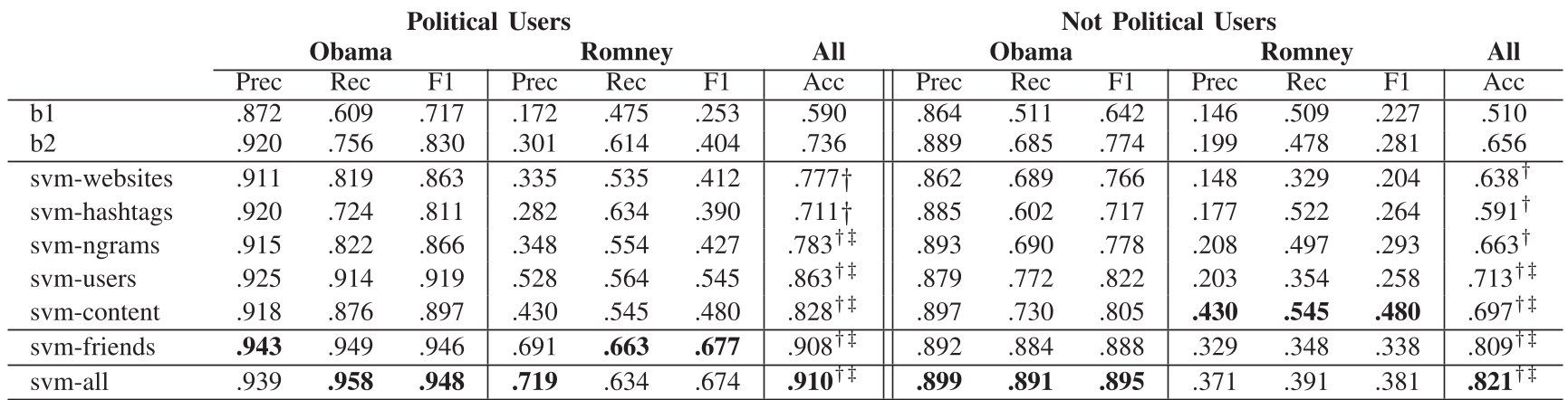 Table 1: Accuracy rates showing that combined (stacked) models significantly exceed baselines.
The "Political Filter"
The study also categorized users into "Political" and "Not Political." Unsurprisingly, the models were drastically more accurate (up to 20% better) on users who discussed politics at least once in every 25 tweets. For non-political users, the accuracy dropped, suggesting that these users either use the platform for entirely different purposes or their political orientation doesn't manifest in standard social signals.
Critical Analysis & Future Outlook
Takeaway: This paper proves that public "identity signals" on social media are sufficient to build high-performance behavioral models without needing private transaction logs.
Limitations:
- Sarcasm: While the authors used a "blacklist" for hashtags like #sarcasm, linguistic irony remains a persistent challenge for regex-based extraction.
- Demographic Bias: Twitter users are not a representative sample of the general voting population, a limitation the authors acknowledge.
Future Work: The transition from political voting to product recommendation (as seen in the author's later project, BookRx) indicates that this methodology is highly portable. In the era of LLMs, we could likely replace regex with zero-shot classifiers, making the "preference mining" step even more robust across different domains.