
Outsmarting the Feed: Time Management Wisdom from the Dawn of Social Media
Social media time management tools and tips
This paper, published in the early Web 2.0 era, examines the productivity challenges posed by the rise of social media, with a specific focus on Twitter. It characterizes social media as a "fusion of sociology and technology" and proposes time management strategies and third-party tools (e.g., Tweetdeck, Hootsuite) to mitigate information overload.
TL;DR
In a world rapidly transitioning to Web 2.0, this 2010 study analyzes how social media shifted from a simple communication tool to a potential "time-sink." By dissecting the explosive growth of Twitter and the phenomenon of information overload, the paper offers timeless heuristics—such as the 80/20 rule for content and the use of specialized filtering "trackers"—to transform social media from an addictive distraction into a productive professional asset.
The Paradox of Abundance: Problem & Motivation
By 2010, the internet was no longer a library; it had become a conversation. The paper argues that the very ease of use that defined Web 2.0—its "friendliness" and "open-source" nature—created a secondary crisis: Information Overload.
The author highlights a startling shift: in 1999, the average user spent seven hours online per week; by 2009, that doubled, with social networking alone claiming nearly a quarter of all internet time. The "pain point" identified is the low signal-to-noise ratio. Without authority approval or accuracy checks, users were forced to spend more time "cross-checking" data than using it for decision-making.
Methodology: The Anatomy of Social Media
To solve the productivity puzzle, the author first defines what makes social media unique through six core principles:
- Persistence: Your digital reputation is emergent and permanent.
- Transparency: Information flow must be open to foster collaboration.
- Emergence: The landscape is unpredictable and non-linear.
Case Study: The Twitter Context
The paper highlights Twitter as the prime example of the "Information Stream" challenge. At the time of writing, Twitter was experiencing a 1358% growth rate. The author identifies that "Twitter-addiction" stems from infinite feeds and "self-obsessed" broadcasting.
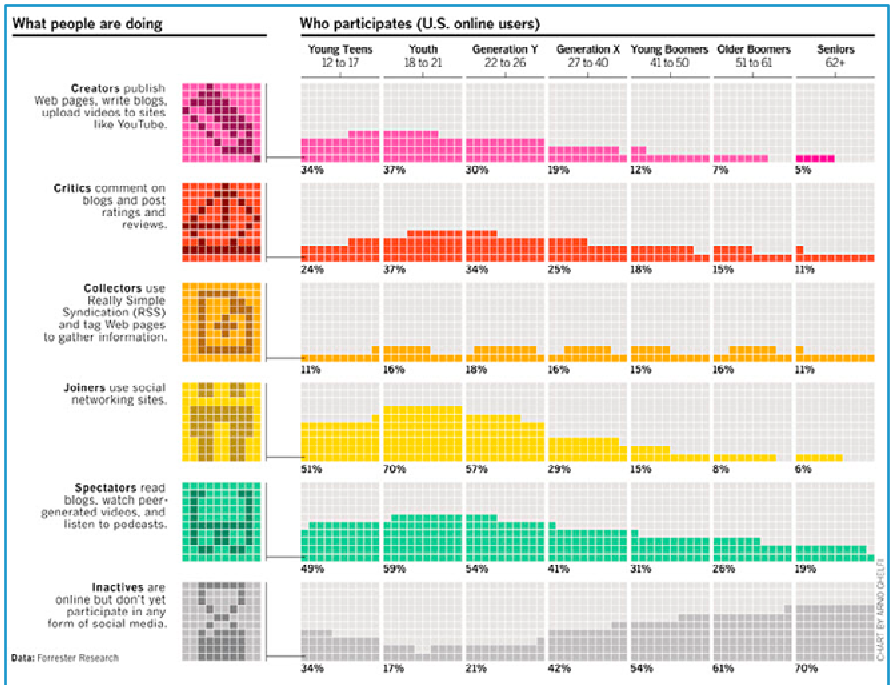 Figure 1: The explosive shift from passive consumers to active "producers" in the Web 2.0 era.
Strategies for Productivity (The Technical "How-To")
The author doesn't suggest quitting social media; instead, they propose a technical and behavioral "stack" to manage it:
- Iterative Interfacing: Limit sessions to 20-30 minutes rather than continuous monitoring.
- The 80/20 Content Rule: 80% of activity should be purpose-driven (theme-specific), and only 20% should be "other" (social/casual).
- Algorithmic Out-smarting: Using third-party tools like Tweetdeck for list-based filtering and Twitalyzer for impact analysis. This shifts the user from a victim of the "noise" to a curator of the "signal."
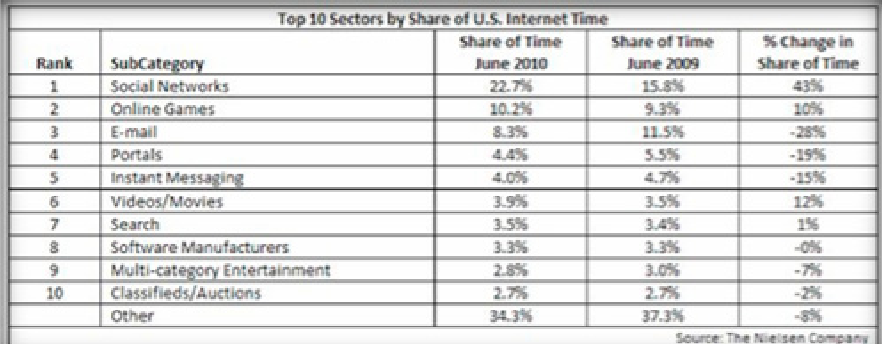 Table 1: The rising dominance of Social Networks vs. the decline of traditional E-mail (2009-2010).
Critical Insight: Why This Matters Today
While the specific tools mentioned (like MySpace or early Tweetup) may have evolved or disappeared, the underlying physics of the attention economy remains identical. The paper’s observation that "every two days we create as much information as the dawn of civilization until 2003" was a radical claim in 2010; in the age of Generative AI, this volume has grown exponentially.
The Takeaway: Productivity in a media-suffused environment is a function of Filtering Efficiency. The paper’s legacy is the early recognition that "staying connected" is a double-edged sword: it requires a deliberate "productivity ruleset" to prevent the tools from owning the user.
Limitations & Future Outlook
The paper focuses heavily on manual filtering (e.g., hash tags and lists). Today’s challenge is that AI-driven algorithms do the filtering for us, often creating "filter bubbles" that the author could not have fully predicted. Future work in this lineage must address how to maintain "Independence" (one of the author's six principles) when the feed is governed by opaque, engagement-maximizing algorithms.