
The Virtual Mask: How Social Media is Rewiring Young Adult Communication
Social Media Use and Impact on Interpersonal Communication
This research investigates the shifting landscape of interpersonal communication among young adults—primarily college students—due to social media usage. Using a qualitative interview-based methodology, the study identifies a significant trend toward virtual interaction at the expense of face-to-face communication skills.
TL;DR
This study explores the profound impact of social platforms on the social fabric of young adults. While digital tools provide a "comfortable" environment for expression, they are simultaneously eroding the fundamental skills required for face-to-face interaction, leading to a generation that mirrors online "likes" with offline avoidance.
Introduction: The Death of the One-on-One Conversation
In the last 20 years, the fundamental nature of human interaction has undergone a tectonic shift. We have moved from private networks to a global culture of public sharing. This research asks a critical question: Is social media usage stunting the development of interaction skills for the next generation of adults?
The motivation is a relatable one: the "glance at the phone" that interrupts family dinners and friendly hangouts. The study suggests that while we are more "connected" than ever, the quality of that connection is increasingly shallow.
The Problem: The High Cost of Digital Convenience
Prior research presents a conflicted view. Some cognitive psychologists suggest the brain interprets digital interaction identically to physical interaction. However, other studies highlight a "desperation for connection" that leads to quantity over quality.
The core pain point identified in this paper is Inductive Bias toward Digital Buffers. Young adults utilize social media as a shield to avoid the "stress" of reading body language or immediate verbal responses. This avoidance behavior creates a feedback loop: the less we practice in-person social cues, the more daunting they become.
Methodology: Tracking the Digital Journey
The researchers utilized a two-phase approach at Kean University to understand both the usage and the psychology of social media.
- Phase One: Quantitative survey to identify the "what" and "why" of device usage.
- Phase Two: 30 in-depth, one-on-one interviews to capture the "how"—the qualitative shift in communication habits.
Participant Demographics and Onset
The study found that the "window of exposure" opens extremely early. Females typically enter the social media sphere at 12.2 years old, while males follow shortly at 12.9 years.

Core Insight: The "Migration" of Social Behavior
The data suggests a mass migration from feature-heavy platforms like MySpace (which caused "popularity rifts") to visual-centric platforms like Instagram. The authors argue that this shift toward visuals (pictures/videos) further diminishes the need for verbal dialogue.
The Paradox of Online Openness vs. Offline Ghosting
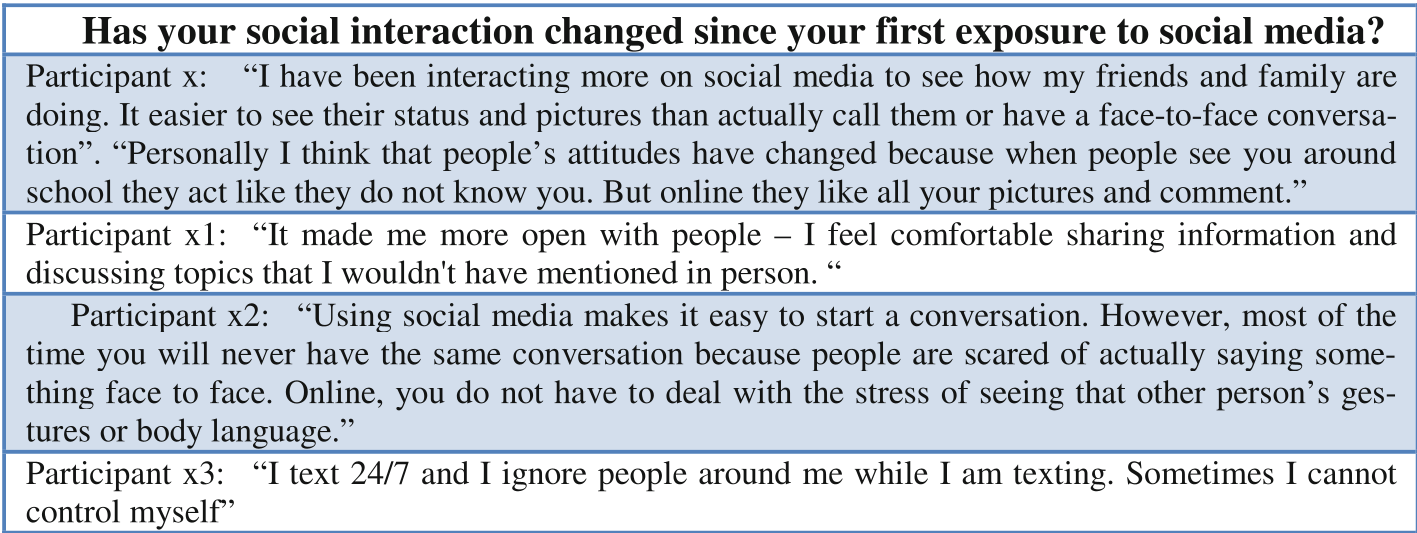
The most striking finding was the disconnect between online and offline personas. Participants reported that peers would "like" their photos online but act like strangers when passing them in a physical hallway.
Key Findings from Participant Interviews:
- Reduced Effort: "It is easier to look at a social media page... than have a face-to-face conversation."
- Avoidance of Non-Verbal Stress: "Online, you do not have to deal with the stress of seeing that other person's gestures or body language."
- Cognitive Distraction: Participants admitted to "texting 24/7" and ignoring physical company.
Discussion: A Future Without "Presence"?
The "Results" section paints a sobering picture of future interpersonal communication. If the current trend continues, "one-to-one interaction" might be replaced entirely by "virtual monitoring"—where we judge and understand our peers solely through a curated feed of images rather than spoken words.
Critical Limitations
- Sample Size: With only 30 participants from a single university, the results are indicative rather than universal.
- Self-Reporting: The study relies on participants' awareness of their own behavior, which may be subject to bias.
Conclusion and Future Outlook
The study concludes that social media has acted as a double-edged sword. While it allows for "greater comfort" in expressing certain opinions, it has fundamentally weakened the "social muscle" required for real-time, physical interaction.
For researchers and developers, this highlights the need for Socially Conscious Design. Future platforms should aim to bridge the gap between digital comfort and physical presence, rather than providing a permanent escape from the "stress" of human reality.
Takeaway: We are trading the richness of body language and immediate presence for the convenience of status updates. The question remains: Is a "like" worth the loss of a "hello"?