
Mapping Social Milieus: How Network Ties Reveal Widening Cleavages in Modern Society
Mapping social milieus and cohesion patterns between 1997 and 2014. Exploiting the potential of the occupational position generator
This study utilizes the occupational Position Generator (PG) technique to map social milieus and cohesion patterns in Hungary between 1997 and 2014. By analyzing four national surveys, the authors identify four stable occupational milieus—Intellectual, Managerial, Market, and Manual—revealing a significant trend toward social polarization and the emergence of "omninex" (inclusive) and "uninex" (exclusive) network patterns.
TL;DR
This research investigates nearly two decades of social transformation in Hungary (1997–2014) through the lens of personal networks. By tracking who knows whom across 19 different occupations, the authors uncover a society becoming increasingly fragmented. The study introduces the concepts of Omninex and Uninex to describe how social elites are shifting from broad, inclusive social circles to narrow, exclusive ones, thereby threatening overall social cohesion.
Context & Motivation: Beyond "Who You Know"
Social capital research has long established that who you know matters for status attainment. However, most studies focus on the vertical ladder—how many high-status people you know. This paper argues that the horizontal structure of networks—the distinct "milieus" or social circles we inhabit—is equally critical for understanding social integration.
In the wake of the 2008 economic crisis and the post-socialist transition, Hungary serves as a critical case study for growing inequality. The authors wanted to see if the "social glue" that connects different classes was strengthening or dissolving.
Methodology: The Geometry of Social Space
The authors utilized the Occupational Position Generator (PG), a tool that asks respondents if they know anyone in specific jobs (e.g., Surgeon, Mechanic, Sales Assistant).
1. Identifying the Four Milieus
Using factor analysis, the researchers identified four stable clusters of occupations that tend to appear together in people's networks:
- M1: Intellectual/Cultural (Scientists, Journalists, Actors)
- M2: Managerial/Technical (Chief Executives, Engineers, Solicitors)
- M3: Market/Service (Waiters, Security Guards, Shop Owners)
- M4: Manual/Working Class (Unskilled workers, Drivers, Farmers)
2. Status vs. Connectedness
Through Goodman’s RC modeling, the study mapped these milieus on a two-dimensional grid. The horizontal axis represents Status (hierarchical power), while the vertical axis represents Connectedness (the ability to act as a bridge between different social segments).
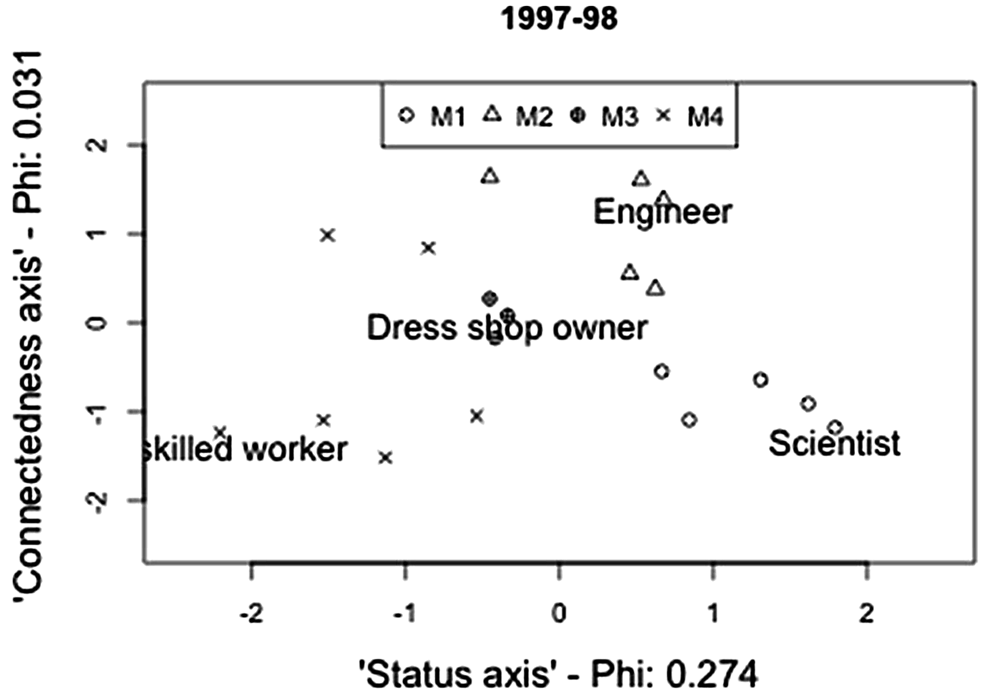 Figure 1: The schematic positioning of occupational milieus along Status and Connectedness axes.
Key Findings: The Rise of the "Uninex" Pattern
The most striking contribution of the paper is the application of the Omnivore/Univore concept to social networks—rebranded here as Omninex and Uninex.
- Upper Omninex: Individuals with "inclusive" networks who have contacts across all four milieus. These are the social bridges of society.
- Upper Uninex: High-status individuals who only know other high-status people. They are socially "exclusive."
Results: A Diverging Society
The data suggests a disturbing trend: the middle is disappearing.
- Increasing Distance: The correlations between high-status milieus and low-status milieus have weakened significantly over time.
- Status Polarization: The "Status" axis in the RC models became more dominant (Phi value increased from 0.27 to 0.39), meaning hierarchies are hardening.
- The Uninex Surge: In the most recent period (2014), the "Upper Uninex" group grew, suggesting that the elite are retreating into exclusive bubbles, reducing the potential for social mobility and empathy between classes.
 Table 1: Partial correlations show that the distance between Managerial (M2) and Manual (M4) milieus has grown increasingly negative (-0.59 to -0.84).
Critical Insight: Why Does This Matter?
This isn't just about who goes to dinner with whom. When a society's elite becomes "Uninex," they lose the "weak ties" that connect them to the realities of the working class. This lack of social betweenness leads to policy blindness and decreased social trust. The "Market Milieu" (M3), which historically acted as a bridge, is also losing its capacity to connect the top and bottom of the social ladder.
Conclusion & Limitations
The study demonstrates that the Position Generator is a powerful tool for macro-structural analysis, not just individual status tracking. However, the authors admit that using a fixed set of 19 occupations might miss emerging digital-economy roles.
Final Takeaway: Social cohesion is not just about income equality; it is about the diversity of our acquaintanceship. As network paths between the boardroom and the factory floor vanish, the structural integrity of the "social contract" is at risk.