
Social Mining: Re-engineering Healthcare Big Data Integration
Social mining-based clustering process for big-data integration
The paper proposes a Social Mining-based Group (SMbG) clustering process for big-data integration in healthcare platforms. It combines traditional static data models with social network relations and uses the PrefixSpan algorithm for sequence mining to predict health risks and provide personalized lifecare services.
TL;DR
This research introduces a Social Mining-based Group (SMbG) clustering process that moves beyond static data models. By integrating social network relationships and temporal sequence mining (PrefixSpan), the proposed platform improves health risk prediction accuracy by over 20% compared to traditional similarity-based methods, effectively solving the "cold start" or sparse data issues in personalized lifecare.
Background & Motivation
Current healthcare platforms are often "data rich but insight poor." They collect vast amounts of "life logs"—scattered digital footprints of our daily health—but clinical models often treat users as isolated islands.
The Problem: Conventional clustering (like basic K-means) uses only static attributes (age, weight, existing conditions). This ignores the Social Influence: the reality that people in similar social circles often share similar lifestyle habits, stressors, and dietary patterns. Furthermore, traditional mining often struggles with the computational intensity of scanning big data repeatedly.
Methodology: The Core of Social Mining
The authors propose a multi-layered approach to create a more "human-oriented" intelligence.
1. Trust-based User Modeling
Instead of just looking at raw medical data, the system builds a social graph where:
- Nodes represent users.
- Edges represent social relations.
- Edge Weights represent the degree of trust (calculated via Pearson correlation and social linkage intensity).
2. Social Sequence Mining with PrefixSpan
To forecast future health events, the paper employs PrefixSpan. Unlike older algorithms that require multiple passes over the entire database, PrefixSpan uses a "pattern-growth" method. It partitions the search space into "projected databases," making it significantly faster and more memory-efficient for analyzing sequences of health events (e.g., how stress leads to caffeine intake, which eventually correlates with hypertension).
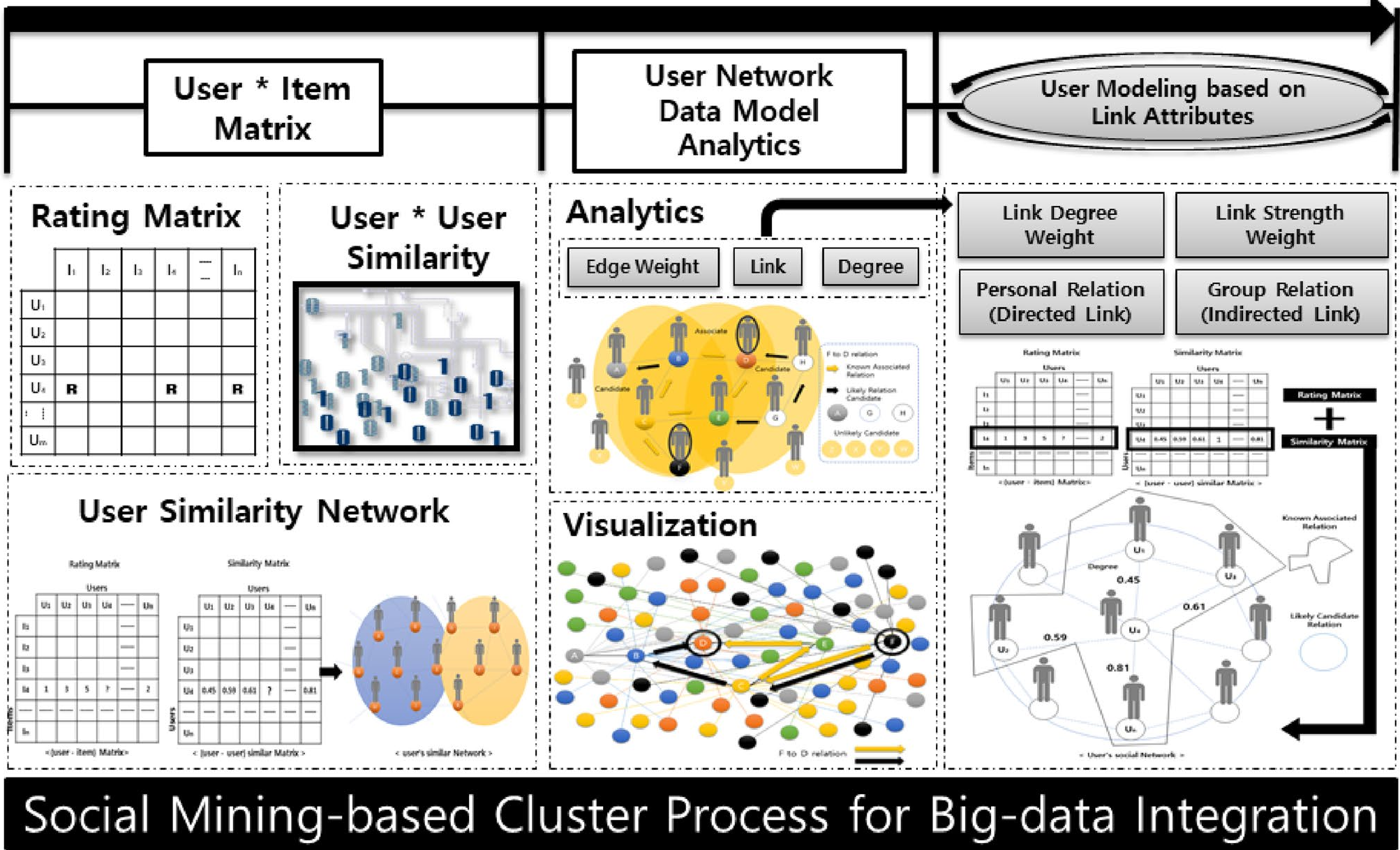 Figure 1: The proposed social mining-based cluster process for big data integration.
Experimental Results & SOTA Comparison
The researchers validated their model using the Korea National Health and Nutrition Examination Survey (KNHANES) and medical big data from HIRA.
Performance Gains
The study compared the proposed SMbG against a Similarity-based Group (SbG) baseline across several metrics:
- Accuracy: Improved by ~4.27%.
- Recall: Improved by ~5.4%.
- F-measure (Overall): The SMbG averaged 89.12% across clusters, significantly higher than the baseline.
Resilience to Data Sparsity
One of the most striking findings was the model's performance as the number of users decreased. Traditional SbG models saw their F-measure plummet when user counts dropped below 200. In contrast, the SMbG (social mining) method maintained high accuracy, proving that social relations can "fill in the gaps" for missing individual data.
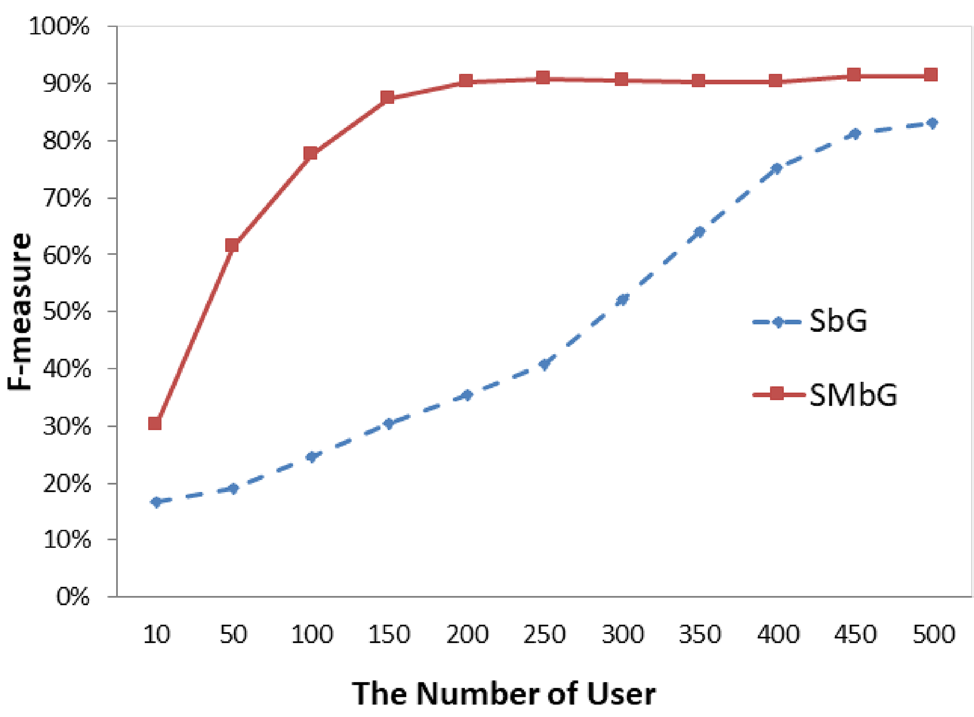 Figure 2: F-measure comparison showing the robustness of SMbG even with limited user data.
Critical Insight & Conclusion
This paper serves as a bridge between Social Computing and Predictive Healthcare. By shifting the paradigm from "What is this patient's history?" to "Who is this patient influenced by?", the authors have unlocked a more precise way to handle big data integration.
Limitations: While the social mining results are impressive, the paper relies heavily on "explicit" relations. In real-world scenarios, social data can be noisy or intentionally hidden for privacy. Future work would likely need to incorporate Privacy-Preserving Data Mining (PPDM) or Differential Privacy to protect the sensitive medical-social links of survivors.
Future Outlook: As wearable IoT devices become ubiquitous, the ability to integrate heterogeneous social streams into clinical decision support will be the defining factor for the next generation of "Lifecare" platforms.