
Simulating Social Sustainability: How to Keep Digital Repositories Alive
Social models in open learning object repositories: A simulation approach for sustainable collections
This paper presents a social simulation model for Learning Object Repositories (LOR) aimed at understanding and ensuring long-term collection sustainability. Using the RePast agent-based modeling framework and empirical data from the MERLOT repository, the authors simulate user contribution and evaluation patterns to establish a baseline for sustainable community growth.
TL;DR
Digital repositories for educational resources often wither away once their initial launch hype fades. This paper argues that sustainability is a social problem, not just a technical or financial one. By using Agent-Based Modeling (ABM), the authors simulate how "Participation Inequality" and social filtering (ratings and bookmarks) shape the health of a repository. They discovered that without specific visibility interventions, high-quality new resources are often buried by "prestige-heavy" older ones.
Background: The Ghost Town Problem
Most Open Learning Object Repositories (LORs) are born from research grants. Once the grant ends, the repository often becomes a "digital ghost town"—outdated, uncurated, and unused. The authors posit that true sustainability requires a shift from a "provider/user" paradigm to a community development model. But how do we predict if a community will flourish or fail?
The Social Engine: Problem & Motivation
The core challenge lies in the 90-9-1 rule of Participation Inequality: 90% of users consume, 9% contribute occasionally, and only 1% are power contributors.
The authors observed two major bottlenecks:
- Productivity Distribution: Contributions follow Lotka's Law (a power law), meaning a tiny fraction of users do most of the work.
- The Ranking Trap: Mature repositories tend to favor resources that already have many ratings. This creates a feedback loop where old, "popular" resources stay at the top, while new, potentially better resources never get the "Social Filtering" they need to surface.
Methodology: Modeling Human Behavior with RePast
To study these dynamics, the researchers built an agent-based simulation using the Recursive Porous Agent Simulation Toolkit (RePast).
1. Agent Attributes
Users weren't modeled as simple "uploaders." They were given attributes like contribution propensity (motivation) and peer reviewer status.
2. Network Projections
The model constructed two types of social networks to track interaction:
- P-Network (Bookmarks): A directed graph where a link exists if User A bookmarks User B’s resource. This represents prestige.
- R-Network (Reviews): A valued graph based on ratings. This represents social filtering.
 Figure 1: Conceptual overview of the socio-technical elements in LOR sustainability.
3. Formulaic Intuition
The simulation used a Lotka distribution with an exponential cutoff to model contribution: This formula captures the reality that the more a user has contributed (), the more likely they are to contribute again, but only up to a point of saturation.
Experiments & Results: Mirroring Reality
The authors validated their simulation by crawling the MERLOT repository (a massive LOR with over 69,000 users).
SOTA Comparison: Simulation vs. Empirical Data
The simulation successfully mirrored the "Participation Inequality" found in MERLOT. The log-log plots of resource indecree followed a Zipf-law distribution, proving that the model's logic for "propensity to bookmark" was accurate to human social behavior.
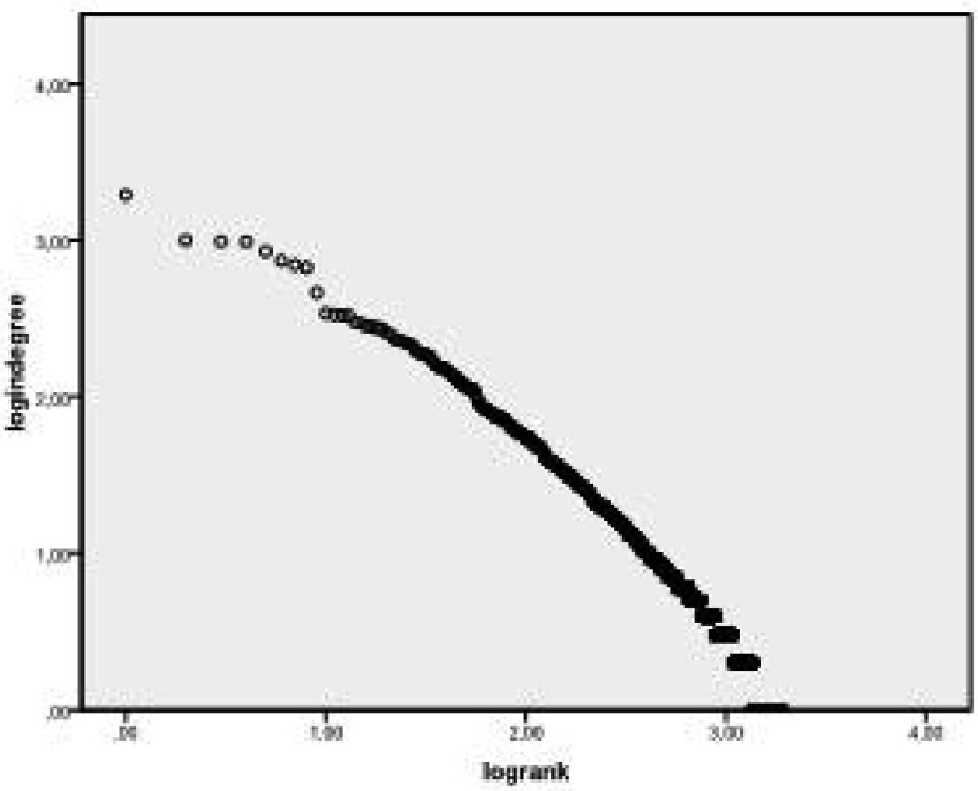 Figure 2: Log-log plot showing the distribution of bookmarks—a clear indicator of "Participation Inequality" and prestige.
The "Quality Decay" Discovery
One of the most striking findings was the stagnation of quality over time. In a standard rating-based system, high-quality resources added later in the repository's life failed to gain traction. The simulation showed a "decreasing tendency" for new high-quality resources to reach the "high-rated" threshold because they were competing with a "backlog" of established favorites.
Critical Insight & Practical Takeaways
Why does this matter? It tells us that a "fair" ranking system actually hurts a repository's sustainability.
- The Solution: Repositories must implement "decay functions" or "temporal filters" that give new content a boost in visibility to allow social filtering to take place.
- Limitation: The model assumes users behave consistently regardless of the specific topic. In reality, a "Biology" sub-community might behave very differently from a "Computer Science" one.
- Future Scope: Future models should look at multi-repository competition. How does a user choose between MERLOT and Connexions? That competition eventually dictates which "social ecosystem" survives.
Final Thought
Sustainability isn't about the server; it's about the social incentive. If your system doesn't account for the power-law nature of human contribution, it's destined to become a digital archive rather than a living community.