
Decoding the Social Contagion of Fitness: Lessons from the YesiWell Network
Social and Motivational Factors for the Spread of Physical Activities in a Health Social Network
The paper presents a comprehensive study of the "YesiWell" health social network, which tracked 254 participants over 335 days to analyze how healthy behaviors spread. By improving proportional hazards models, the authors quantified the varying impacts of self-motivation, social influence, and susceptibility on physical activity adoption.
TL;DR
Can fitness be "caught" from your friends like a virus? This study analyzes the YesiWell social network, proving that healthy behaviors do indeed spread through social ties. By tracking 254 participants over nearly a year, researchers found that digital interventions can increase walking by 164%. More importantly, the paper deconstructs the specific psychological profiles—like stress levels and social habits—that determine whether you are an "influencer" or a "follower" in the world of health.
The Identification Problem: Influence or Coincidence?
In social science, there is a persistent challenge: if two friends both start running, is it because one influenced the other (Influence), or because they were already similar people who like running (Homophily)?
The authors argue that current digital therapeutics are too generic. They lack the "high-definition insights" needed to understand why someone changes their behavior. To solve this, the researchers tracked everything from minute-by-minute step counts to biomarkers (cholesterol, BMI) and social "exhaust" (private messages, game invites).
Methodology: The Proportional Hazards Approach
The core of this research lies in its improved Proportional Hazards Model. Instead of just looking at whether someone became active, the model looks at how quickly they reacted to different stimuli.
The researchers categorized behavior changes into three distinct buckets:
- Self-Motivation: Triggered by joining competitions or setting personal goals.
- Peer Influence: Triggered by receiving encouraging messages from others.
- Spontaneous Action: Natural fluctuations in activity without external triggers.
The Interaction Loop
 The study recorded over 7 million data points, spanning physical, social, and biological metrics to create a holistic view of the participant.
Experimental Breakthroughs: Who Influences Whom?
The results provide a fascinating map of human social behavior in the context of health:
- The Power of Calmness: "Relaxed" people are significantly more influential. In fact, they exert 109% more influence on non-stressed peers than the baseline. Conversely, "stressed" people are 96% less effective at motivating others.
- The Introvert Paradox: Participants who self-characterized as "keep-to-themselves" were the most susceptible to being influenced (79% higher than others) but also showed 34% higher self-motivation.
- Age and Influence: Influence and susceptibility both increase with age. Participants over 60 were 143% more likely to influence their peers than those under 40, though they were less likely to act spontaneously.
- Quality over Quantity: Having a massive friend list (30+) actually decreased influence and susceptibility. The strongest behavioral spread happened in groups with 1–10 high-quality connections.
Performance Metrics
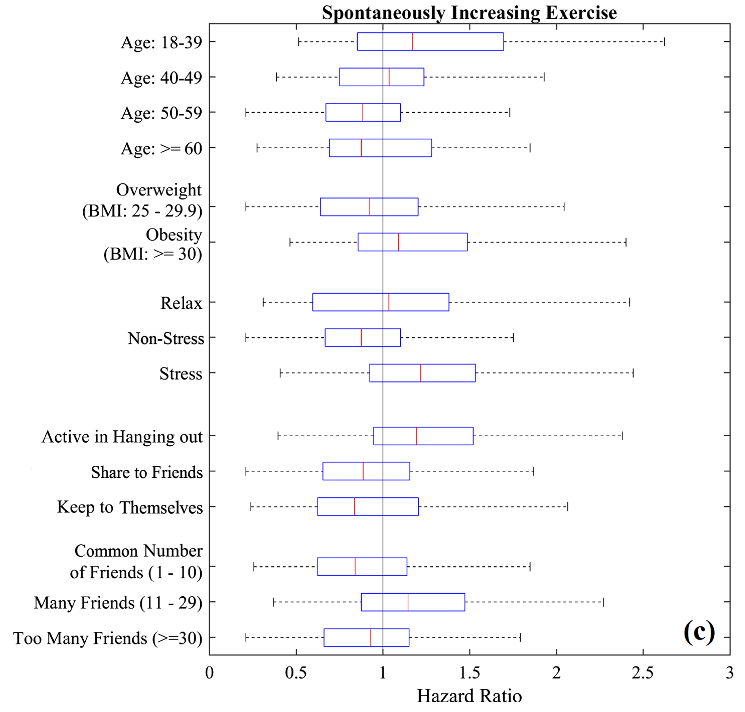 Figure (a) shows how attributes like Age and BMI correlate with influence and susceptibility. (b) and (c) highlight drivers for self-motivation and spontaneous activity.
Impact on Digital Therapeutics
The clinical outcomes of the YesiWell study are striking. Participants in the social network didn't just walk more; they saw tangible results:
- Weight Loss: 5.2 lbs lost for YesiWell users vs. 1.5 lbs for the control group.
- Walking Increase: A massive 164% jump in weekly leisure walking minutes (from ~129 min to 341 min).
Critical Insight & Conclusion
This paper moves the needle from "digital apps as tools" to "digital apps as social ecosystems." The takeaway for developers and researchers is clear: Personalization is paramount.
If you know a user is "highly susceptible" but "keep-to-themselves," you shouldn't just send them generic alerts. Instead, you should pair them with a "relaxed influencer" in a small, high-engagement group. The future of healthcare isn't just about tracking steps; it's about engineering the social fabric that makes those steps inevitable.
Limitations: The study cohort focused on overweight and obese individuals, so the dynamics might differ in a general population. Additionally, the social interactions were limited to the platform's specific features (games, messages).