
Social Multimedia: Bridging the Semantic Gap via Community Context
Social multimedia: highlighting opportunities for search and mining of multimedia data in social media applications
This paper introduces the concept of "Social Multimedia," a framework that leverages social media context and community curation to enhance multimedia search and mining. By combining noisy social metadata (tags, geo-location) with unsupervised content analysis, the author demonstrates SOTA-level improvements in representative image selection (Flickr Landmarks) and automated video synchronization (Concert Sync).
TL;DR
In this seminal work, Mor Naaman redefines the boundary between Computer Vision and Social Media. By introducing the term Social Multimedia, the paper argues that we shouldn't just look at what is in a photo, but where, when, and why it was shared. Through two robust applications—Flickr Landmarks and Concert Sync—the research demonstrates how noise-heavy social data can be transformed into high-precision discovery engines using a structured four-step mining pipeline.
Problem & Motivation: The Noise and the Gap
For decades, multimedia researchers have struggled with the Semantic Gap: a machine sees a grid of pixels (RGB values), while a human sees "The Golden Gate Bridge."
While modern social platforms like Flickr and YouTube provide a "Big Data" solution, they introduce a new problem: Unstructured Noise. Tags are often misleading (e.g., a photo tagged "Bay Bridge" taken from the bridge but not showing it). Standard content-based retrieval fails at scale because it is too computationally expensive to process billions of items without a prior "anchor" of context.
Methodology: The Four-Step "Social Multimedia" Pipeline
The author proposes a generalized approach to move from raw, noisy web data to highly organized, representative collections.
1. Contextual Filtering
Instead of analyzing all images for "tigers," the system uses Geo-tags and Time-stamps to narrow the search space. For landmarks, it uses TF-IDF on geographic clusters to find "location-driven" tags that are statistically unique to a specific coordinate.
2. Domain-Specific Content Analysis
Once the data is filtered, the system applies unsupervised algorithms tailored to the task:
- For Images (Landmarks): Using SIFT (Scale-Invariant Feature Transform) and global color/texture features to find "Canonical Views"—the most recognizable angles of a landmark.
- For Video (Concert Sync): Using Audio Fingerprinting (Short-time Fourier transforms) to find temporal overlaps between clips captured by different users at the same show.
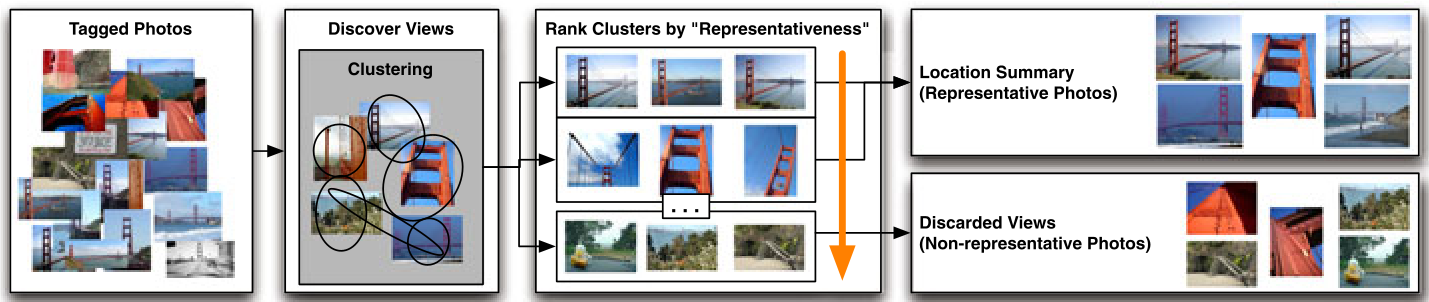 Above: The content analysis process for identifying canonical landmark views.
3. Metadata Refinement
This is the "Magic Step." By linking multiple resources together (e.g., five videos showing the same 10 seconds of a song), the system can:
- Identify the highest quality audio track among redundant clips.
- Extract song titles automatically by looking for common tags across overlapping video clusters.
4. Leveraging Human Interaction
The final layer uses Implicit Feedback. If users consistently click to expand a specific photo of the Eiffel Tower, the system learns that this view is "representative," even if the initial algorithm was unsure.
Experiments & Results: Precision Over Recall
The research shifts the focus from "finding everything" (Recall) to "finding the best" (Precision).
Concert Sync Performance
The system effectively synchronized multiple viewpoints of live music events. By utilizing the graph structure of matching hash values (Audio Fingerprints), the system identifies different camera angles for the same moment in time.
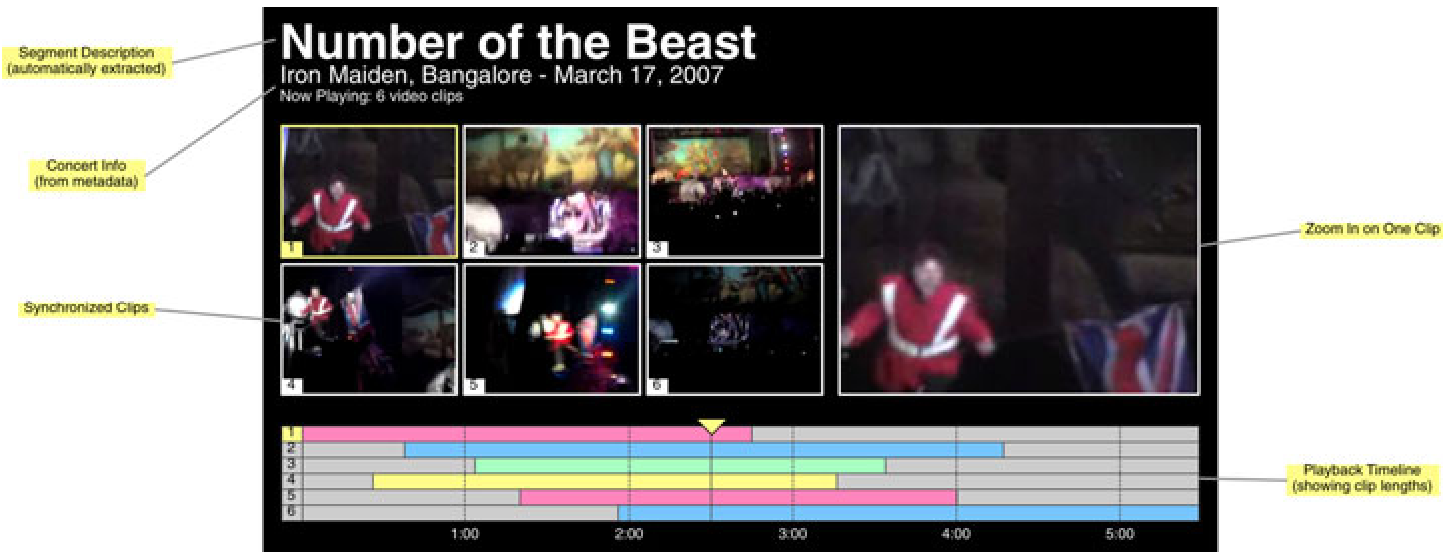 Figure: The Concert Sync interface allows users to switch between different community-contributed angles while maintaining a single, high-quality audio stream.
Key Findings
- Importance Mining: The number of people recording a specific moment serves as a proxy for "interest levels," allowing the system to automatically summarize a two-hour concert into its most viral highlights.
- Tag Accuracy: By using cluster-based TF-IDF, the system successfully extracted song names like "Intervention" or "Fear of the Dark" for clusters where the individual video titles were often just "IMG_004.mov."
Critical Analysis & Conclusion
This paper was ahead of its time in recognizing that community behavior is a feature, not a bug.
Strengths:
- Robustness: By using unsupervised methods (SIFT, Audio Fingerprinting), it avoids the need for massive labeled training sets which are impossible to maintain for the "Long Tail" of global landmarks and events.
- Human-Centric: It integrates HCI (Human-Computer Interaction) principles directly into the mining pipeline.
Limitations:
- Data Sparsity: For less popular landmarks or small local concerts, the lack of "social density" (multiple users) prevents the aggregate mining steps from working effectively.
- Evaluation Complexity: As the author notes, evaluating "representative visualization" is subjective and requires deep qualitative research rather than just clicking a F1-score button.
Takeaway: Social Multimedia isn't just about the media; it's about the Social Context surrounding it. This work paved the way for modern geo-spatial search and the collaborative curation systems we see in today's social platforms.