
Social Graphs Meet Image Retrieval: Refining the Manifold via Three Degrees of Influence
15838_Social Neighborhood Graph and Multigraph Fusion Ranking for Multifeature Image Retrieval.
The paper introduces two unsupervised graph-based methods, N3G (k-nearest neighbors' neighbors' neighbors' graph) and MFR (multigraph fusion ranking), for multifeature image retrieval. It provides the first theoretical proof using probability theory to explain how integrating multiple independent features reduces error and improves ranking consistency.
TL;DR
This research bridges social network theory and computer vision by introducing N3G (a three-tier neighborhood graph) and MFR (Multigraph Fusion Ranking). By treating images as "social nodes," the authors filter out visual outliers and fuse multiple independent features (CNN, SIFT, HSV) to achieve SOTA retrieval performance. Crucially, they provide a probabilistic proof explaining why multifeature fusion inherently boosts accuracy.
Background: The Manifold Trap
Most image retrieval systems fail because they treat similarity purely as a distance metric (Euclidean/Manhattan). This ignores the manifold structure of data. In a high-dimensional space, an "outlier" might be closer to the query than a "relevant" image simply because the manifold is curved or intersected by another category.
As shown in the paper's motivation, the problem is two-fold:
- Visual Outliers: Images that are near the query but don't belong to its class.
- Adjacent Manifolds: Samples from a different category that happen to sit near the query's manifold boundary.
Methodology: The Three Degrees of Influence
The core innovation is the N3G (Neighbors' Neighbors' Neighbors' Graph). Inspired by the principle that your true influence in a social network extends to three degrees, the algorithm builds a relationship weight based on the Jaccard coefficient of shared "friends" across three levels.
1. N3G: Cleaning the Candidate Set
Instead of trusting the immediate neighbors (KNN), N3G looks at the neighborhood of the neighborhood. If an image is a "friend of a friend of a friend" of the query, it is weighted more heavily. This automatically prunes outliers that might appear close in distance but lack a dense relational structure within the manifold.
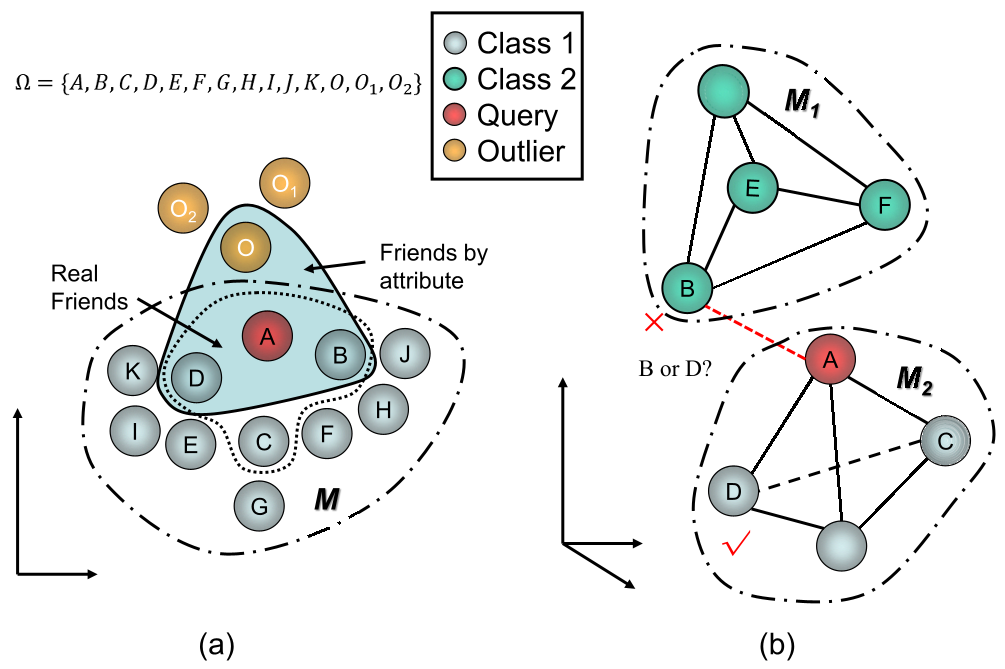 Figure 1: Comparison of how outliers (O) and adjacent manifolds (M2) interfere with standard retrieval compared to the proposed graph approach.
2. MFR: Probabilistic Fusion
Once N3G refines the neighbors for individual features (e.g., Color vs. Shape), the Multigraph Fusion Ranking (MFR) combines them. The authors prove that if features are independent, the fusion weight is linear to the probability of similarity.
The MFR selection process: This equation ensures that the next image added to the results list is the one most "connected" to the group of images already selected, rather than just the query itself.
Experimental Battleground
The researchers tested N3G and MFR across diverse datasets like UK-bench, Corel-1K, and Cifar-10.
Key Performance Wins:
- UK-bench: Achieved an NS-score of 3.93/4.0, outperforming most state-of-the-art methods like Sparse Contextual Activation (SCA).
- Generalization: Unlike iterative "diffusion" methods, N3G-MFR is efficient. It handles "out-of-sample" extensions without re-constructing the entire graph.
- Independence Matters: The performance gains were most significant when fusing highly independent features (e.g., CNN global features + VOC local features).
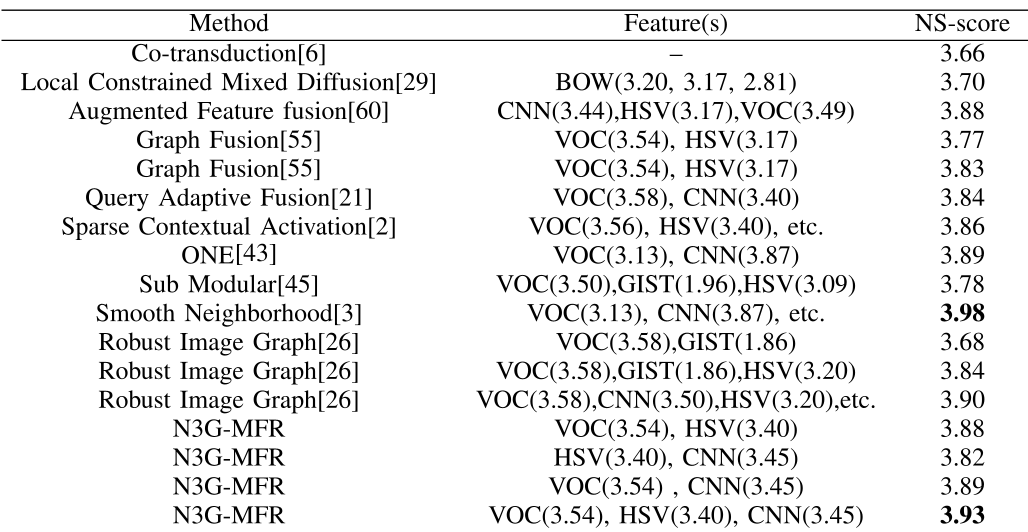 Table 1: N3G-MFR consistently dominates benchmarks when combining VOC, HSV, and CNN features.
Critical Analysis & Conclusion
Takeaways
The marriage of social networking principles and image retrieval is more than a metaphor—it provides a robust mathematical framework for manifold denoising. By focusing on the "community" around a query, the system becomes resistant to the noise inherent in individual feature descriptors.
Limitations
- Feature Dependency: If feature extraction methods destroy the underlying manifold structure, graph-based reranking cannot recover it.
- The "K" Constraint: The method requires the dataset to have a reasonable "image capacity" per category (k >> 1). On datasets like Holiday, where categories often have very few images, the probabilistic gains are minimized.
Future Outlook
The next frontier is integrating this graph-based fusion directly into the feature extraction pipeline (e.g., End-to-end Graph Neural Networks), potentially allowing the model to learn fusion weights dynamically during the training phase.