
Hyperbolic Ad Allocation: Solving Billion-User Optimization with 2D Geometry
Social network ad allocation via hyperbolic embedding
This paper introduces a novel offline Social Network Service (SNS) Ad allocation framework that leverages hyperbolic embedding and "unit impression decomposition." By mapping complex social networks into a 2D Poincaré disc, the authors transform high-dimensional integer programming (IP) problems into scalable geometric optimizations, achieving near-optimal results while significantly reducing computational overhead.
TL;DR
The core challenge of Ad allocation in Social Network Services (SNS) is balancing advertiser budgets, user influence, and fairness at scale. This paper moves away from the "curse of dimensionality" inherent in Integer Programming (IP) by embedding social networks into a 2D Poincaré disc. By representing allocation strategies as geometric shapes—such as fans and rings—the authors achieve a 6-order-of-magnitude speedup over traditional baselines while maintaining near-perfect revenue optimality.
Problem & Motivation: The SNS Scalability Wall
In search engine advertising (the "AdWords" model), impressions are isolated events. In SNS, a single user might have ten impressions a day, and an Ad engagement by one user ripples through their ego-network via social influence.
From an optimization perspective, the standard approach is Integer Programming (IP). However, if you have 1 million advertisers () and 1 billion users (), your decision matrix for who gets which impression becomes an impossible variables. Furthermore, representing "Fairness" (e.g., ensuring all advertisers get a similar distribution of high-influence users) is mathematically messy in a discrete graph setting.
Methodology: The Geometry of Influence
The authors' breakthrough is utilizing the hidden underlying structure of social networks: Hyperbolic Geometry.
1. Hyperbolic Embedding
Social networks are scale-free and follow a power-law degree distribution. These properties emerge naturally in hyperbolic space. By mapping users to a Poincaré disc, the distance from the center () correlates with user influence (degree).
- Node Density: .
- Degree Distribution: .
2. Unit Impression Decomposition
To handle users with multiple impressions, the authors decompose the SNS into a series of "Unit Impression Graphs" (), where each user has exactly one impression. This allows for a multi-stage optimization where users are removed from the disk once their daily impressions are exhausted.
3. Allocation as Shape Design
The most intuitive part of the method is translating business rules into 2D shapes:
- Fan (Pie) Shape: Used for Fairness. Since the degree distribution is uniform across angles , every advertiser (sector) gets the same demographic of "influentials" vs. "followers."
- Ring Shape: Used for Priority. High-bid advertisers get inner rings (central influential nodes), while lower-priority Ads get outer rings.
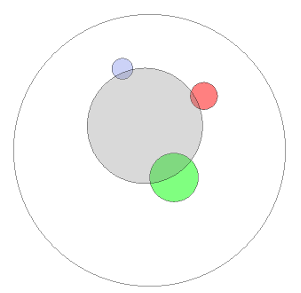 Figure 1: Visualizing how Fans and Circles partition the user population based on geometric embedding.
Experiments & Results: Efficiency without Loss
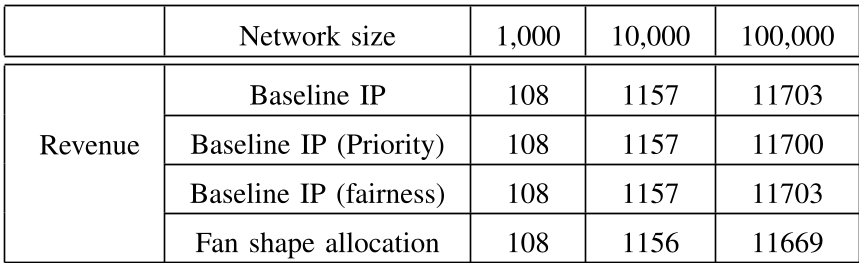
The team evaluated the framework using SNAP (Stanford Network Analysis Platform) datasets. They compared a "Fan-shaped" Linear Programming (LP) approximation against a baseline IP solver.
The "Free Lunch" of Speed
The results were striking. As the network size grew from 1,000 to 100,000 nodes, the IP solver's runtime spiked from 19 seconds to 500 seconds. In contrast, the Hyperbolic Fan Allocation remained virtually constant at roughly 0.07 seconds.

Revenue Stability
Crucially, this speed didn't cost revenue. The revenue generated by the geometric approximation was within 0.3% of the exact IP solution across all network sizes.
Critical Insight & Future Outlook
The genius of this approach is recognizing that we don't need to optimize for every individual user in a social network. Because social networks have a predictable statistical structure, we can optimize for regions of population.
Limitations:
- The paper currently focuses on a "Single Target Group" (homogeneous bids).
- The "Circle" shape allocation, while flexible for hybrid fairness models, introduces non-convexity which could slow down convergence.
Takeaway: As social platforms continue to scale, the transition from discrete graph algorithms to continuous geometric representations is no longer just a theoretical curiosity—it is a computational necessity.