
Understanding the Human Network: Agent-Based Insights into Disaster Behavior
Social Network Analysis of a Disaster Behavior Network: An Agent-Based Modeling Approach
This study presents a Social Network Analysis (SNA) and Agent-Based Modeling (ABM) framework to analyze human behavior during disasters using the eBayanihan platform. It identifies key actors through centrality measures to enhance Disaster Risk Reduction and Management (DRRM) strategies in the Philippines.
TL;DR
Disasters are not just physical events but social ones. This paper utilizes Agent-Based Modeling (ABM) and Social Network Analysis (SNA) to map how people in the Philippines interact during calamities. By analyzing data from the eBayanihan platform, the study identifies who truly holds influence in a crisis, revealing that while officials are central hubs, ordinary citizens often serve as the fastest bridges for information.
Motivation: The Behavioral Gap in DRRM
The UNISDR has long claimed that behavioral change is the key to reducing disaster losses. However, understanding why people act the way they do—and who they listen to—is notoriously difficult. Most existing models treat populations as uniform masses. This study breaks that mold by treating individuals as autonomous agents with specific tasks, beliefs, and levels of knowledge, mapping their interactions to find the "structural holes" and "power players" in a disaster network.
Methodology: Mapping the Invisible Grid
The researchers employed a two-pronged approach:
- Perceived Models: Using surveys to create matrices like Agent x Knowledge and Agent x Belief.
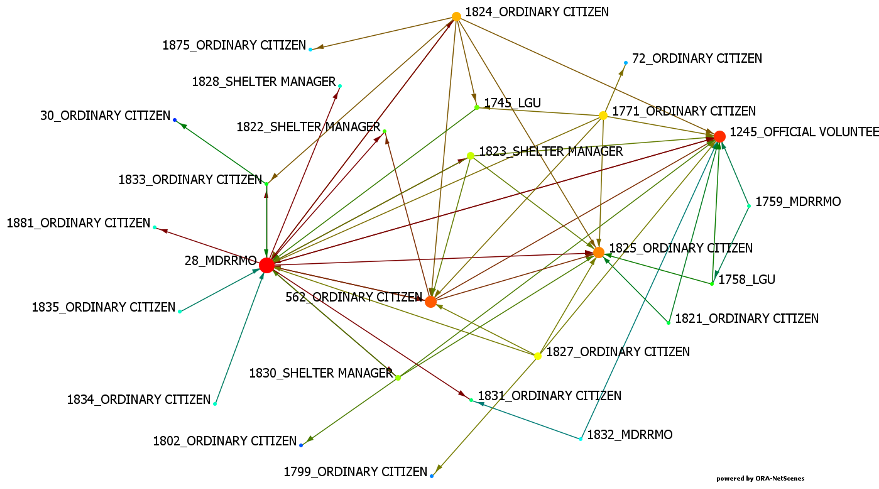
- Simulated Reality: Capturing real-time interactions on the eBayanihan platform during a simulated disaster event to build an Agent x Agent network.
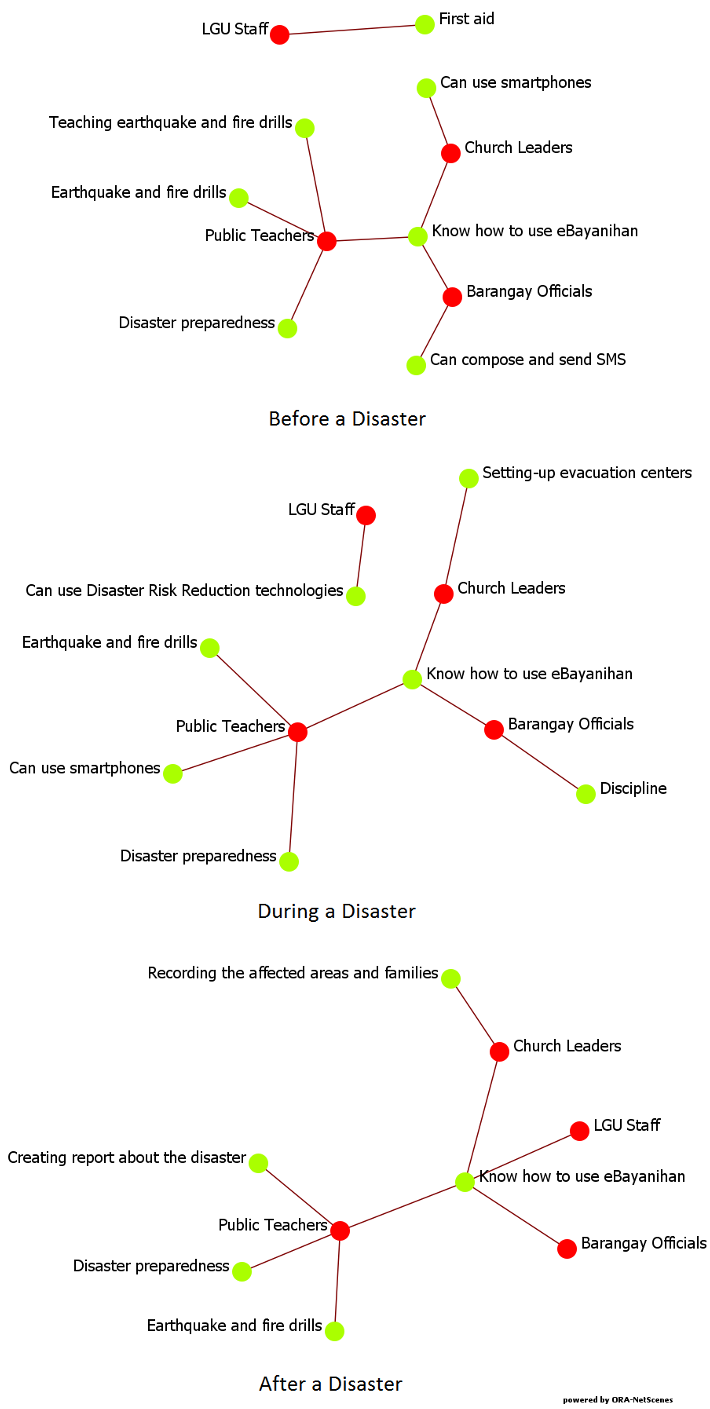
The "secret sauce" here is the use of ORA-Netscenes, a tool that allows for multi-dimensional network analysis. Instead of just looking at who talks to whom, they looked at who knows what and who is assigned to which task across three phases: Pre-disaster, During, and Post-disaster.
Core Insights: Who Really Matters?
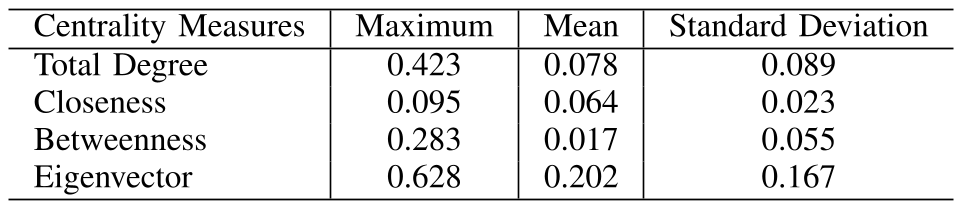
By applying four key Centrality Measures, the study discovered several non-obvious truths about disaster networks:
- Total Degree Centrality: The MDRRMO (Municipal Disaster Risk Reduction and Management Office) had the most direct links. This confirms their role as the "Command Center" for information dissemination.
- Closeness Centrality: Interestingly, an Ordinary Citizen (User 1771) scored highest here. This means they are "closest" to all other nodes and can receive or spread novel information faster than formal officials who might be bogged down in hierarchy.
- Eigenvector Centrality: This identifies "influence by association." The MDRRMO and certain Official Volunteers scored high, indicating they are connected to other highly active individuals, creating a robust core for the network.
Critical Findings: The "Indifference" Problem
The Agent x Belief models yielded a sobering insight: while technology instability is a technical hurdle, the biggest perceived hindrance to disaster recovery is the indifference of people. Furthermore, while knowledge of technology (using apps) was high, basic life-saving skills like first-aid and swimming were alarmingly scarce among the agents.
Conclusion and Future Outlook
This work proves that Social Network Analysis isn't just for marketing or social media; it is a life-saving tool. By identifying high-betweenness agents, disaster managers can proactively target "bridges" in the community to ensure that when a warning is sent, it doesn't just reach the "official" channels but permeates the entire social fabric.
Limitations: The study was conducted with a relatively small sample (23-27 agents). Future work must scale this to city-wide simulations to test if these centralities remain stable in a decentralized, high-noise environment.