
SNA-Based Test Packaging: Using Social Networks to Tame JUnit Complexity
Social Network Analysis in Software Testing to Categorize JUnit Test Cases based on Coverage Information
This paper introduces a novel technique for the automatic categorization of JUnit test cases into packages using Social Network Analysis (SNA). By modeling test cases as nodes and defining link weights based on code coverage similarity, the authors employ K-means clustering to dynamically reorganize test suites, achieving State-of-the-Art results in improving test package cohesion and coupling.
TL;DR
Maintenance is the "silent killer" of software budgets, and test suites are just as prone to erosion as production code. This paper proposes a first-of-its-kind approach: treating JUnit test cases as a social network. By analyzing how tests overlap in their SUT (System Under Test) coverage, the researchers automatically group tests into packages that are more cohesive and less coupled than those designed by humans.
Background: The Hidden Cost of Test Decay
In high-stakes software development, testing accounts for 40% to 80% of total costs. However, as requirements shift and code is refactored, the test suite often becomes a "black box." When a test fails, or a new developer joins, improper organization (packaging) makes it hard to identify the purpose of a test. The authors identify this as a specific "Test Smell" that directly inflates maintenance costs.
Methodology: Mapping the "Social Life" of Tests
The core innovation lies in the mathematical definition of a relationship between two test cases.
1. Constructing the Network
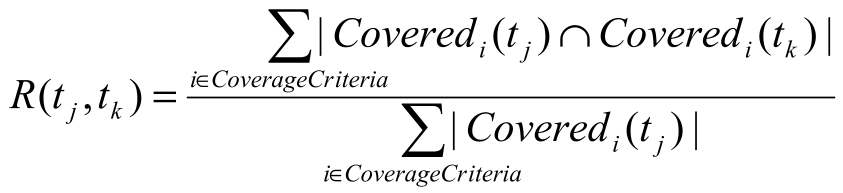
Instead of analyzing the code structure of the tests, the authors look at their behavioral footprints (statement coverage). If Test A and Test B cover the same lines of code in the SUT, they are "related."
2. The Similarity Formula
The relationship weight is defined by the ratio of shared coverage to total coverage. Unlike many metrics, this is directional (non-symmetric):
3. Clustering with K-Means
Each test case is assigned a feature vector based on its similarity to every other test in the system. These vectors are fed into a K-means algorithm to identify clusters. These clusters represent the optimized "packages."
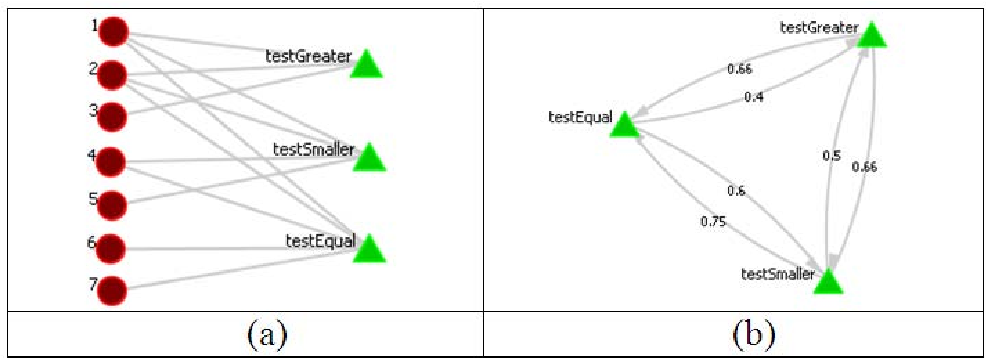 Figure: The transition from statement coverage (a) to a weighted Social Network (b).
Experiments & Results: Better than Human Design?
The authors tested their technique on three Java projects: Lurgee, Allelogram, and JMeter. They compared the SNA-generated packages against the original packages created by the developers using two primary metrics:
- Coupling: How much packages depend on each other (Lower is better).
- Lack of Cohesion (LCOM): How "unfocused" a package is (Lower is better).
Key Findings
| Project | Coupling Improvement | Cohesion Improvement (LCOM) |
|---|---|---|
| Lurgee | -0.08 (Reduction) | -0.11 (Better Cohesion) |
| Allelogram | -0.50 (Reduction) | Maintained |
| JMeter | -0.62 (Reduction) | Maintained |
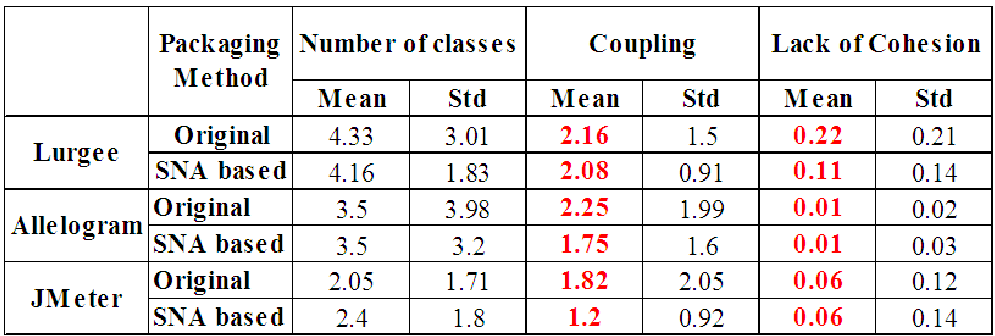 Table: Comparison of Original vs. SNA-based packaging across three SUTs.
The data suggests that the SNA-based method actually creates cleaner architectural boundaries than manual human design, specifically by reducing dependencies between packages.
Critical Analysis & Perspective
Why it Works
The "Insight" here is that coverage is a proxy for functionality. Tests that cover the same code paths are likely testing the same feature or module. By grouping them, we align the test structure with the actual behavioral structure of the software, rather than an arbitrary naming convention.
Limitations
- Instruction Granularity: The study only uses statement coverage. Incorporating branch or path coverage might provide even higher resolution for clustering.
- K-Value Selection: K-means requires a predefined number of clusters (). While the authors use a range based on existing packages, a fully autonomous system would benefit from algorithms like X-Means or Density-Based Clustering (DBSCAN) that determine the number of clusters automatically.
Conclusion
This paper bridges the gap between Social Network Analysis and Software Engineering. By automating the packaging of JUnit tests, it provides a dynamic way for test suites to "self-heal" and reorganize as the underlying system evolves. For developers, this means fewer "messy" test suites and a significant reduction in long-term maintenance overhead.