
The Organizational X-Ray: Leveraging SNA to Decode the Informal Power of Business
Social Network Analysis in Organization Development Studies i
This paper explores the application of Social Network Analysis (SNA) as a diagnostic tool for Organization Development (OD). By mapping intra-organizational networks of communication, advice, and support within a bank branch, the study identifies structural bottlenecks and optimizes human resource allocation to enhance productivity.
TL;DR
Modern organizations are more than just boxes on a chart; they are dynamic, living "webs of relations." This paper demonstrates how Social Network Analysis (SNA) can expose the hidden informal structures within a bank branch, identifying critical bottlenecks where formal authority fails and informal influence takes over.
Beyond the Org Chart: The Motivation
Why do some departments thrive while others fail despite having similar resources? The author argues that the answer lies in the informal network—the invisible pathways through which advice, support, and critical information travel. Prior scholarship often ignored these "intangible" relations. The motivation behind this study is to turn these invisible links into tangible data, allowing for precise Organization Development (OD) interventions.
Methodology: Mapping the Nervous System
The research utilizes Organizational Network Analysis (ONA), a subset of SNA tailored for corporate environments. The methodology involves:
- Actor-Relation Identification: Framing employees as "nodes" and their interactions (advice, routine communication, support) as "ties."
- Quantitative Metrics: Using Centrality (who is the hub?) and Density (how well-connected is the group?) to evaluate the health of the network.
- Visualization: Employing software like NetDraw to create topographic maps of influence.
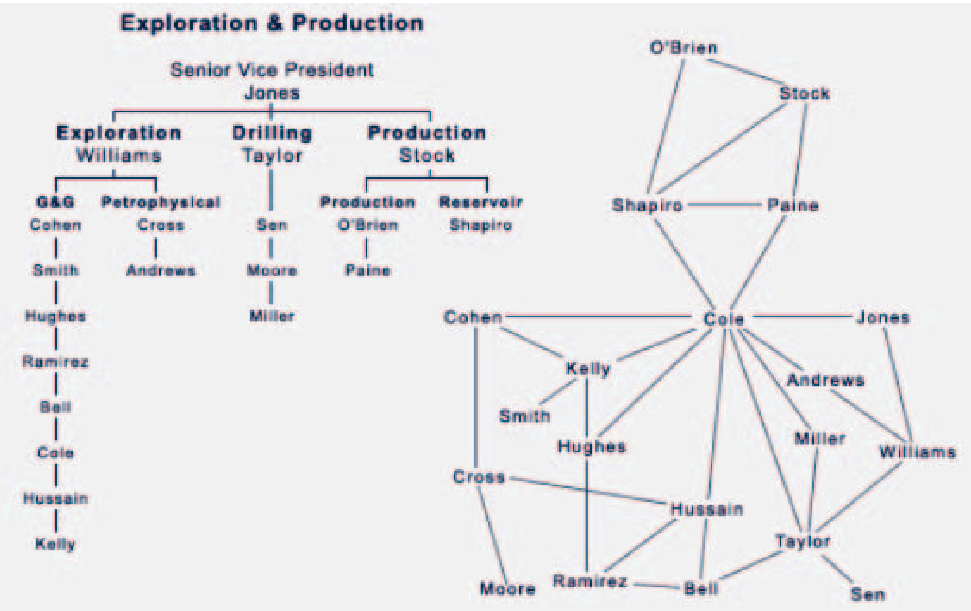 Figure 2: A striking comparison between a rigid formal hierarchy (left) and the chaotic, yet functional, informal communication network (right).
Experimental Insights: The Bank Case Study
The application at a Turkish bank branch revealed several "invisible" issues:
- The Over-Centralized Hub: Due to vacant management roles, the sole Director became a massive bottleneck, with a centrality score so high it hindered routine decision-making.
- The Isolated Silos: Despite working in the same branch, certain deputy directors had zero communication ties, revealing deep-seated friction that was invisible on the formal org chart.
- Inefficient Resource Flow: The marketing department was over-burdened because the "critical support" network showed they were essentially doing work for other units without formal recognition.
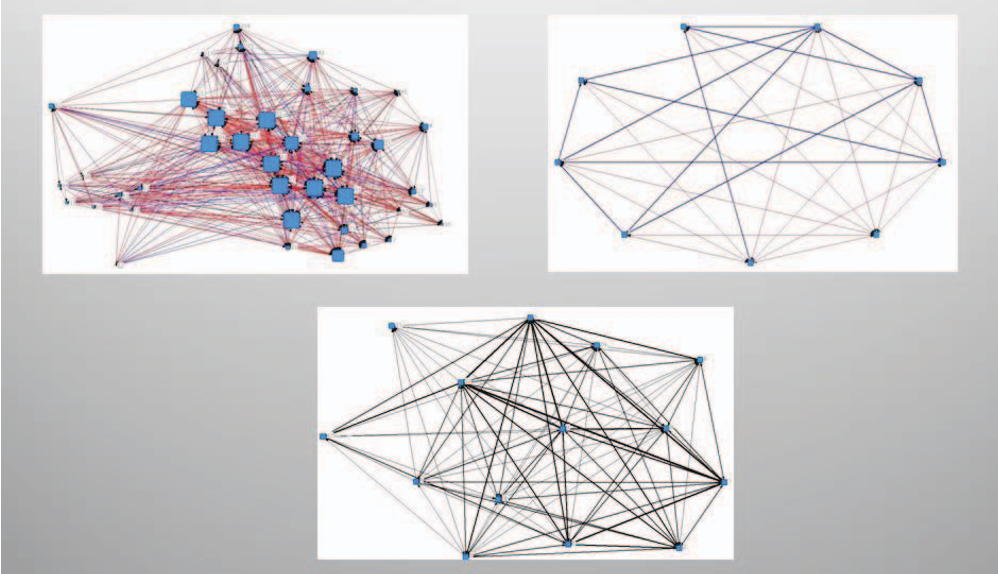 Figure 3: Multi-dimensional maps illustrating different network types (advice vs. routine work flow).
Critical Insight & Conclusion
The true value of this research lies in its characterization of SNA as an "X-ray diagnostic tool." It moves OD from a "trial-and-error" approach to a data-driven science.
Key Takeaways:
- Structure over Attributes: Performance is often a result of where you sit in a network, not just who you are.
- Strategic Restructuring: The study led to a recommendation to restructure the bank into specialized customer units, proving that network data can drive architectural changes in business.
While the study is limited to a single branch, it provides a powerful template for how managers can use graph theory to resolve "clogged" information flows and optimize the human element of production.