
Subgraph Generalization: Navigating the Trade-off Between Intelligence Sharing and Privacy
Terrorist or criminal social network analysis is helpful for intelligence and law enforcement force in investigation. However, individual agency usually has part of the complete terrorist or criminal social network and therefore some crucial knowledge is not able to be extracted. Sharing information between different agencies will make such social network analysis more effective; unfortunately, it may violate the privacy of some sensitive information. There is always a tradeoff between the degree of privacy and the degree of utility in information sharing. Several approaches have been proposed to resolve such dilemma in sharing data from different relational tables. There is not any work on sharing social networks from different sources and yet try to minimize the reduction on the degree of privacy. In this paper, we propose a subgraph generalization approach for information sharing and privacy protection of terrorist or criminal social networks. Our experiment shows that such approach is promising
This paper introduces a subgraph generalization approach designed for secure information sharing and privacy protection in terrorist or criminal social network analysis. By collapsing sensitive communities into "generalized nodes" with shared statistical properties, the method achieves localized privacy while enabling cross-agency intelligence fusion with significantly improved analytical accuracy (Closeness Centrality error reduced from 35% to 17%).
TL;DR
In the world of counter-terrorism and criminal investigation, no single agency has the "whole picture." While sharing social network data is crucial for identifying kingpins and gateways, privacy laws often block the exchange of sensitive identity data. This paper proposes a Subgraph Generalization approach that allows agencies to share "summarized" versions of their networks. By replacing sensitive sub-communities with statistical proxies, researchers reduced the error in social network metrics (like Closeness Centrality) from 35% to just 17% without exposing individual identities.
The "Partial View" Problem in Intelligence
Terrorist organizations are decentralized and elusive. As illustrated in the paper, agency A might know about a specific cell’s internal communication, while agency B knows how that cell connects to international financiers. If they don't share data, the "information hub" (the bridge between these two sets of information) remains invisible.
The traditional solution for tabular data—k-anonymity—fails here because social networks are defined by relationships. Simply removing a name isn't enough; the structure of the graph itself can reveal an identity (a "linking attack").
Methodology: The Core Architecture of Subgraph Generalization
The authors propose a shift from sharing raw nodes () and edges () to sharing a Generalized Graph.
1. Partitioning and Collapsing
A complex graph is partitioned into disjoint subgraphs. Each subgraph is treated as a "Generalized Node." The internal structure (who talks to whom inside a cell) is hidden, but the "macro" connections between cells are preserved if the connecting nodes are public knowledge.
2. Sharing Geometric Attributes
Instead of a node list, a generalized node shares attributes like:
- N: Total number of hidden nodes.
- L_SP: The maximum length of the shortest path within that collective.
- AVG_SP: The average internal distance.
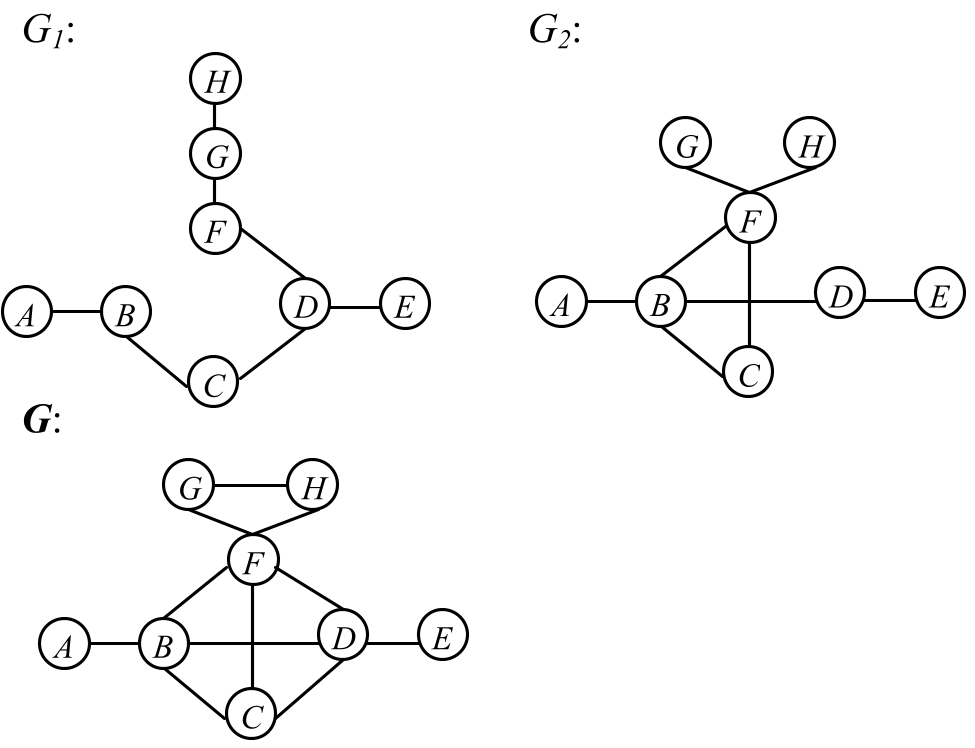 Figure: The process of integrating partial graphs G1 and G2 into a complete network G.
3. Estimating Distances (The Formulaic Intuition)
To compute social network centrality across agencies, the system calculates estimated distances. For example, the average distance () between a node in one agency's network and in another's is calculated as: This formula essentially treats the hidden subgraphs as "black boxes" with known transit times, allowings for a global calculation without seeing the internal "wires."
Experimental Validation: Accuracy vs. Privacy
The authors tested their approach by simulating data sharing between agencies. They focused on Closeness Centrality, a measure of how "central" a person is in a network.
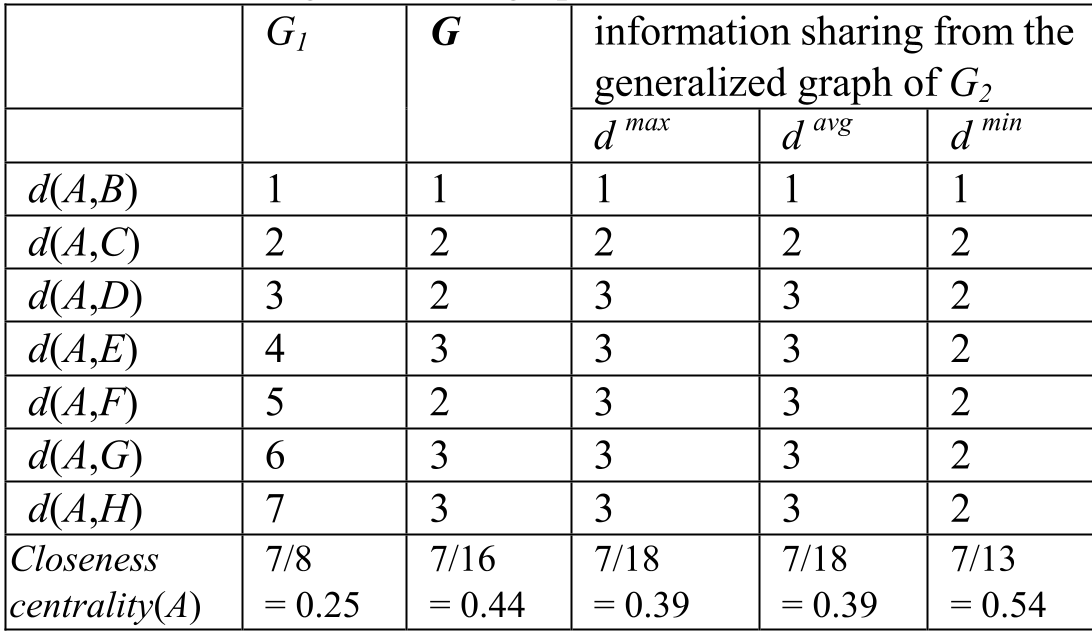 Table: Comparison of accuracy between partial data, full data (Benchmark), and generalized sharing.
Key Results:
- No Sharing: Error rate of 35% in centrality calculations.
- Generalized Sharing (d_avg): Error rate dropped to 17%.
- Insight: Sharing even just the "average internal distance" of a community provides enough signal for law enforcement to identify major hubs without compromising individual privacy.
Case Study: Online Cyberactivism
The paper applies these techniques to a case study of "Free Tibet" online activities. Through Web Site and Forum Analysis, they identified that:
- tibet.org acts as a major information hub, characterized by a high variety of "hub words."
- Forums like FreeTibetAndYou showed significant activity decay, with a small "vital few" (power users) contributing the vast majority of content.
Critical Insight & Conclusion
The genius of this work lies in treating graph geometry as a privacy tier. Instead of a binary "share vs. don't share," it provides a sliding scale. By adjusting what metadata is included in a generalized node (e.g., adding the range of node degrees or relationship types), agencies can tune the balance between utility (how useful the data is for catching criminals) and privacy (how well it protects citizens/informants).
While modern techniques like Differential Privacy have since emerged, this "Generalized Node" approach remains a foundational logic for Federated Social Network Analysis in security-sensitive domains.