
Decoding the Metaverse: Social Network Analysis in Virtual Worlds
Social Network Analysis of Virtual Worlds
This paper presents a social network analysis of virtual worlds by crawling data from Second Life to map avatar connections based on shared group memberships. It introduces a weighted undirected graph approach to represent 1.6 million avatars and compares its structural metrics to traditional "flat web" social networks like Facebook and Orkut.
TL;DR
This research investigates whether social structures in 3D immersive environments like Second Life mirror those of traditional social media. By crawling over 1.6 million avatars and mapping their connections through shared groups, the study reveals that virtual world networks are structurally similar to the "flat web," featuring small-world properties and similar degree distributions. This suggests that the "3D-ness" of the environment doesn't fundamentally change how humans (or their avatars) aggregate.
Background: Beyond the Flat Web
While we understand the social graphs of Facebook or LinkedIn, the "Virtual World" represents a different beast—an immersive, spatialized ecosystem. The authors argue that as these worlds become more fragmented, we need a rigorous way to map avatar connections to improve content recommendation and interface design.
The central question: Does an avatar in a 3D space behave like a user on a 2D profile page?
Methodology: Mapping the Avatar Graph
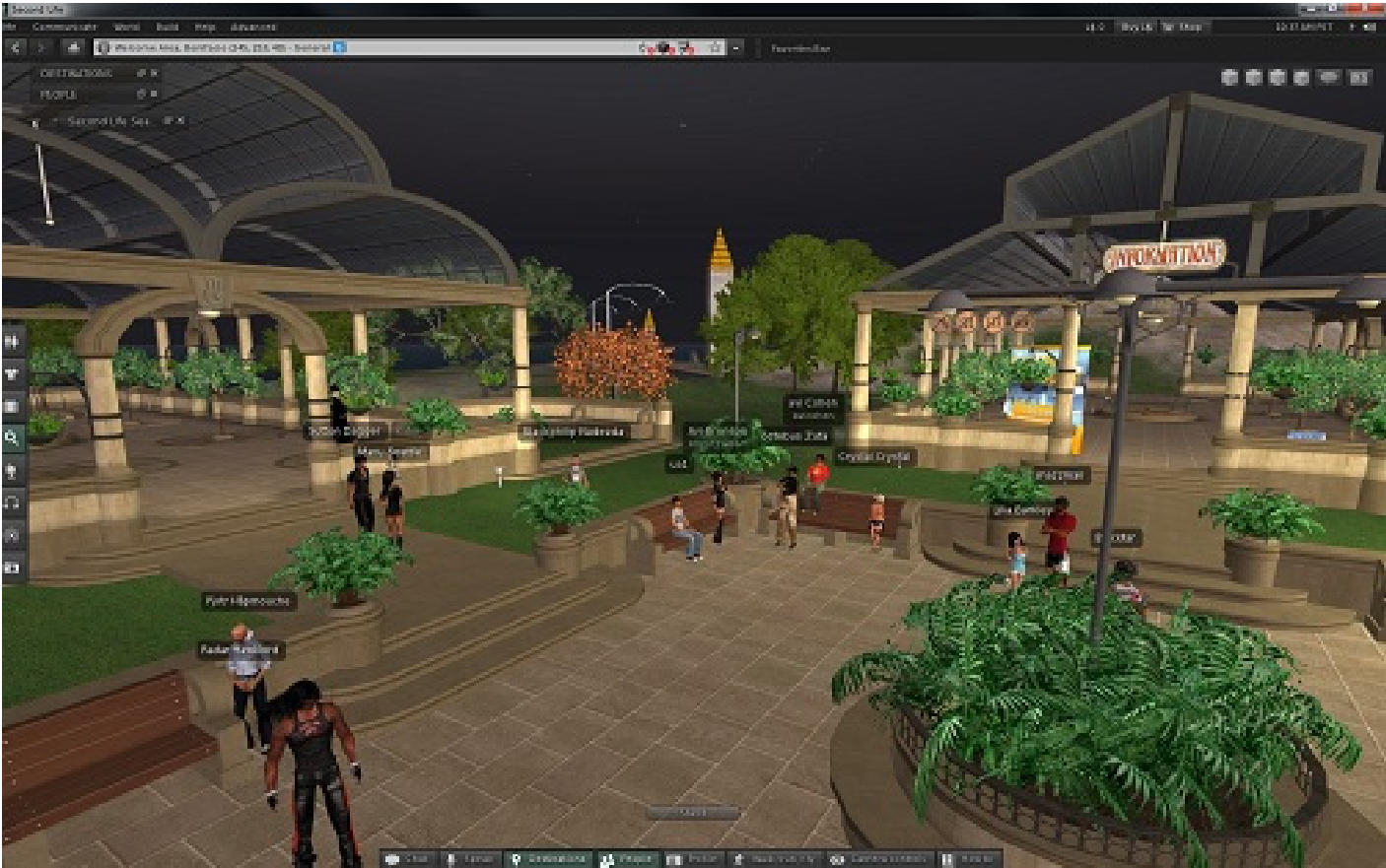
The researchers built a custom semi-autonomous crawler to navigate Second Life and collect data on 1,628,532 avatars and 310,702 groups.
The Proxy for "Friendship"
In Second Life, explicit "friend" lists are often private. To bypass this, the authors used shared group memberships as a proxy for social connection.
- Nodes: Avatars.
- Edges: Shared groups (Weight = Number of groups in common).
Scaling Challenges
Large groups (e.g., those with >20,000 members) create an exponential "edge explosion" that can crash graph processing software. To solve this, the authors used power-law analysis to prune the top 1% of largest groups, focusing on the 99th percentile (groups with 457 members) where social ties are likely more meaningful.
Experimental Insights: Virtual vs. Physical Sociality
1. Small World Properties
The study compared two versions of the network: All_Edges and All_Except_1_Edge (requiring 2+ shared groups). Both showed a high degree of connectivity. The average path length in the virtual world (2.96 to 4.89) is actually lower or comparable to Orkut (4.25) and Flickr (5.67), proving that the "six degrees of separation" rule is even tighter in virtual spaces.
2. The Power of "Weak" vs. "Strong" Ties
The comparison between these two networks (Table 3) is telling:
- All_Edges: 315 Million links.
- All_Except_1_Edge: 10 Million links.
Removing ties where avatars share only one group cuts the network density by 96%. However, the core component remains intact, representing a "robust backbone" of the virtual society.
3. Joint Degree Distribution
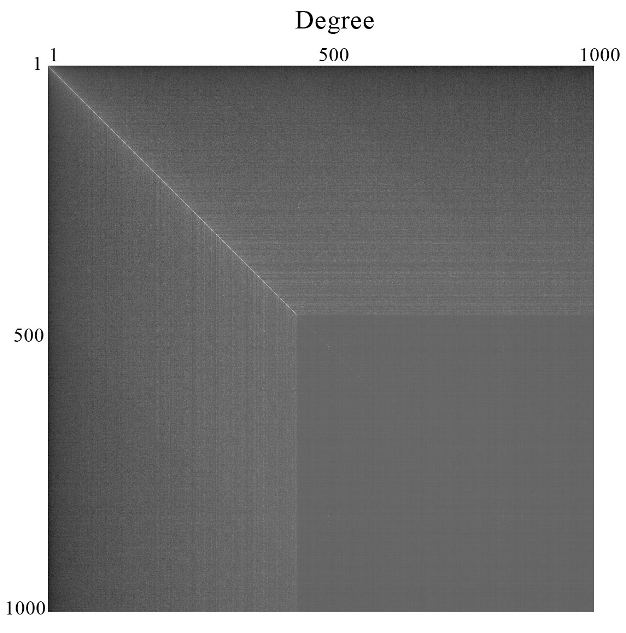
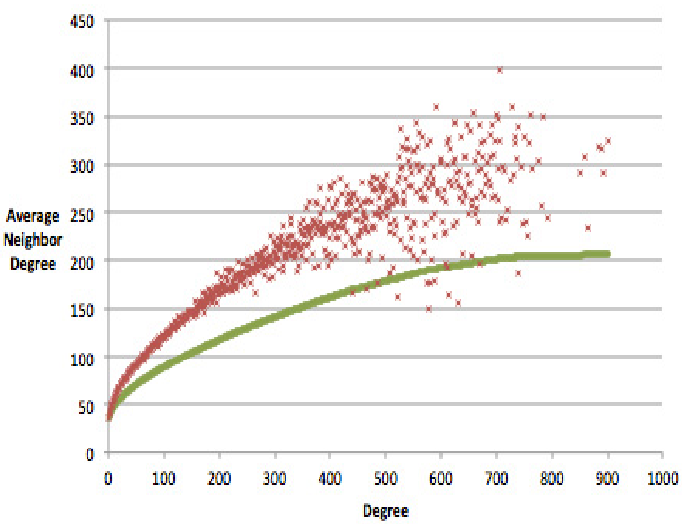
The authors utilized Joint Degree Distribution (JDD) to visualize connectivity patterns. As seen in the heatmaps, there is a distinct diagonal trend: avatars tend to connect with others who have a similar number of connections (assortative mixing), a classic trait of human social networks.
Key Results & Comparative Analysis
Comparing Second Life to "Flat Web" data (Mislove et al.) yielded surprising results:
| Metric | Second Life (99%) | Orkut | YouTube |
|---|---|---|---|
| Avg Path Length | 2.96 | 4.25 | 5.10 |
| Diameter | 9 | 9 | 21 |
| Radius | 7 | 6 | 13 |
The virtual world network is more compact than YouTube and remarkably similar to Orkut, which is also an undirected network. This suggests that the lack of "directionality" in virtual world group memberships creates a more cohesive, tightly-knit social fabric.
Critical Insight & Future Outlook
The most profound takeaway is that immersion does not equal deviation. Even when users are represented by fantastical avatars in 3D spaces, their organizational logic—how they form groups and link to one another—remains grounded in the same social physics that govern "The Flat Web."
Limitations: The study relies on group membership rather than direct interaction (chat/proximity). Future work should integrate spatial proximity data (e.g., "how often do two avatars stand near each other?") to refine the definition of a "link."
Conclusion: For developers building the next generation of the Metaverse, this is good news: your existing toolkits for search, ranking, and social recommendations are more applicable than you might think.