
Social-Aware D2D: Bridging Virtual Interests and Physical Proximity for 5G Offloading
14379_Social Network Aware Device-to-Device Communication in Wireless Networks.
This paper proposes a social-aware Device-to-Device (D2D) communication framework that optimizes traffic offloading in wireless networks by integrating Online Social Networks (OnSN) and Offline Social Networks (OffSN). The authors utilize the Indian Buffet Process (IBP) to model content popularity and a Gamma distribution for user encounters, achieving a significant increase in system data rate (up to 2x) compared to traditional cellular-only models.
TL;DR
As wireless networks face a massive capacity crunch, traditional cellular architectures are struggling under the weight of redundant content requests. This paper introduces a dual-layer approach: using the Online Social Network (OnSN) to predict what users want and the Offline Social Network (OffSN) to determine how to deliver it reliably. By combining the Indian Buffet Process (IBP) with a social "closeness" metric, the authors achieve a 200% data rate improvement through efficient, stable D2D traffic offloading.
Problem & Motivation: The Mobility Paradox
The fundamental challenge in D2D (Device-to-Device) communication is intermittency. Physical proximity is transient—two users walking past each other might trigger a D2D link that drops seconds later, forcing the Base Station (BS) to resume the transmission and wasting resources.
The authors' core insight is that social relations are more stable than physical locations. While a user's instantaneous GPS coordinate changes, their "encounter pattern" (who they work with, see at the gym, or live with) remains consistent. By shifting the D2D paradigm from "proximity-aware" to "social-aware," we can build links that aren't just close, but stably close.
Methodology: The Two-Layer Architecture
1. The Virtual Layer: Indian Buffet Process (IBP)
To predict content popularity, the authors move away from static zipf distributions. They utilize the Indian Buffet Process, a nonparametric Bayesian model where "customers" (users) sample "dishes" (content).
- External Influence: Users are influenced by what others have already downloaded.
- Innovation: Each user also has a probability of requesting "new" content.
- Learning: The BS learns the popularity matrix over time, allowing it to know which UEs already cache "old" content that others might want.
2. The Physical Layer: Social Closeness
Using a Gamma Distribution , the model captures encounter durations. They define a Closeness Metric (): This represents the probability that two users will stay in range long enough to finish a content transfer ().
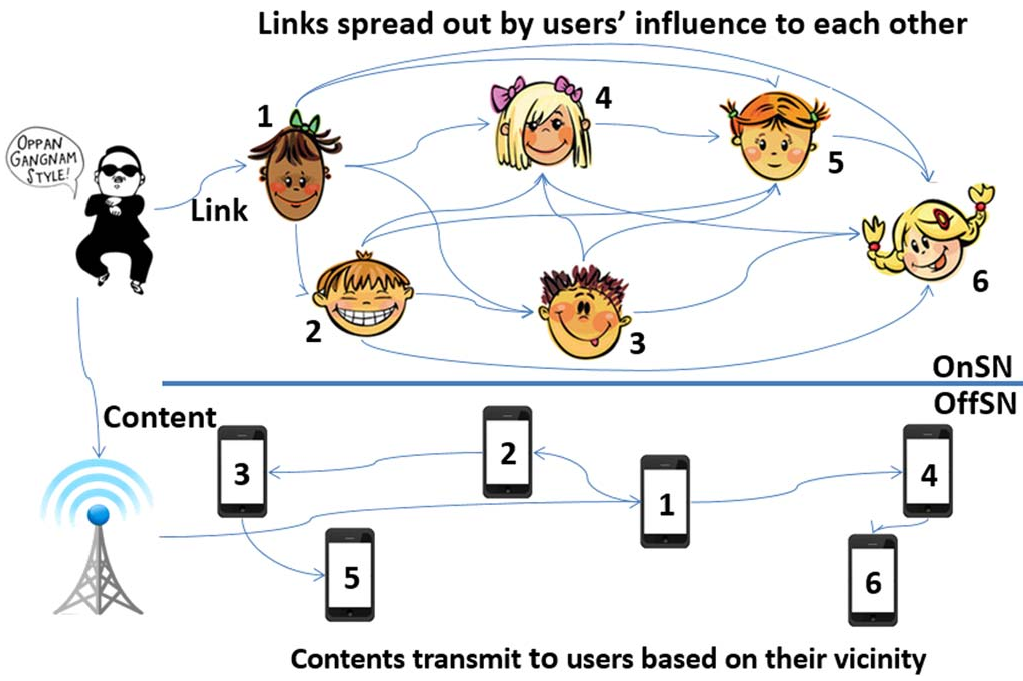 Figure 1: The dual-layer model showing the mapping between online influences and offline D2D encounters.
Proposed Algorithm: Maximal Closeness
Unlike the standard "Nearest Neighbor" approach, this algorithm selects D2D pairs based on the highest .
- Request Stage: User requests a video.
- Analysis Stage: BS checks if the content is "old" (already in the local neighborhood).
- Selection Stage: BS identifies all UEs holding the content and picks the one with the highest social closeness to the requester, even if they aren't the absolute closest in meters.
Experiments and Results
The authors validated their model using real-world data from YouTube growth patterns and the CRAWDAD sensor mote dataset.
Performance Gains
The results are striking:
- Sum-Rate Enhancement: The D2D-underlaid network nearly doubled the system's data rate compared to traditional cellular networks.
- Robustness: As the cellular network size grows, the "Maximal Closeness" strategy significantly outperforms "Minimal Distance" because it prioritizes the stability of the link over the instantaneous SNR.
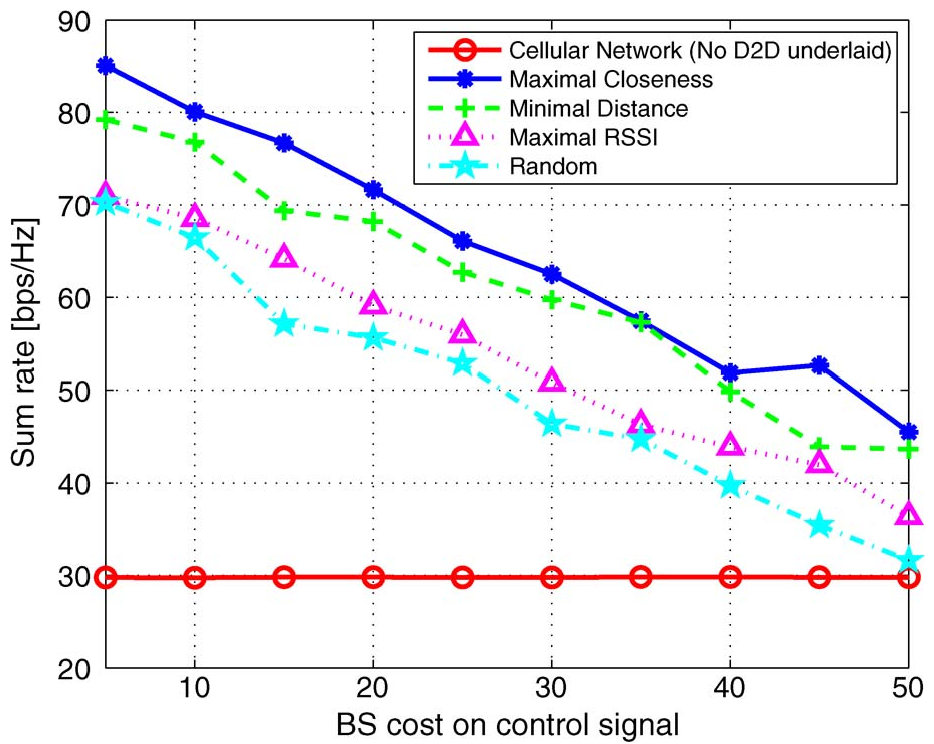 Figure 2: Impact of social activity () on the network data rate. Increased social participation leads to higher D2D offloading efficiency.
Critical Analysis & Conclusion
This paper succeeds in moving D2D research from pure signal processing into the realm of Social-Physical Network Science.
Key Takeaways:
- Why it works: By modeling the IBP, the BS doesn't just guess popularity—它 anticipates it based on recursive social feedback.
- Limitations: The model assumes the BS has access to encounter histories and content tags. In modern contexts, this raises significant Privacy concerns, which the authors acknowledge would require advanced encryption or incentive mechanisms for users to share their data.
Future Outlook: As we move toward 6G, "Social-Awareness" will likely move to the edge. Integrating this with Federated Learning could allow the "closeness" and "popularity" metrics to be calculated locally on-device, solving the privacy bottleneck while retaining the massive throughput gains demonstrated here.