
TS-SVM: Uncovering Organizational Anomalies through Temporal Social Network Mining
Social Network Based Anomaly Detection of Organizational Behavior using Temporal Paern Mining
The paper introduces a temporal pattern mining framework for detecting Organizational Behavior Anomalies (OBAnomalies) by modeling organizations as evolving social networks. It utilizes a novel TS-SVM approach that combines unsupervised One-Class SVM for filtering with supervised SVM classification to achieve SOTA performance in identifying event-related anomalies in dynamic interaction data.
TL;DR
Organizational Behavior (OB) isn't static; it's a living, evolving process. This paper presents a specialized framework to detect OBAnomalies—critical events like corporate collapses or terrorist attacks—by treating organizations as dynamic social networks. By implementing a clever two-step procedure (Unsupervised Filtering + Supervised Classification), the researchers achieve superior accuracy in identifying rare, high-impact events within noisy communication data.
Problem & Motivation: The "Needle in the Haystack" of Data
Most existing anomaly detection systems look for "point anomalies"—single data points that look weird. However, in a corporate or social organization, an anomaly isn't just a sudden spike; it's often a subtle shift in how people interact over weeks or months.
The authors identify three major pain points:
- Complexity of "Normal": Defining a stable "normal" state is nearly impossible as organizations naturally evolve.
- Feature Selection: Which of the hundreds of social network metrics (Centrality, Density, Clustering) actually signal a crisis?
- Data Imbalance: Significant events (like the Enron collapse) are extremely rare, making standard machine learning models prone to high false-positive rates.
Methodology: The Two-Step (TS-SVM) Approach
The core innovation is the decomposition of the detection task into a filtering stage and a refining stage.
1. Feature Engineering
Instead of just looking at current network metrics, the authors use:
- Current Behaviors: Basic stats like link counts and average speed of interaction.
- Temporal Comparisons: The "gap" between today's network and yesterday's (e.g., ).
- Historical Behaviors: Moving averages of the last seven timestamps to account for historical context.
2. The Architecture
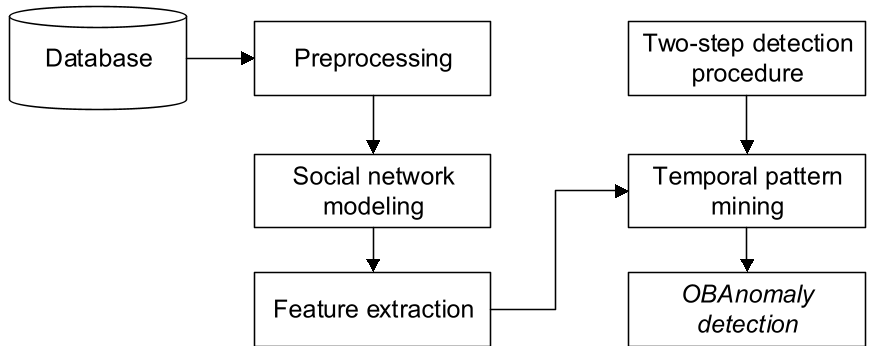
- Step 1: Regular Network Filtering: Using One-Class SVM (OC-SVM), the system aggressively discards clearly "normal" data. This reduces the search space and addresses the data imbalance.
- Step 2: OBAnomaly Detection: The "suspects" from Step 1 are fed into a supervised SVM. This stage uses historical event labels (like the FBI investigation into Enron) to learn the specific signature of a "meaningful" anomaly versus just random noise.
Experiments: Real-World Validation
The framework was tested on two iconic datasets: the Enron Email Network and the Al-Qaeda Attack Network.
Key Results:
- Precision and Recall: In the Al-Qaeda dataset, the TS-SVM reached a Recall of 0.889, meaning it successfully caught nearly 90% of documented events.
- Baseline Comparison: It outperformed standard Supervised Classifiers (Decision Trees, Neural Nets) and Unsupervised Outlier Detection (LOF, SPC) across all metrics.
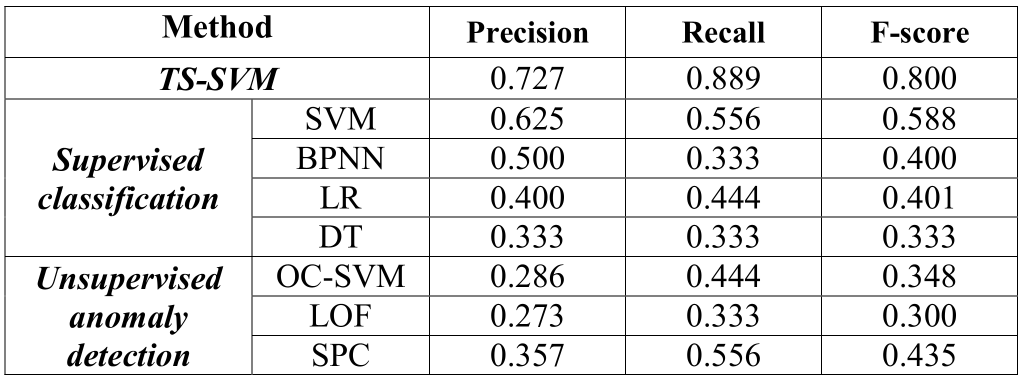
The results (shown in Table IV above) highlight that one-step methods either miss too many anomalies (low recall) or flag too many false alarms (low precision). The TS-SVM finds the "sweet spot" by leveraging labels only after the initial noise has been filtered.
Deep Insights & Conclusion
The physical intuition here is that organizational stress reveals itself through structural changes. When Enron was collapsing, the way executives corresponded changed—not just in volume, but in the "clique" structures and "information speed" of the network.
Takeaways for Researchers:
- Hybrid is Better: For rare event detection, don't jump straight to supervised learning. Use unsupervised methods to "clean" the distribution first.
- Context Matters: Including "Historical Behaviors" (averages) acts as a low-pass filter that helps the model distinguish between a temporary blip and a systemic shift.
Limitations:
The method currently treats all events as equal. Future work could differentiate between "positive" evolution (growth) and "negative" evolution (collapse or attack) by multi-class labeling.