
Leveraging the Social Graph for Semantic Modeling: Scaling Annotation via Collaboration
On the Social Network Based Semantic Annotation of Conceptual Models
This paper introduces a socio-technical approach to the semantic annotation of conceptual models by integrating social network application data. Utilizing the ADOxx-based SeMFIS toolkit, the author provides a modeling method and rule-based behavioral specifications to facilitate collaborative and semi-automated annotations.
TL;DR
Semantic annotation is the "bridge" that makes human-centric conceptual models (like flowcharts) machine-readable. However, annotating thousands of models manually is an economic nightmare. This paper proposes a novel solution: integrating Social Network Applications into the modeling process. By linking modelers via social graphs, we can use crowdsourcing and automated recommendations to make semantic annotation faster, cheaper, and more accurate.
Context & Motivation: The "Annotation Bottleneck"
Conceptual models—such as BPMN diagrams or IT architecture maps—are vital for human communication but are often opaque to machines. Semantic Annotation solves this by mapping model elements to formal ontologies (like OWL).
The problem? The "Knowledge Engineering Paradox." To make models smart, experts must spend hundreds of hours manually tagging them. Prior work attempted to automate this with NLP, but these "suggestions" still require human confirmation. The author argues that instead of relying purely on AI, we should leverage Social Intelligence—the connections, groups, and shared interests already present in digital social networks.
Methodology: Extending the SeMFIS Meta-Model
The core innovation lies in the architectural fusion of three distinct domains: Conceptual Models, Ontologies, and Social Networks.
1. The Meta-Model Architecture
The author extends the SeMFIS (Semantic Model Federation Integration System) toolkit. The meta-model acts as the "glue," defining how a business process element relates to an ontology concept, and crucially, which Social Actor performed that action.
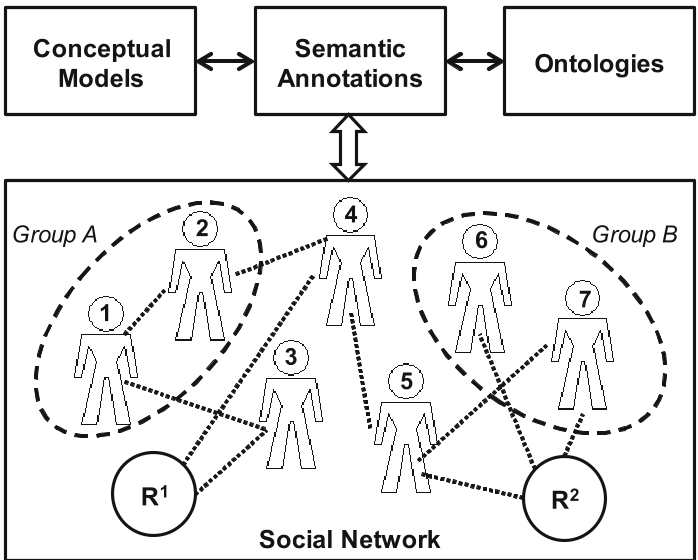 Figure 1: The Conceptual Framework linking Models, Ontologies, and Social Networks.
2. Rule-Based Behavior & Logic
Beyond just storing data, the system implements behavior through formal rules. For instance, if Actor A and Actor B both annotate different process models using the same "Risk Management" ontology term, the system recognizes a "shared interest."
The paper formalizes this using a recommendation function:
recommendConnection: (a × b) → [ 0 … 1 ]
As actors perform similar tasks, a "modification factor" () increases the likelihood of a system-suggested connection or group invitation, effectively creating a self-organizing community of experts.
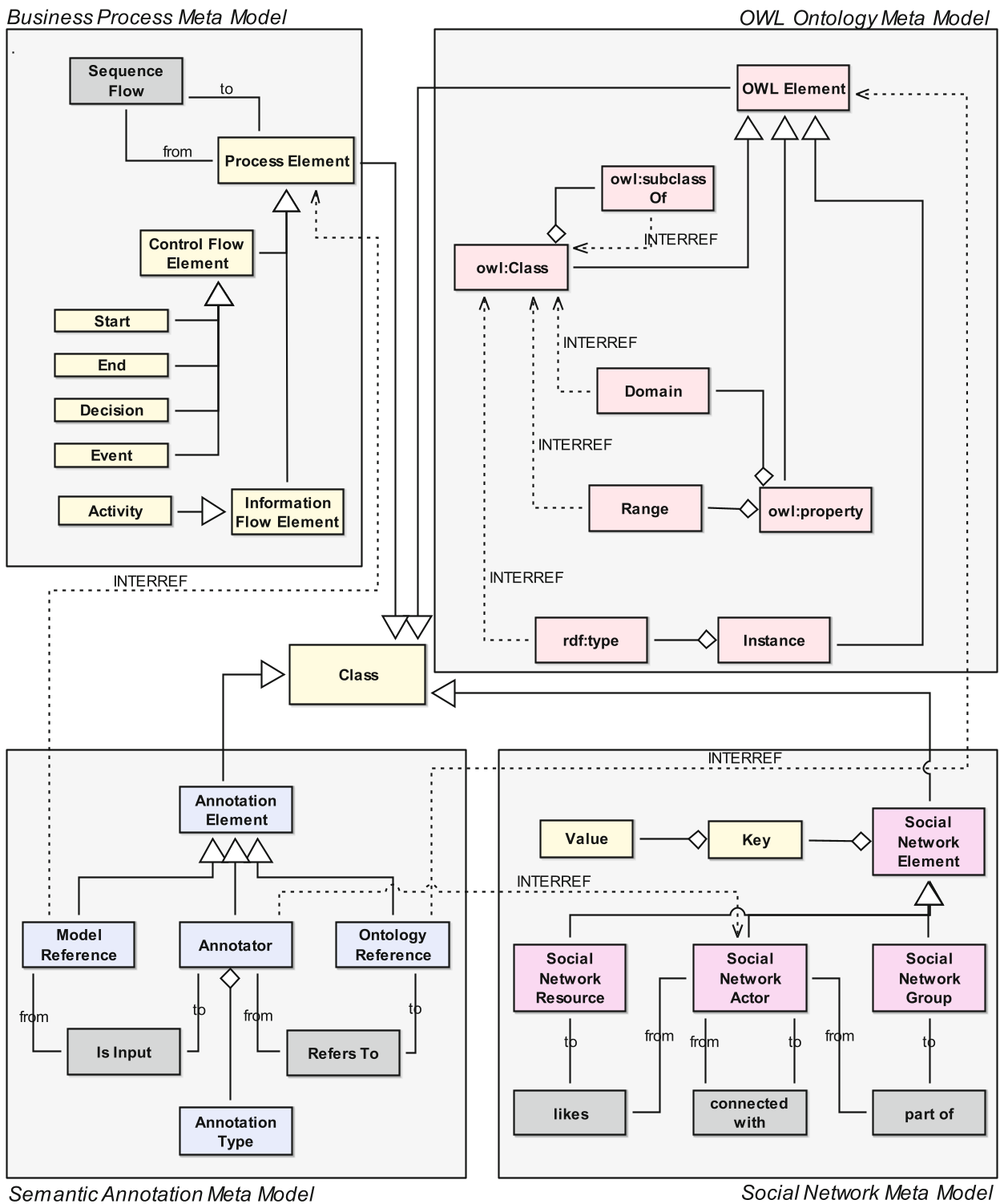 Figure 2: Excerpt of the extended meta-model implemented on ADOxx.
Experiments & Practical Implementation
The theory was put to the test using the ADOxx meta-modeling platform. The prototype demonstrates three key "Socio-Technical" benefits:
- Communication Support: Modelers can share annotations across their social feed, allowing peers to review or "like" specific semantic mappings.
- Economic Efficiency: By distributing tasks across a "Social Crowd," the burden on a single systems architect is drastically reduced.
- Technical Synergy: Using Social Network APIs (like Facebook Graph API) allows for seamless authentication (Single Sign-On) and profile management, lowering the barrier to entry for new users.
Critical Insight: Why This Matters
The genius of this work isn't just in the technical "linking" of databases, but in its recognition of the Inductive Bias of human expertise. Experts don't work in a vacuum; they work in social clusters. By capturing the metadata of "who knows what," the modeling tool evolves from a drawing board into a collaborative knowledge engine.
Limitations & Future Work
- Privacy: Merging professional modeling data with social network profiles raises significant privacy concerns that require robust group policy management.
- Noise: Social networks are notoriously noisy. Future iterations will need more sophisticated filtering to ensure that "crowdsourced" annotations remain high-quality.
Conclusion
This research marks a significant step toward Agile Semantics. By moving away from rigid, top-down annotation processes and embracing the fluid, collaborative nature of social networks, we can finally populate the "Semantic Web" of conceptual models at scale.