
Trust as an Epidemic: Decoding the Social-Based Propagation Model for P2P Security
A social network-based trust-aware propagation model for P2P systems
This paper introduces a Social Network-based Trust-aware Propagation (STP) model for P2P systems, integrating social trust mechanisms with aware-computing. It utilizes a Markov process to model dynamic trust transitions and evaluates stability through a modified SIS (Susceptible-Infected-Susceptible) epidemic dynamics model.
TL;DR
In the decentralized wilderness of P2P networks, "hard security" like encryption isn't enough to stop liars. This paper proposes a Social Network-based Trust-aware Propagation model that treats trust like a beneficial "virus." By using Markov processes and small-world dynamics, the model identifies malicious nodes and stabilizes the network, outperforming traditional trust models in both speed and robustness.
The "Soft Security" Motivation
Traditional security architectures are rigid. In a distributed P2P system, nodes are anonymous and dynamic; forcing a centralized authority to verify everyone is impossible. The authors argue that we should look at Social Networks. In human society, if Alice wants to trust Tony, she looks for a "trust path" (mutual friends).
The core problem is Awareness. Prior works often treated trust as a static value. This paper introduces Aware Computing, where trust is conditional: a peer might be trustworthy for high-bandwidth tasks but risky for sensitive data computation.
Methodology: The Three-Layer Architecture
The paper structuralizes trust propagation into three distinct functional layers:
- Computation Layer: Gathers raw context (CPU, memory, bandwidth) and computes initial fitness.
- Aware Layer: The "brain" that makes strategic decisions—to trust or not to trust—based on risks.
- Propagation Layer: Executes the strategy through mechanisms like Commissioned Transfer or Role Mapping.

The Mathematics of Trust
The authors define trust as a Markov Process. A peer's status (Trust/Distrust) transitions over time based on interactions. The intensity of trust-aware is calculated as: Where represents contextual parameters. This intensity dictates how fast a node adjusts its strategy when interacting with neighbors.
Trust Dynamics & The Small-World Effect
Borrowing from epidemiology (the SIS model), the authors view "distrust" as an infection.
- Trust nodes can be "infected" by malicious neighbors.
- Distrust nodes can be "healed" by positive interactions.
By leveraging Small-World properties (high clustering + shortcuts), trust propagates faster across the network. The dynamics equations suggest that while malicious nodes are never 100% eliminated, they can be marginalized to a "steady-state" minimum, preventing system-wide failure.
Experimental Validation
The model was tested on the ENCE (Ecological Network Computing Environment) platform against two major baselines: LDTP and MRFTrust.
Key Findings:
- Convergence: As "intensity of trust-aware" increases, the ratio of healthy trust nodes climbs to a stable ~85%.
- Resilience: When 20% of the network consists of malicious peers, the proposed model identifies them significantly faster than existing models, maintaining a higher average trust value across the system.
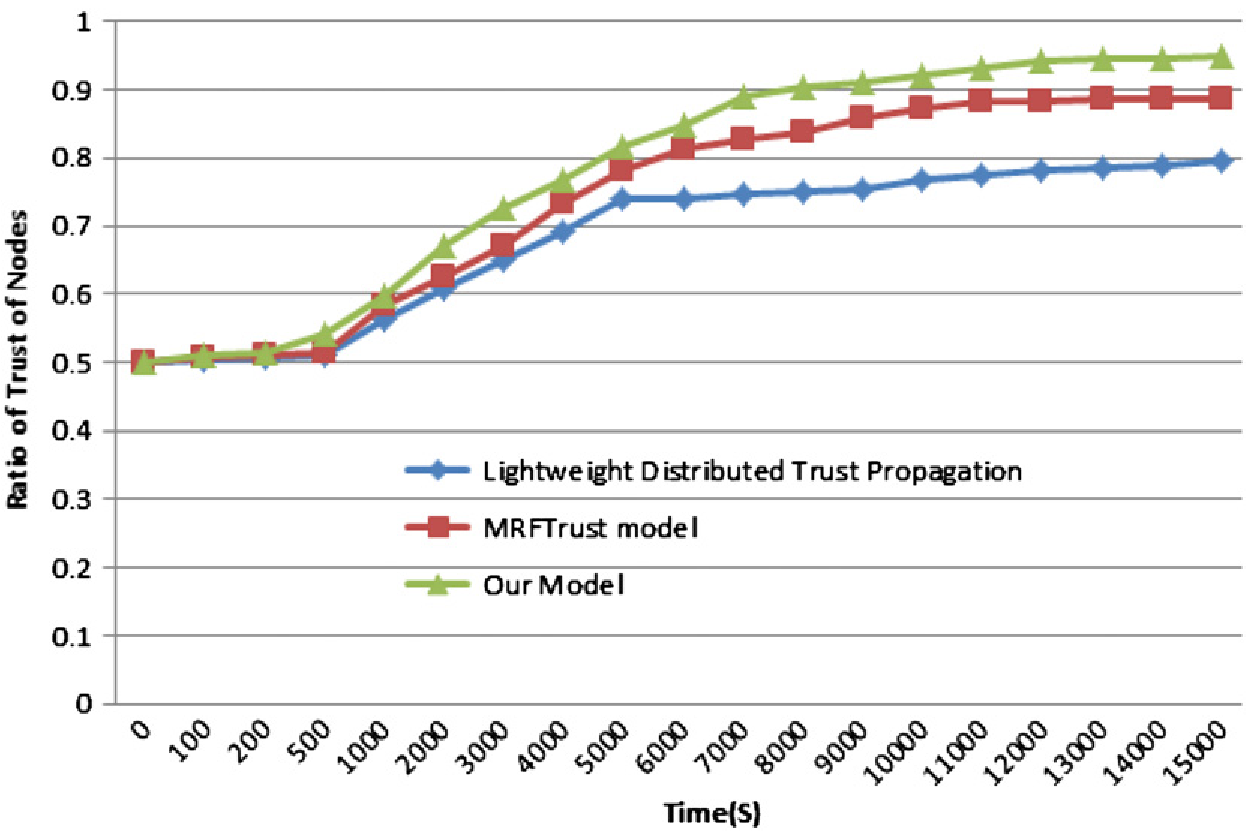 In Fig 5, the "Proposed Model" (highest curve) demonstrates a faster and more stable adoption of trust strategies compared to competitors.
Critical Analysis & Takeaways
The brilliance of this work lies in its biomimetic approach. By treating network security as a social/biological phenomenon, it solves the rigidity of traditional P2P protocols.
Limitations: The model assumes contextual information (CPU/bandwidth) provided by nodes is initially honest or verifiable. In a truly adversarial setting, nodes might falsify their "context" to gain initial trust.
Future Outlook: Transitioning this model into Zero-Trust architectures or Blockchain consensus (where "trust" is skin in the game) could provide a mathematical foundation for more resilient decentralized autonomous organizations (DAOs).